POSITAL Announces Absolute IXARC Encoders with IO-Link Interface
November 12, 2019
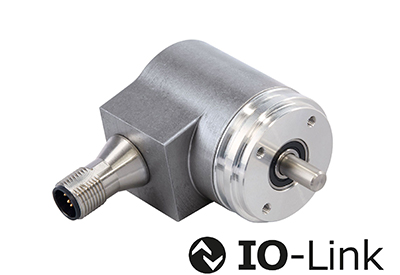
Position and motion sensor specialist POSITAL has announced that its family of absolute IXARC rotary encoders has been expanded to include support for the popular IO-Link communications interface.
IO-Link is a low-cost, easy-to-implement communications system designed to simplify connections between large-scale fieldbus or industrial Ethernet networks and sensor or actuator devices located on the factory floor. On one side of an IO-Link master gateway device is an interface to the plant-wide network, while the other side has multiple point-to-point connections to individual sensor devices. The IO-Link interface for end devices is relatively simple, eliminating the need to support complex communications protocols at the sensor/actuator level. IO-Link supports a variety of data types, including measurement data, device configuration instructions and information about operating condition parameters such as temperature.
IXARC encoders, based on POSITAL’s high-precision magnetic measurement technology, are very well suited to IO-Link implementations. They are compact, easy to install, and provide highly reliable performance, even under harsh industrial conditions. Two versions of IO-Link connected encoders will be offered: single-turn (360 ° range, 14 bit resolution) and multi-turn (up to 1 billion revolutions). Single-turn variants can be converted to operate in incremental mode by making use of a different pin-out arrangement in the connector.
Multi-turn models have several exciting new features, including 16 bit resolution, the ability to output rotation speed directly to the controller and the addition of electronic cam/preset/reset functionality, making use of binary digital signals transmitted through pin 2 of the connector. There are also extended device diagnostics. A temperature and vibration sensor built into multi-turn encoders enables monitoring these condition parameters. Rotation counters on multi-turn models are powered by energy harvested (via Wiegand effect) from the rotation of the device’s shaft, ensuring that the rotation count is always up to date – even when movements occur when power to the device is unavailable. This eliminates the need for backup batteries and helps to reduce maintenance costs.
Like other POSITAL IXARC encoders, the IO-Link connected sensors will be available with a wide range of housing materials, levels of environmental protection (up to IP69K), shaft type/diameter and mounting flanges. This means that customers can configure sensors that have exactly the right mechanical and performance characteristics for their application, quickly and at competitive costs. POSITAL makes it easy for customers to find the right IO-Link encoder for their specific application. The product finder tool at www.posital.com enables a customer to specify the product features required for their project and quickly zero in on the most suitable products POSITAL IXARC encoders with IO-Link interfaces will be introduced at the SPS trade show in Nuremberg, Germany (November 26 to 28) and at the IREX exhibition in Tokyo (December 18 to 21). They will be available in sample quantities at the end of 2019.
For more information, visit www.posital.com.