The Hidden Electrical Fault: Why RCCB Protection Matters
August 31, 2026
How to Choose the Best Residual Current Circuit Breaker
Electrical systems need to do more than deliver power—they need to protect the people and equipment that depend on them. While conventional circuit breakers protect against overloads and short circuits, another potentially dangerous electrical fault can occur without generating enough current to trip them: a ground fault.
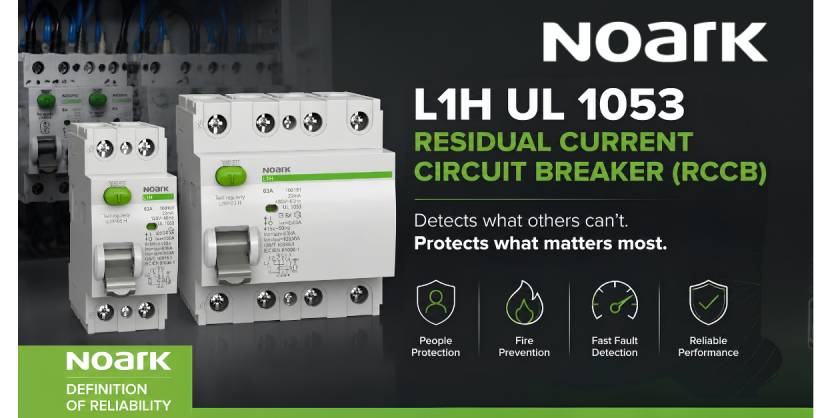
That’s why residual current protection is an important part of modern electrical safety. With the impending introduction of the NOARK L1H Residual Current Circuit Breaker (RCCB) to the North American market, electrical professionals have another dependable solution for detecting potentially hazardous leakage currents.
Understanding Ground Faults
A ground fault occurs when electrical current escapes its intended path and flows to ground. Common causes include damaged cable insulation, moisture entering electrical equipment, worn components or accidental contact with conductive surfaces.
Normally, the current leaving the power source returns through the designated conductors. If some of that current takes another path, an imbalance occurs. Even relatively small leakage currents can create a hazardous situation if they pass through a person or continue long enough to generate excessive heat.
Because these faults may not be detected by standard overcurrent protection, RCCBs provide an important additional layer of protection.
How Does an RCCB Work?
An RCCB continuously compares the current flowing through the live conductor(s) with the current returning through the neutral.
During normal operation, these currents are equal. If current leaks to ground because of damaged insulation, equipment failure or accidental human contact, the RCCB detects the imbalance.
Once the difference reaches its rated sensitivity, the RCCB disconnects the circuit within milliseconds, helping prevent the fault from developing into a serious hazard.
Unlike conventional circuit breakers, which primarily respond to excessive current caused by overloads or short circuits, RCCBs are specifically designed to detect leakage current that might otherwise go unnoticed.
Introducing the NOARK L1H RCCB
Designed to meet the growing demand for advanced electrical protection, the NOARK L1H RCCB is a durable electromagnetic residual current device. It uses a toroidal coil to detect imbalances between live and neutral currents and offers several important advantages:
1. High Capacity
With a robust 63A capacity, the L1H RCCB is designed for demanding electrical applications, helping protect high-power equipment and electrical systems.
2. Strong Anti-Interference Performance
Modern equipment such as variable-speed drives can generate electromagnetic noise. The L1H’s electromagnetic design provides strong resistance to this interference, helping deliver reliable operation while reducing nuisance shutdowns.
3. Impact and Heat Resistance
Built for demanding environments, the L1H features rugged construction, flame-retardant material and reinforced contacts designed to withstand vibration and high ambient temperatures without compromising performance.
4. Easy Fault Identification
When downtime matters, faster troubleshooting makes a difference. The L1H’s fault current indicator makes it easier to identify whether a leakage fault is present without having to check each line individually—saving valuable troubleshooting time.
The Right Protection Makes a Difference
Ground faults can be difficult to detect—but their consequences can be serious. Choosing the right RCCB adds an important layer of protection for people, equipment and property.
The NOARK L1H RCCB is COMING SOON, and combines dependable residual-current protection with electromagnetic operation, strong anti-interference performance, rugged construction and convenient fault indication, making it a strong choice for residential, commercial and industrial applications.
More Information
For more information, contact nasales@noark-electric.com. Visit the L1H RCCB Product Page here, or download the L1H RCCB flyer for complete product information.
Related Story
NOARK M-Series MCCBs Deliver Seamless Integration with Rittal RiLineX Busbar Systems
NOARK Electric announces the compatibility of its M-Series molded case circuit breakers (MCCBs) with Rittal’s RiLineX 60 mm busbar system through specialized component adapters designed for modern panel-building applications. The integration combines NOARK’s high-performance circuit protection technology with RiLineX’s universal mounting platform to deliver faster assembly, enhanced flexibility, and simplified system design for panel builders and OEMs.
NOARK’s M1, M2, and M3 MCCBs are fully supported within the RiLineX ecosystem, enabling streamlined installation and optimized power distribution configurations across industrial and commercial applications.