Does Sonair’s ADAR One Sensor Solve Something You Cannot Solve?
October 19, 2026
By Krystie Johnston
Achieving a “first” of something is always special. Sonair recently announced their ADAR One sensor has become the world’s first 3D ultrasonic sensor to receive independent safety certification (SIL 2 / PL d) for human-robot collaboration. Why does this matter? Read on to find out if this major milestone for the company – and the robotics industry as a whole – solves something you cannot solve yet.
A series of firsts
Knut Sandven is CEO and founder of Sonair. Sandven’s background is deeply rooted in industrial safety and commercializing deep-tech research. Before starting Sonair in 2022, he was CEO of GasSecure, where he and his team developed what they say is the world’s first wireless optical gas detector for high-risk industrial environments. In another world first, Sandven leads an experienced team of engineers who recently became the first team to develop and certify a 3D ultrasonic sensor.
Sonair’s 3D ultrasonic sensor solves a unique problem. One that you may be struggling with right now. Sandven explains that traditionally, industrial robots had to be kept behind physical cages and barriers because separation was the only way to guarantee human safety. Today, some of the most valuable robotic applications require humans and machines to work in close, collaborative contact. And mobile robots, by definition, cannot be fenced in.
While AI and robotic capabilities have advanced rapidly, safety-critical perception has lagged behind. The industry has relied on 2D laser scanners (LiDAR), which are restricted to detecting objects in a single flat plane, essentially a flat slice of the world, leaving massive blind spots. “We founded Sonair to bridge that gap,” Sandven says.
“Our offer to the market is true 3D spatial awareness using sound instead of light. We have developed a new sensor category named ADAR (Acoustic Detection and Ranging). Our flagship product, the ADAR One sensor, solves this by acting as a deterministic, safety-certified 3D perception foundation that sits beneath any robot’s motion or AI system.”
ADAR One
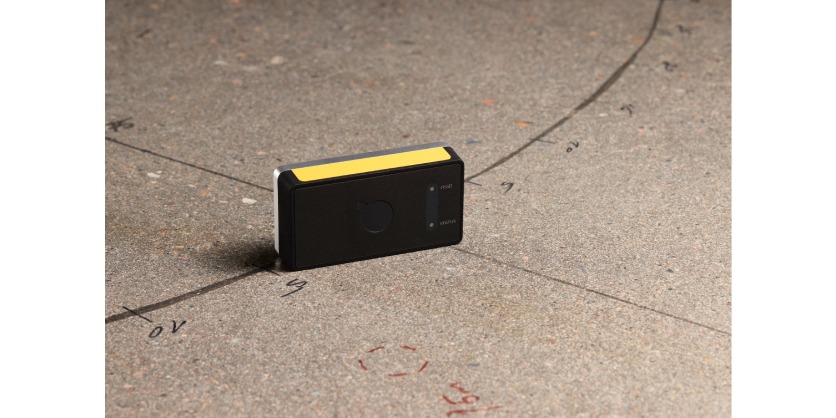
ADAR One is the world’s first safety-certified 3D ultrasonic sensor – a claim that Sonair is extremely proud of. Their sensor is a breakthrough in mechatronic design.
The core highlights of ADAR One include:
- True 3D Safety Coverage: It delivers a full 180° × 180° field of view with a range of up to 4 meters, eliminating the blind spots typical of 2D sensors.
- Sees What Optics Miss: Because ADAR uses sound instead of light, it detects surfaces that routinely defeat cameras and LiDAR (i.e., glass, dark or reflective material, thin or irregular shapes) with the same reliability as a matter wall. Nothing about the surface’s colour or transparency changes what the sensor hears.
- Unaffected by Dust, Glare, or Darkness: Optical sensors degrade in direct sunlight, fog, or low light – and dust can outright blind them. Sound does not have that problem. ADAR One performs the same in a dusty warehouse aisle at noon as it does in an unlit loading bay at night. And it carries an IP54 rating for dust and splash exposure (with higher IP ratings to come).
- MEMS-Based Acoustic Array: Sonair has solved a major historical hurdle in air-based 3D ultrasound: creating miniaturized transduces that are powerful enough to transmit sound several meters through air, where energy is quickly attenuated.
- While making small transducers is easy, making them both small and powerful for in-air sensing is exceptionally difficult. Sonair’s patented MEMS hardware places those powerful, micro-fabricated transducers close enough to satisfy the fundamental physical constraint of λ/2 (half-wavelength) spacing (measuring just over 2 mm at Sonair’s 80 kHz operating frequency).
- This eliminates spatial ambiguity and “ghost” detections while maintaining a highly scalable and robust design.
- Built in Rust: ADAR One is the first safety-certified embedded system built in Rust – a language Sonair chose specifically for its superior memory safety and real-time execution predictability.
- Privacy-by-Design: Because ADAR One uses sound waves rather than visual lenses, it captures zero images of the people or environment around it. This makes it ideal for secure facilities such aerospace and defence, or facilities where privacy is a concern, like hospitals, for example.
Transformative implications for automation
ADAR One transforms safety from an engineering burden into a commercial differentiator:
- Robot Manufacturers (OEMs): OEMs can move away from complex, expensive 2D safety LiDAR setups. ADAR One allows them to bring certified safety to full 3D and quickly enter the market with a more effective, lower-cost mechatronic design.
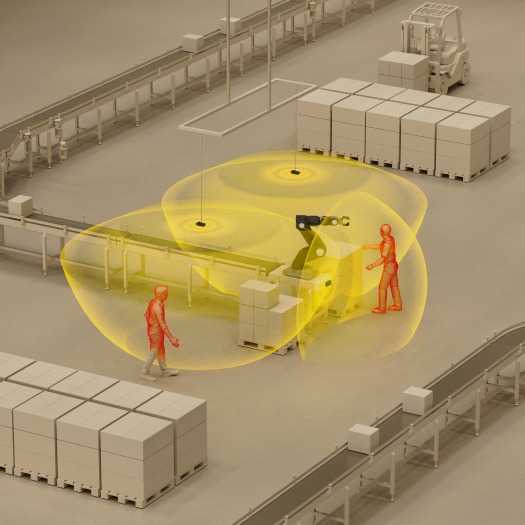
- Machine Safety (Industrial Robots and Fixed Cells): For industrial robots, cobots, and automated cells, ADAR One protects a full working volume instead of a single scan plane or entry point. It fits open robotic cells, closed or partially enclosed cells, and production lines where people and machines share space, with safety zones shaped to match real machine movement. This reduces fencing and separation distances that flat-plane sensors force.
- System Integrators: Integrators get a plug-and-play, drop-in 3D safety layer to deploy AMRs, AGVs, and collaborative and industrial robot architectures safely without having to seek special regulator exemptions.
- Humanoid OEMs: Because ADAR One’s compact, shape-agnostic form factor, it can be embedded flushed directly into a humanoid’s body shell without requiring major structural redesign, giving the humanoid a certified 3D perception backstop.
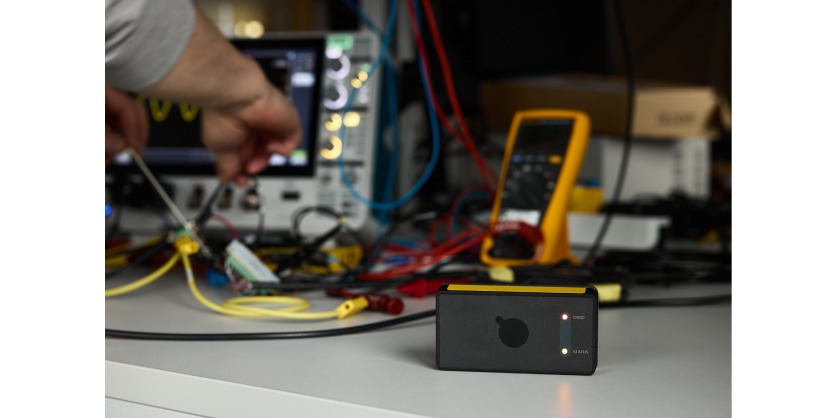
Moreover, environmental resilience is a core pillar of ADAR’s design. “We deliberately designed ADAR One to operate where traditional optics fail,” Sandven explains. “Because our sensor uses sound, it is less affected by dust airborne debris, moisture, cleaning vapors, bright glare, highly reflective floors, or total darkness. Additionally, because it has no moving parts and no optical lenses, there are no sensitive glass surfaces to clean. This drastically reduces maintenance overhead in dirty environments.”
In terms of certifications, Sonair designed ADAR One from day one to meet the highest global standards:
- SIL 2 & PL d Certified: Certified by exida (a notified body under the Machinery Directive 2006/42/EC) to meet IEC 61508 (SIL 2) and ISO 13849 (Performance Level d) with a probability of dangerous failure (PFH) below 1.5 x 10⁻7 per hour.
- Human Protection: Assessed as a human protection sensor under the demanding IEC 61496 standard for electrosensitive4 protection devices.
- EU Machinery Directive: Fully certified to fulfill the requirements of the European Machinery Directive.
- System-Level Standards: It fits seamlessly into modern safety concepts, such as IEC 63327 for autonomous cleaning machines.
Meeting these standards is a massive milestone because it takes certified safety for mobile machines from a flat, 2D plane into a true 3D volume for the first time in robotics history.
Practical limitations
Like any technology, acoustic sensing has physical boundaries:
- Physical Range: Sound attenuates much faster in air than light or radio waves, limiting ADAR One’s maximum range to approximately four meters.
- Indoor Focus: The first generation of ADAR is designed and certified for indoor use. Outdoor use is on the roadmap.
- No Object Classification: ADAR One does not classify objects (e.g., distinguishing between a box and a human); it is designed for high-reliability people and obstacle detection.
- Regarding Compatibility: The sensor is highly versatile. Because it is small and shape-agnostic, it can fit virtually any robot platform. It is fully compatible with AMRs, AGVs, collaborative robots (cobots), and humanoids.
Local expertise, global reach
Is all this starting to sound like Sonair’s ADAR One might be able to solve a problem something you have not been able to solve yet? Sandven offers one more insight for you to consider. “We offer a safety-first philosophy backed by decades of state-of-the-art Norwegian research. We do not believe safety should be bolted on as an afterthought. With the ADAR One, you are choosing a deterministic, prove safety layer that allows your robots to truly work shoulder-to-shoulder with humans safely.”
Sandven adds, “In Canada, we are working with a leader in palletizer/depalletizing solutions called beRobox. For customers looking for those kinds of solutions, beRobox might be a good first stop. Otherwise, we ship directly to Canada.”
More Information
Still interested in learning more? To learn more, buy, or request an evaluation kit, customers can visit Sonair’s website at www.sonair.com/contact or reach out to their team directly at hello@sonair.com.
Related Story
Robot Safety is Now 3D: Sonair Unveils World’s First Safety-Certified 3D Ultrasonic Sensor for Human-Robot Collaboration
The ADAR One sensor from Sonair is now suitable for SIL2 and PL d applications and is certified to fulfil all requirements of the European machine directive as a sensor for the safe detection of humans and objects.