Festo Drives Progress and Innovation With Education and WorldSkills
September 24, 2026
“Education is the basis for progress and future to thrive for” – Festo’s Technical Education Partnerships
By Krystie Johnston
Festo Didactic is a world leader in industrial automation and technical education. For decades, they have sponsored events like WorldSkills that focus on Industry 4.0 and mechatronics, driving progress and innovation, aligning education with industry, while supporting the workforce of the future.
Festo’s commitment to technical education and skills development started in 1991 when they became a WorldSkills partner and helped to design and equip the first WorldSkills Competition in mechatronics. On a national level, they extended their expertise to events like SkillsCanada and SkillsUSA, developing a tiered structure of competitions reaching regional and intramural groups of competitors desiring the opportunity to demonstrate their skills.
Watch this video for a brief overview of Festo Didactic’s involvement in WorldSkills:
In Canada, Festo Didactic has sponsored the SkillsCanada Competition in mechatronics since 1992. Through hands-on competitions utilizing industry-relevant training equipment, students apply their technical knowledge and skill in practical, real-world situations. In the United States, Festo’s involvement with SkillsUSA is a mirrored example of their overarching commitment to connecting education with the evolving needs of industry. At WorldSkills 2026 in Shanghai, the top competitors from participating countries around the world will meet and compete on the world stage.
Alyssa Evans, Technical Support Engineer at Festo and SkillsUSA Mechatronics Technical Chair recently shared her insights into how competitions like Skills play a vital role in fostering innovation and progress and support the development of the workforce of the future. Evans earned a bachelor’s degree in mechanical engineering from the New Jersey Institute of Technology and continued to earn a master’s degree in engineering management while working for Festo. Her pathway was unconventional then – but is becoming more common today as industry, education, and government recalibrate their focus.
A road less travelled makes all the difference
For Evans, engineering always seemed like a natural pathway. Her technical aptitude was fostered at a young age by her family who were always engaged in some kind of hands-on activity. Evans recalls that her high school experience was focused on theoretical learning with little hands-on activities baked in. Fortunately, she was able to explore more hands-on activities during her post-secondary education and apply them full on in her career.
“I got into engineering because I have always had a technical background,” she reflects. “Growing up, my parents hosted a Christmas light show at our house where we would build custom displays and program them to all work together. I always had that technical background and my dad always worked on cars. Engineering seemed like a natural pathway. And it led me to Festo because they were looking for interns many, many years ago.”
Technical standards equal the playing field
Becoming Technical Chair for the SkillsUSA mechatronics competition gave Evans the opportunity to deepen her passion for technology. “As Technical Chair, I help facilitate partnerships, coordinate the event, determine staffing and equipment needs, and work with a team of partners to plan the tasks and write the technical standards each year,” she says.
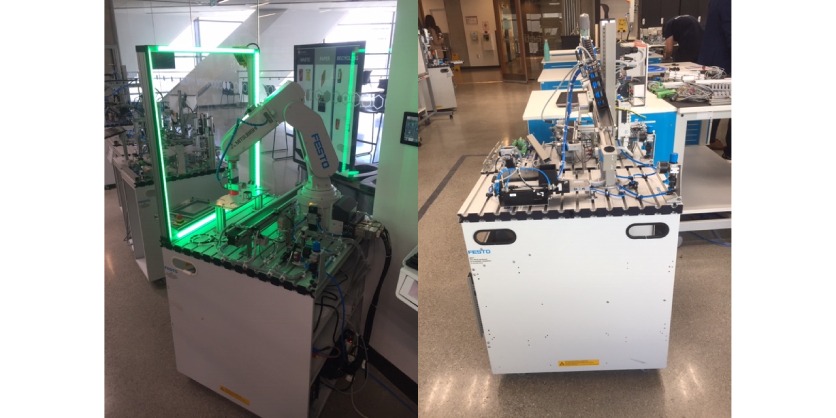
“Technical standards are essentially the framework from which teachers will train their students to participate in the SkillsUSA Competitions and compete on the equipment,” says Evans. The importance of these standards in leveling the playing field should not be underestimated. “We have been revamping these technical standards over the last five years to better align with the Department of Labor (DOL) standards for what is considered a mechatronics engineer or technician. This ensures that as students leave school, they understand the job responsibilities before they even get into the role.”
Closing the industrial skills gap
With skilled labour in short supply, reshoring the manufacturing on the rise, and geopolitics adding another layer of uncertainty, building a strong local talent pool has never been more important. And with the industry landscape constantly shifting, the need to connect education with the work of the future is becoming even more urgent. Evans is at the crest of a new wave of technical training that helps bridge this gap – developing the skills people need while preparing them for the future of industry. She has seen firsthand the disconnect between the education system and the workforce. And is actively working to rewire these connections.
Evans says technical standards are key to turning the system on to be more efficient. Training needs to be aligned with the needs of industry, and this process needs to be standardized at a national – even international – level. “We have this skills gap right now between the workforce and how many people are actually [emphasis added] getting accurately trained. There was a huge disconnect between how the technical standards used to be written and what the current workforce needs were. So, we have been working to improve these so teachers have a better idea of what they need to do to prepare their students to work.”
Practice and theory in one continuous loop
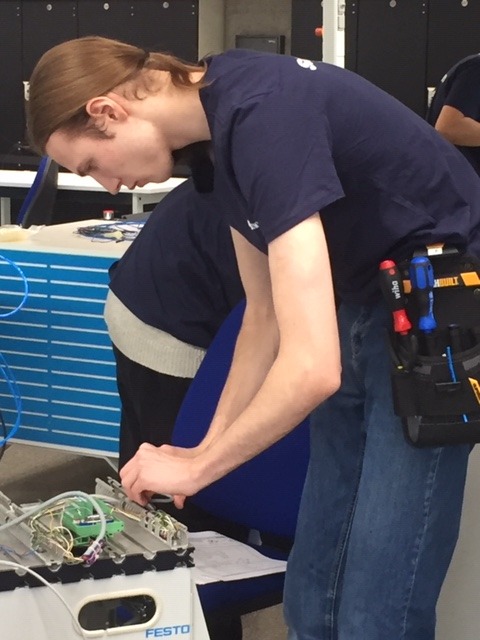
Evans is seeing this shift happening firsthand. “From my perspective, when I went to school, it was kind of your standards courses, like mathematics and English. Today, [teachers] get students involved in all kinds of cool topics. Like robotics. I did not get to touch a robot in school. I do not know of anybody at my age who actually got to touch physical equipment. Now, my brother is going through his education, and he gets to do robotics and all these practical tasks.” She adds, “It is nice to see how they have moved into a different pathway where you physically work on the equipment. They get to work on practical skills, not just theoretical.”
This shift is the effort of many hands. But Evan says it is also being supported by the work that she and Festo are doing at SkillsUSA and similar programs across North America. These initiatives help develop, adapt, and certify the technical skills needed for the workforce of the future. Evans explains, “It forces instructors to have their students work on equipment. Especially now with the fact that they are having us align all our competitions with the DOL standard. I think it is great to see that students come into the SkillsUSA competitions and they know what they are doing. They know how to use a screwdriver. They know how to use a measuring tape.”
Evans says the collaboration between industry partners, educational institutions, and government is building momentum and creating new opportunities. “When I started [doing these competitions] students did not know how to use a measuring tape of a multimeter. Now they know. They know how to program a PLC at 16 years old, which was definitely not the case 10 years ago. It has become substantially more advanced. And the NC3 FICP certification build on that, because now the instructors feel more confident since they are certified, they are able to teach the students more effectively.”
Return on investment
Over the years, Evans has watched these combined efforts take shape as new, tangible opportunities. Teachers are becoming more effective, students are gaining practical skills, and industry is better positioned to plan for growth. Her story may be trailblazing, but her experience interning while completing her master’s degree is becoming increasingly common among young people today. It used to be common to earn a four-year degree first, then start working. Increasingly, however, companies are creating apprenticeship opportunities for high school graduates, allowing them to work while continuing their education.
“I am noticing a lot of other industry partners are doing kind of a similar thing where they will have high schoolers come in and apprentice while going to community college in conjunction to get an associate degree, but already be working, so that they have the workforce being built up,” Evans says. She has also seen students offered a job during SkillsUSA competitions because their participation demonstrates they have some employable skills.”
Mechatronics provides the building blocks for many different industries because it integrates mechanics, electronics, and computer systems – all technical skills that are essential for working with basic equipment that can be adapted to a wide range of applications.
Festo’s training capabilities extend far beyond mechatronics competitions. Their MPS and Cyber-Physical lab systems were developed to demonstrate skill in a competition setting, their applications go much further. They can be used in classrooms, for one. They can also be used in industrial settings to upskill the current workforce, for another. And they can be tailored to specific industries like semiconductor, biopharma, and even data centres. Moreover, Festo LX is a digital learning platform offering Festo courseware and Learning Pathways covering topics from mechatronics and fluid power to semiconductor technologies, Industry 4.0, and AI.
Conclusion
Festo has been a leader in industrial automation and technical education for decades. For more than a century, Festo has advanced industrial automation, while its longstanding commitment to technical education has helped strengthen the connection between education and the evolving needs of industry. Their engagement in Skills is an ongoing legacy, most recently played out on the world stage in Shanghia China at WorldSkills 2026.
More Information
Interested in learning more? Visit Festo today!
Related Story
Festo Provides Basis for Growth – Strengthening Innovation Leadership and Competitiveness
Festo achieved solid financial results in fiscal year 2025. Following a 3.7% decline in turnover due to economic conditions, Festo is focusing 2026 on expanding its leadership in innovation and competitiveness. To this end, the company is continuing to further develop its structure and, with an R&D ratio of over 8%, is investing in the expansion of Seamless Automation with a comprehensive portfolio, seamless connectivity, and an intuitive digital experience.