Why Dobot Robots Are the Right Fit for Proof-of-Concept Projects
October 6, 2026
Every automation project starts with the same problem. Someone has an idea for a pick-and-place sequence, a sorting line, or an assembly step that could be automated, and before anyone spends real capital building it at production scale, someone has to prove it actually works. That proof stage is where a lot of good ideas die for the wrong reason: not because the automation concept was flawed, but because testing it required the same investment as building the real thing.
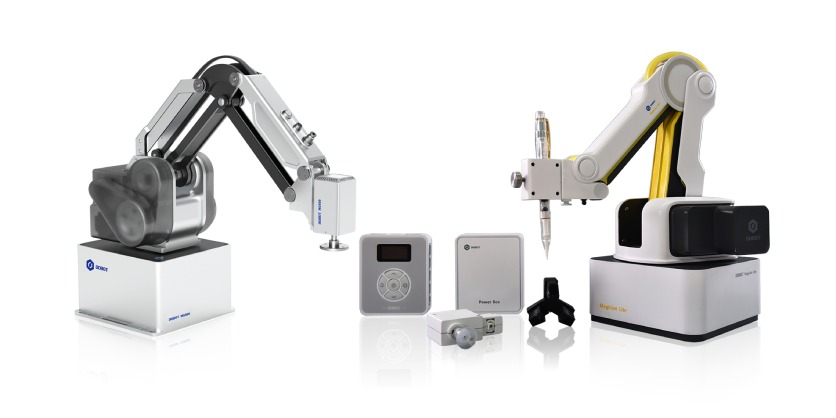
Dobot’s desktop lineup exists specifically to remove that barrier. The Magician E6 and the MG400 in particular are built to behave enough like an industrial robot that a proof-of-concept run on one actually tells you something, without requiring the floor space, the safety infrastructure, or the price tag of the industrial robot itself.
Testing at the same scale as the ideal answer instead of a hopeful one.
A proof-of-concept doesn’t need a robot that can lift twenty kilograms and run a full shift at production speed. It needs a robot that can demonstrate the motion, the sequencing, and the tolerance the final application will require, so the results actually transfer when the project scales up. This is where the MG400 does its best work. It holds ±0.05 mm repeatability, the tightest figure in the entire Dobot desktop range, in a 190 mm x 190 mm footprint and an 8 kg body with a payload up to 750 g. That repeatability number matters more than it sounds like it should: if a pilot is testing whether a pick-and-place layout can hit a required tolerance, the MG400 can actually show whether that tolerance is achievable, rather than just showing that the general concept of picking and placing works. The result is a pilot that gives a real answer instead of a hopeful one.
The Magician E6 takes a different approach to the same goal. It’s a genuine 6-axis cobot, meaning it has the same degrees of freedom as an industrial six-axis arm, but it does that in a base footprint of just 162 mm x 120 mm x 103 mm, weighing 7.2 kg or less, with a 450 mm working radius and ±0.1 mm repeatability. For a proof-of-concept that depends on full 6-axis motion, orientation changes, or complex tool paths that a 4-axis arm can’t replicate, the E6 is the model that lets an engineering team test the actual kinematics of the final application, not a simplified stand-in for it.
Why the built-in safety changes the economics of testing.
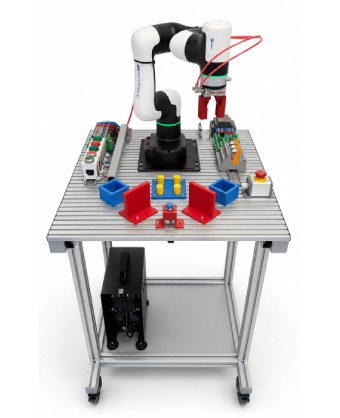
This is the part that actually decides whether a proof-of-concept gets funded and started, or gets pushed to next quarter. Full-size industrial robots run higher payloads at higher speeds, which puts them under ISO 10218-2’s guarding requirements.
That standard calls for perimeter fencing, interlocked access gates, and in some cases light curtains, around the robot’s full range of motion. Building that cell is not a quick add-on. It’s often a larger line item than the robot arm itself, and once it’s built, it isn’t something you tear down and rebuild somewhere else next month.
Dobot’s desktop robots don’t trigger that requirement. Payload across the MG400 and E6 stays under a kilogram, and both run at low enough speed that built-in collision detection covers the residual risk on its own.
That means a proof-of-concept can start on an open bench, in a shared lab, on the same day the robot arrives. No procurement cycle for fencing, no facilities request, no waiting on a safety sign-off before the first test run happens. For a project that’s trying to prove a concept before it earns a real budget, that difference is the difference between testing this week and testing next quarter.
Built for integration testing, not just demonstration.
A proof-of-concept also needs to prove the robot can talk to the rest of the system it’s meant to fit into: a PLC, a vision system, a conveyor, a higher-level controller. Both the MG400 and the E6 support TCP/IP and Modbus TCP communication out of the box, which means they can be wired into an existing test cell’s control architecture rather than running in isolation. The E6 goes further, with 16 digital inputs and 16 digital outputs on its base alone, plus additional I/O at the arm’s tip, giving an engineer enough signal lines to integrate sensors, grippers, and external triggers into a real test setup rather than a simplified demo. The E6 also supports ROS and secondary development through its own SDK, so a research or engineering team building a custom application isn’t limited to the robot’s out-of-box programming interface.
Both models support drag-to-teach programming alongside script-based control, so the same robot can be taught a motion path by hand for a quick first pass, then refined through code once the concept proves out. That flexibility matters during a proof-of-concept phase specifically, when the team often doesn’t know yet whether the final solution needs full programmatic control or whether a taught sequence will do the job.
Testing without tearing anything down.
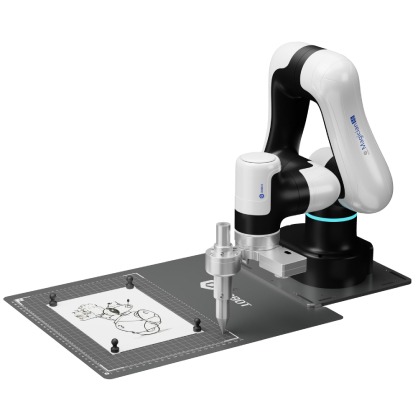
Because both robots weigh well under 10 kg, a proof-of-concept doesn’t have to happen in a permanent location. It can run on a shared bench this week, move to a different lab or a different department next month, and relocate again if the project moves from an engineering group to an operations pilot line.
That mobility means the same physical robot can follow a project through several stages of validation, rather than requiring a new setup, or a new capital request, at every stage.
None of this replaces a full industrial robot cell once a concept is proven and the project moves to production. That was never the job these robots were built for.
What they do is answer the question that comes before that decision: does the automation concept actually work, at what tolerance, and integrated with what other equipment, before anyone commits the budget a full-scale cell requires.
Related Products
 Dobot Magician – Educational Version CA$2,218.52 Add to Compare
 Dobot Magician Lite Educational Robot CA$1,330.52 Add to Compare
 Dobot Magician E6 Educational Robot CA$8,434.52 Add to Compare
 Dobot MG400 4-Axis Desktop Industrial Robot CA$2,960.00 Add to Compare
 Dobot Magician – Standard Version CA$1,774.52 Add to Compare
This article is original content created and posted by Electromate. Please do not re-post this content without prior approval from Electromate.
More Information
Related Story
Electromate Makes the Case for Hands-On Robotics Education with Dobot
As schools, colleges and universities expand robotics and automation programs, one of the biggest challenges is often not curriculum, but access to hardware. Electromate Inc. is highlighting how Dobot’s educational robotics platform can help educators create more hands-on learning environments by making it practical to deploy multiple robots throughout a classroom or lab.