Electromate Makes the Case for Hands-On Robotics Education with Dobot
August 18, 2026
Compact educational robots help schools put robotics directly into students’ hands while supporting programming, automation and advanced robotics coursework
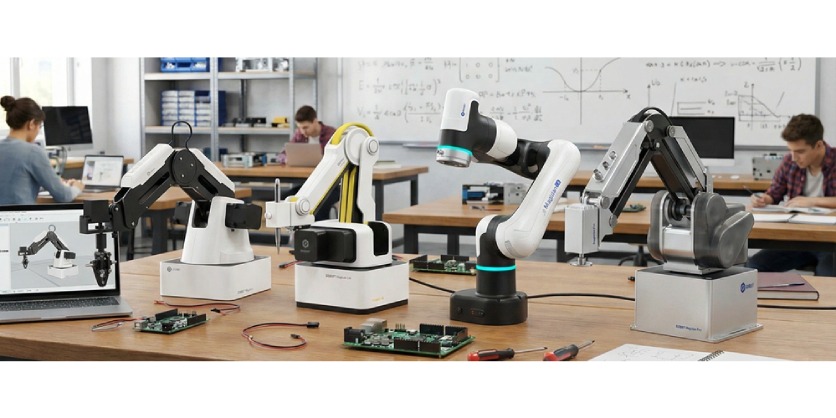
As schools, colleges and universities expand robotics and automation programs, one of the biggest challenges is often not curriculum, but access to hardware. Electromate Inc. is highlighting how Dobot’s educational robotics platform can help educators create more hands-on learning environments by making it practical to deploy multiple robots throughout a classroom or lab.
Traditional robotics labs often rely on a small number of larger industrial robots shared among many students. This can limit the amount of time each student spends programming, testing and interacting directly with a robot.
Dobot’s education lineup, including the Magician Lite, Magician and Magician E6, takes a different approach. Their compact footprints allow multiple robots to be installed on standard student desks and lab benches, giving schools the option to provide smaller groups of students with direct access to robotic hardware.
Compact Robots Designed for the Classroom
The Dobot educational robots require relatively little workspace. The Magician Lite has a base footprint of 146 x 146 mm and weighs 2.4 kg, while the Magician measures 158 x 158 mm and weighs 3.4 kg. The 6-axis Magician E6 has a base footprint of only 162 x 120 mm and weighs 7.2 kg or less.
Their compact size allows schools to deploy several robots in the same classroom rather than dedicating a large portion of a lab to a single robotic workcell.
Payloads range from 250 g for the Magician Lite to 500 g for the Magician and 750 g for the Magician E6. Built-in collision detection and classroom-oriented operating characteristics also allow the robots to be integrated into teaching environments without the large perimeter guarding typically associated with full-size industrial robot installations.
Programming That Grows with the Student
An educational robot must be accessible to students with little or no programming experience while providing a path toward more advanced skills.
The Magician Lite and Magician support DobotLab, including a graphical Blockly-based programming environment. Students can begin by creating robot sequences without writing traditional code and then progress to MicroPython and Python as their programming skills develop.
This allows educators to use the same robotic platform across different levels of instruction rather than replacing entry-level hardware as students advance. The Magician also supports several methods of interaction, including PC software, mobile applications, gesture and voice control, as well as Bluetooth and Wi-Fi connectivity.
For more advanced robotics programs, the 6-axis Magician E6 supports ROS and secondary development. This gives colleges and universities a platform for introducing concepts such as robot kinematics, path planning and custom robotic application development.
One Robot Platform, Multiple Areas of Study
Interchangeable end effectors and accessories allow the Dobot educational robots to support a variety of classroom exercises. A robot can be configured for pick-and-place exercises using a gripper or suction cup, then adapted for drawing, sorting or other automation exercises. Optional sensors, vision systems and conveyor accessories can further expand the types of applications students can build.
As a result, the same hardware can support coursework involving:
- Robotics and automation
- Programming and software development
- Mechanical and mechatronic design
- Electronics and sensors
- Motion control & Machine vision
- Manufacturing and industrial automation concepts
- The Magician Lite’s external Magic Box controller also provides 12 expansion interfaces, allowing educators to add sensors, I/O and accessory kits as their programs develop
Increasing Hands-On Time
The classroom case for Dobot is not based on replacing full-size industrial robots where industrial payload, speed and production capabilities are required. Instead, the platform addresses a different educational objective: increasing the amount of time students spend actually programming and operating robots.
By combining a small physical footprint, classroom-oriented safety features, interchangeable accessories and programming environments that progress from graphical blocks to Python and ROS, schools can build robotics programs around multiple student workstations rather than a single shared demonstration robot. This approach gives more students the opportunity to learn robotics by doing rather than watching.
Dobot Educational Robots Available in Canada Through Electromate
Electromate Inc. supplies and supports Dobot educational robots for Canadian schools, colleges, universities and technical training programs. The company can assist educators in selecting the appropriate robot platform, accessories and classroom configuration based on course objectives, student skill levels and the number of workstations required.
More Information
Learn more at https://www.electromate.com/hej-90-high-efficiency-joint-for-mobile-robots/ and https://www.electromate.ca/news/post/the-classroom-case-for-dobot-robots
For further information, please contact:
Warren Osak
Electromate Inc.
sales@electromate.com
Toll Free Phone: 877-737-8698
www.electromate.com
Related Story
Electromate Named One of Canada’s Best Workplaces by Great Place to Work
Electromate Inc., a Canadian distributor of advanced mechatronic and robotic solutions, has been recognized as the 95th Best Workplace in Canada in 2026 by Great Place to Work.This recognition reflects their ongoing commitment to building a workplace grounded in employee engagement, trust, and a clearly defined company culture.