How Machine Builders Can Simplify Safety Without Slowing Production
October 20, 2026
Modern machines are more modular, connected, and flexible than ever. But as automation expands across robotic cells, conveyors, packaging equipment, logistics systems, and electronics manufacturing lines, safety architecture can become more complex.
Many safety systems still rely on long wiring runs back to a centralized control panel. That can increase installation time, cabinet space, troubleshooting effort, and dependence on specialized safety programming resources. So how can manufacturers keep safety reliable while making machines easier to build, commission, and maintain?
What is the challenge?
Traditional panel-based safety systems can make machine design and maintenance harder than they need to be. When every safety signal must travel back to a cabinet before action is taken, manufacturers may face:
- More wiring between devices and panels
- Larger cabinets and higher installation effort
- Longer startup and commissioning time
- Greater dependence on safety PLC programming expertise
- More difficult troubleshooting during downtime
- Response-time challenges in high-speed or space-constrained applications
What is the better approach?
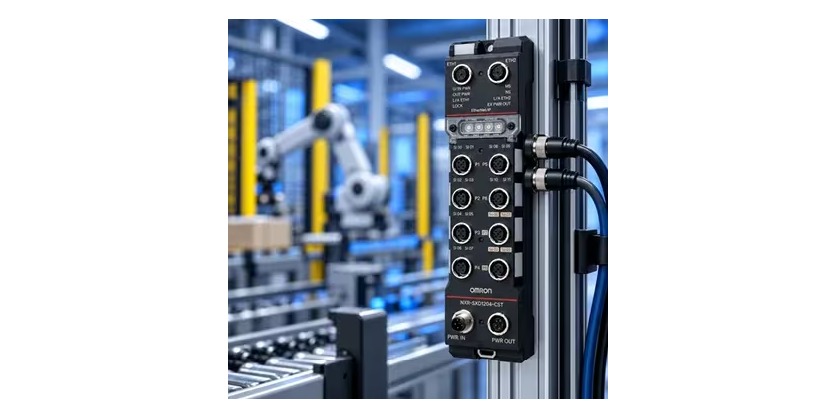
A more scalable approach is to bring safety connections and simple safety logic closer to the machine. By mounting safety I/O near the devices it serves, machine builders can reduce wiring, simplify installation, and allow common safety decisions to happen locally. At the same time, centralized safety management can still support configuration, monitoring, and lifecycle control.
This hybrid architecture helps deliver:
- Faster local safety reaction near the hazard
- Less wiring back to the control cabinet
- Smaller, simpler machine panels
- Easier standardization across machine variants
- Faster commissioning for modular equipment
- Improved troubleshooting and recovery for maintenance teams
How does this help your team?
For controls engineers, distributed safety I/O can reduce design complexity and help address safe-distance and response-time requirements. It also makes repeated machine modules easier to configure, validate, and scale.
For maintenance teams, built-in diagnostics and clearer device visibility can make it easier to identify issues, check wiring, replace devices, and restore operation faster.
For OEMs, system integrators, and operations leaders, the benefits include faster startup, lower wiring effort, improved serviceability, and a more flexible safety architecture that can support changing production needs.
- Standardize motor control across applications
- Reduce external safety components
- Simplify wiring and installation
- Improve integration with modern automation networks
- Build a more flexible machine architecture
What should you look for in a modern safety solution?
When evaluating machine-level safety, look for a solution that can:
- Mount directly on the machine
- Connect safety devices close to the hazard
- Execute simple safety logic locally
- Stay centrally configured and monitored
- Reduce wiring and cabinet complexity
- Support fast diagnostics and replacement workflows
- Scale across modular machines and global installations
Ready to simplify machine-level safety?
OMRON’s NXR-S Series Simple Logic Safety I/O Block for CIP Safety is designed to bring safety logic closer to the machine while maintaining centralized CIP Safety management. With IP67 on-machine mounting, fast local safety logic, SmartClick M12 connectivity, built-in diagnostics, and support for scalable safety architectures, it helps machine builders reduce wiring, speed startup, simplify maintenance, and build safer, more flexible machines.
More Information
NXR-S Series Logic Safety I/O Block for CIP Safety
Related Story
Smart Connected Control Panels from Omron
A standardized, modular approach to panel design that integrates power management, machine control, and predictive monitoring, while adding visibility into key process variables. This reduces engineering time, simplifies BOMs, and improves uptime through better diagnostics and consistency.