Smart Connected Control Panels from Omron
October 6, 2026
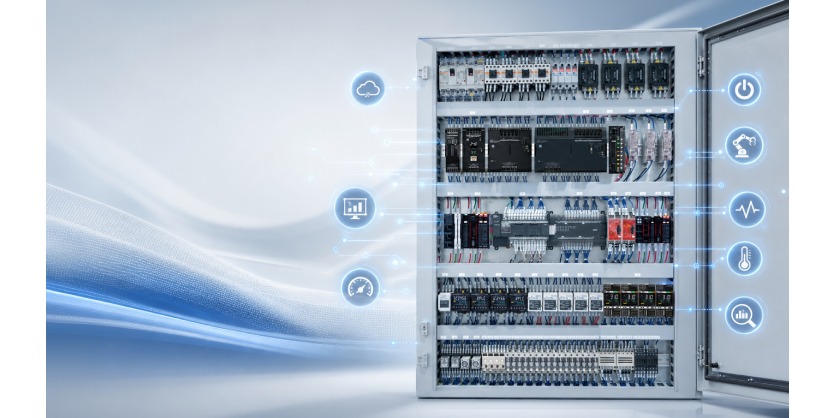
Standardize, simplify, and connect your control panels for faster builds and better performance.
What Are Smart Connected Control Panels?
A standardized, modular approach to panel design that integrates power management, machine control, and predictive monitoring, while adding visibility into key process variables.
This reduces engineering time, simplifies BOMs, and improves uptime through better diagnostics and consistency.
Simplify
Simplify panel engineering with proven building blocks.
- Downsize panels by reducing dead space, weight, and increasing device density
- Speed design and deployment with standardized components and unified specifications
- Improve reliability with better heat flow, fewer hot spots, and rubust construction
- Reduce wiring, installation, and maintenance time with streamlined panel architecture
Simplify Panel Design Through Standardization
Control panels are often designed around the specific needs of each machine or application. While this flexibility can address unique requirements, it can also lead to significant variation in design, wiring, and documentation, increasing complexity as systems grow and evolve.
Standardized panel design helps reduce that complexity. It gives engineering, assembly, installation, and maintenance teams a common structure to work with. The result is a panel that is easier to design, easier to build, and easier to support over time.
Reduce unnecessary design variation
Standardization does not mean every panel must be identical. It means using repeatable design rules where they make sense. Common layouts, approved component groupings, consistent wiring paths, and unified specifications all help teams avoid solving the same design problems repeatedly.
This is especially valuable for manufacturers and machine builders managing multiple machines, lines, or facilities. When panels follow a familiar structure, teams can move faster from design to deployment while reducing errors and rework.
Use space more intentionally
A simplified panel is not just smaller. It is better organized. By reducing dead space, arranging components by function, and planning wiring routes early, teams can increase device density without making the panel difficult to access or maintain.
Good space planning can also improve airflow and reduce hot spots. This supports long-term reliability while helping manufacturers optimize the machine footprint.
Make installation and maintenance easier
Standardized panel architecture can reduce wiring time, simplify installation, and make troubleshooting more intuitive. When labels, terminals, documentation, and component locations follow a consistent logic, technicians spend less time interpreting the panel and more time resolving the issue.
Simplifying panel design creates a stronger foundation for smarter automation. Before adding more intelligence or connectivity, manufacturers should first ask whether the panel is easy to understand, build, maintain, and scale.
A standardized panel design methodology not only improves clarity and consistency, but also drives greater engineering efficiency, enhances long-term reliability, and better supports future expansion.
Optimize
Enhance panels with built-in intelligence and monitoring.
- Monitor key process variables (temperature, voltage, current)
- Add visual indicators and diagnostic capabilities
- Improve troubleshooting and maintenance response times
- Reduce downtime with better visibility into panel conditions
Better Panel Visibility Improves Troubleshooting and Maintenance
A control panel contains critical information about machine and process health, but much of that information is often hidden until something goes wrong. When teams have limited visibility into panel conditions, troubleshooting can become reactive, time-consuming, and dependent on manual inspection.
Optimizing a control panel means making important conditions easier to monitor, interpret, and act on.
Monitor the conditions that matter
Key variables such as temperature, voltage, and current can reveal early signs of abnormal operation. Rising temperature may point to airflow issues or excessive heat buildup. Voltage or current changes may indicate electrical irregularities, load changes, or developing equipment stress.
The goal is not to monitor everything. The goal is to identify the conditions closely tied to uptime, reliability, and maintenance response.
Making information easy to interpret
Data is only useful when it helps people make faster, better decisions. A temperature reading, for example, becomes more valuable when it is tied to a normal operating range. A diagnostic signal becomes more useful when it points technicians toward a likely issue.
Clear thresholds, trend information, and visual indicators can help teams understand whether a condition is normal, changing, or approaching a risk point.
Improve response time
When panel conditions are visible, maintenance teams can troubleshoot with more direction. Instead of checking multiple possible causes manually, technicians can start with targeted information.
This can reduce downtime, improve repair accuracy, and support more proactive maintenance practices. Over time, visibility also helps teams identify recurring issues and improve panel or machine design.
A panel with better visibility helps teams detect problems earlier, respond faster, and maintain equipment with greater confidence.
Connect
Integrate panel data into IIoT and SCADA platforms.
- Enable predictive maintenance and remote diagnostics
- Optimize panel footprint without sacrificing functionality
- Support scalable, modular panel architectures
- Create a unified panel design with optimal visual accessibility and superior performance
Connecting Control Panels to IIoT and SCADA with a Clear Data Strategy
As manufacturing becomes more connected, control panels are becoming important sources of operational data. Machine-level data can support IIoT platforms, SCADA systems, remote diagnostics, and predictive maintenance.
But connectivity only creates value when it is intentional. Sending more data upstream does not automatically improve performance. In many cases, it can create noise, confusion, and unnecessary complexity.
Start with useful data
A connected panel can provide information such as equipment status, alarms, temperature, voltage, current, runtime, and communication health. Not all of this data needs to be connected.
The first step is to define which information supports real decisions. Maintenance teams may need trend data to identify developing issues. Operators may need alarm visibility to respond faster. Engineering teams may need performance data to improve future designs.
Useful connectivity starts with a simple question: What data will help someone operate, maintain, or improve this system?
Standardize the data structure
Connected panels become easier to scale when data is organized consistently. Tag names, alarm definitions, device groupings, and documentation should follow a clear structure across similar machines or lines.
Without standardization, every connected panel becomes a separate interpretation project. With standardization, teams can compare performance, build dashboards, and expand connected systems more efficiently.
Balance local and remote visibility
Remote diagnostics are valuable, but they should not replace local visibility. Technicians still need clear information at the machine or panel during commissioning, maintenance, and troubleshooting.
A strong connected panel strategy supports both: local indicators for immediate action and IIoT or SCADA integration for broader operational insight.
Connected control panels can help manufacturers move from isolated machine control to smarter, more coordinated operations. The key is to connect the right data, structure it clearly, and make it useful for the people who rely on it.
Build smarter panels with less complexity
OMRON smart connected control panel technologies help standardize designs, reduce wiring and panel footprint, and add visibility into critical operating conditions. The result is faster engineering and installation, easier maintenance, and more reliable performance across connected operations.
S8VK-G Switch Mode Power Supply
Delivers compact, reliable DIN-rail power across a wide range.
Controls motor speed, torque and positioning with flexible networking.
Delivers protected DC power directly on the machine.
More Information
Simplify Your Panels. Improve Your Uptime.
Work with Omron’s experts to standardize and modernize your control panels for faster builds and better performance. Contact them today
Related Story
Omron Expands Motion Portfolio with Introduction of the New M1 Inverter Family
OMRON Automation has introduced the M1 Inverter family, a new addition to its motion portfolio designed to provide machine builders and manufacturers with a scalable solution for AC motor control. The M1 family combines advanced drive performance, flexible networking options, and integrated safety capabilities to help customers simplify automation architectures while improving machine efficiency and reliability.