Assuring the Supply Chain: Flex and Teradyne Partnership Expands to Support Customers Across the Globe
August 26, 2026
By Krystie Johnston
Flex is the manufacturing partner of choice for Teradyne Robotics with end-to-end solutions; uses UR and MiR across internal operations
Flex Ltd. is one of the world’s largest electronics manufacturing companies and service providers. For more than five decades, Flex’s manufacturing and supply chain solutions have enabled leading brands like Teradyne Robotics (parent company of UR and MiR) to bring critical technologies to market at a competitive pace.
Earlier this year, Flex announced an expanded partnership with Teradyne focused on helping them scale intelligent automation across global manufacturing. Dennis Kirkpatrick discusses more details and shares why companies like Teradyne continue to come to Flex.
A story of growth
Kirkpatrick joined the company in 2006 and muses that over his career at Flex, change has been part of the culture. Flex began as Flextronics in 1969, a family company founded in Silicon Valley that made circuit boards. Over the years, the company grew through global expansions and corporate acquisitions organically and purposefully to support their customers, maturing into a trusted global partner in technology, supply chain, and advanced manufacturing solutions. The ethos of Flex is transformation for a new era of innovation.
“The biggest thing that I have seen [at Flex] is this evolution of both; the industry and Flex really leading the industry in that evolution.” Kirkpatrick says he has seen Flex go from what used to be called an EMS or electronics manufacturing services industry to an outsourced or asset-light mindset, which has necessitated the addition of products and services to support that demand.
“People wanted to outsource their electronics because assets were too expensive to buy themselves when they were only using a piece of it. That is how the industry was born more than 50 years ago. At Flex, we have continued to evolve as customers want more and more services…so we have added things like mechanical assemblies, plastics, and sheet metal. We do large assemblies of products. Everything from vacuum cleaners to full hyperscale racks to AMR robots and everything in between.”
What Flex brings to the market
The electronics industry is a huge market. When I interviewed Kirkpatrick in July, his title was President, Lifestyle, Consumer Devices, and Industrial. Before publishing this article, he was announced as the expected leader of Flex’s Integrated Technology Solutions Segment. A shift that emphasizes the magnitude and gravity of the electronics market and braces Flex for the next wave of technological advancements that digital transformation and artificial intelligence will bring.
From an EMS base to a global solutions provider has not happened by accident. Growth has been strategic and methodic. “On top of what we now have as the EMS base, we have added products and services. We have acquired a number of companies where we actually own our own intellectual property. We have products that we sell to the market, which are focused on the industries that we serve. For example, we have recently been investing in power for the hyperscale market and the data center market. That is both critical power and embedded power.”
“And our services range from engineering services where we will help a customer design a product to our aftermarket services where we will do third party logistics, forward logistics, manage spare parts, and the return of the product in terms of servicing it, so bringing it back, doing repair, managing parts, upgrading software. And we do that around the world, in over 30 countries and more than 100 factories.”
Flex and Teradyne Robotics
What is the connection between Flex’s capabilities and Teradyne Robotics, one of the leading robotics manufacturers in the world? Flex and Teradyne have been partners for decades; this latest announcement highlights how they are taking things to the next level. Kirkpatrick says that advancing technology and market demand have shaped both companies over time.
“Teradyne has gone through an evolution in recent years too, expanding from a test and measurement company, a leader in semiconductor test, to a fully targeted automation and robotics company,” Kirkpatrick explains. “We have been a manufacturing partner on the test and measurement side with Teradyne for about 20 years. The relationship spans from when they first outsourced their manufacturing and they came to Flex.”
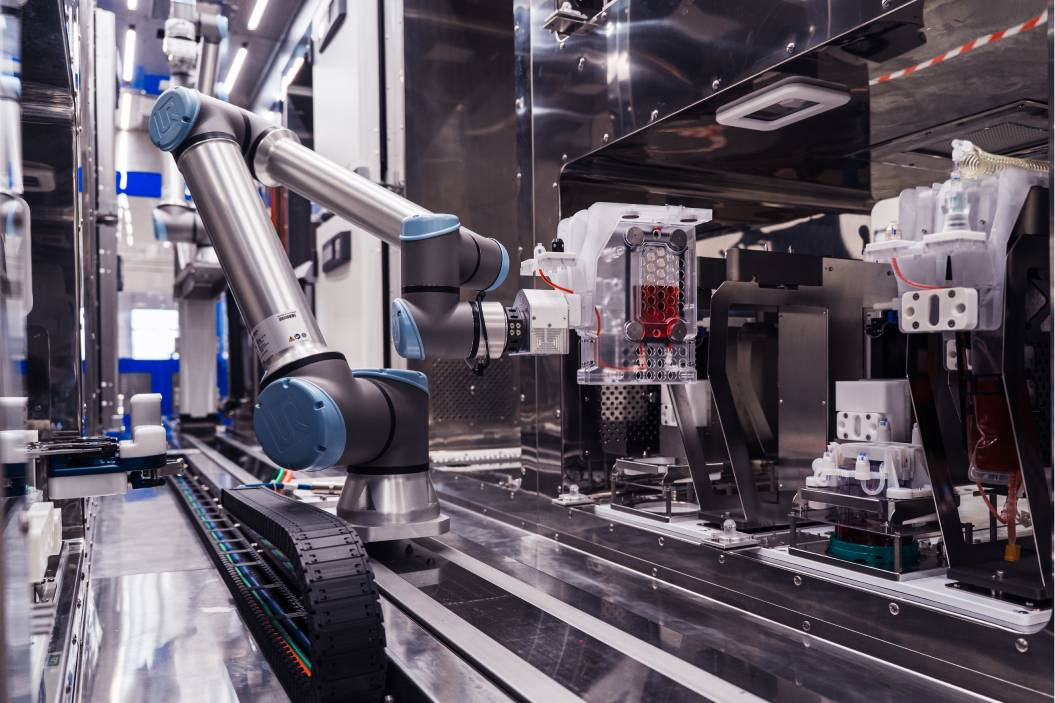
Fast-forward 20 years and Flex is proud to say that they support Teradyne in multiple geographies. And as both companies matured, new opportunities arose that were mutually beneficial. “We started to also help them with the manufacturing of certain parts of their robotics products,” Kirkpatrick says. “Teradyne still maintains their own factories in those robotics parts that they have, but we also manufacture parts for them. And then on top of that, we have now evolved into this real symbiotic relationship where we are buying those [robotic] products to use in our own factories to accelerate our growth in automation and technology.”
Ensuring the supply chain
The edges of automation and robotics are fuzzy – they often overlap or are used synonymously – but there are distinctions. “There are robots and then there is automation. When you look at something like building a printed circuit board, we have fully automated systems, but in most cases, you have a very semi-automated system where the machine does the majority of the work. You have maybe three people monitoring a multi-million-dollar piece of equipment that layers all the technology together in the electronics.”
“When we think about robotics, we also think about automation because typically, robots are integrated together with other tools to completely automate a system,” Kirkpatrick adds. “We have chosen UR and MiR as strategic partners in our journey, across our global manufacturing operations, to continue to accelerate our growth in automation and robotics. When you think about the heart of Flex, it is really a supply chain solutions company. Our life revolves around assurance of supply. And that is why people continue to come to Flex.”
What is next?
On May 5, 2026, Flex announced that its Board of Directors has unanimously approved moving forward with a plan to spin off its Cloud and Power Infrastructure segment, creating two independent, publicly traded companies, each optimally positioned to serve their customers. Following the spin-off, Flex will continue to operate as a leading global manufacturing partner designing and building highly complex products and services at global scale for premier brands across diversified end markets, including robotics.
Interested in learning more? Visit Flex today!
Related Story
Flex and Teradyne Robotics Expand Partnership to Scale Intelligent Automation Across Global Manufacturing
Flex and Teradyne Robotics are expanding their collaboration to accelerate intelligent automation across global manufacturing. Under the expanded relationship, Flex plays a dual role by deploying Teradyne Robotics solutions within its own production facilities while manufacturing key robotics components that enable scalable automation deployments for Teradyne Robotics customers worldwide.