All You Need to Know About the Augmenta Construction Platform – An Interview with CEO and Co-Founder, Francesco Iorio
August 18, 2022
By Krystie Johnston
Augmenta made headlines recently with an announcement that they have raised US $4.1 million in seed funding to automate building design for the construction industry. Their platform, the Augmenta Construction Platform (ACP), enables contractors and engineers to design fully detailed, code-complaint and constructible designs in hours rather than weeks or months.
The seed funding will accelerate the development of the Augmenta Construction Platform for the Electrical System Design (ESD) module – with additional modules to follow including plumbing, mechanical, and structural system designs. Augmenta has tremendous potential to deliver substantial time and cost savings to the construction industry with their generative design technology platform. Additionally, the ACP can improve sustainability; as the buildings it designs are fully detailed, coordinated, and optimized, they are efficient than and less materials are wasted compared to present construction and design project.
Mechatronics Canada had an opportunity to speak with Francesco Iorio, CEO and co-founder of Augmenta. In this interview, he provides more details about the ACP; what it is, how it works, and why it is going to change the construction industry, exponentially.
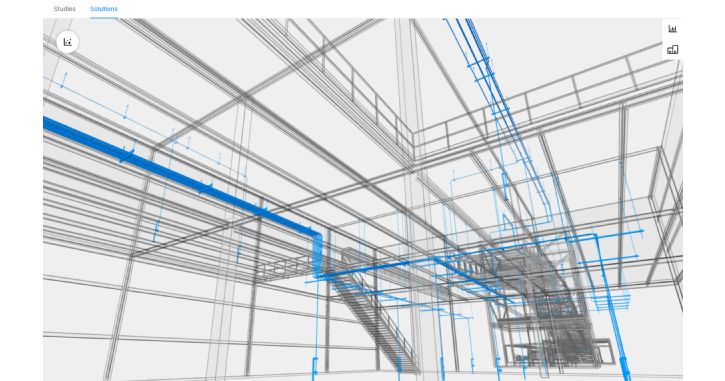
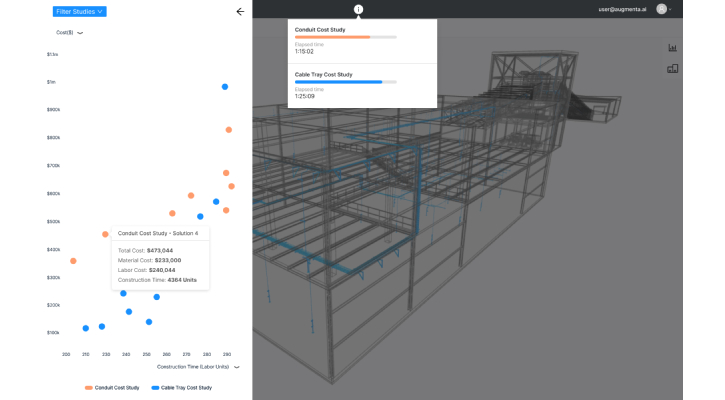
ACP 3D Viewer
What is the Augmenta Construction Platform?
The ACP is meant to be the next generation of digital design tools for the construction industry. It is progressing towards being “the next thing” after the current generation of computer aided design tools. The fundamental departure is that CAD tools for architecture and construction have been created mostly from the perspective of the architect. They were all about the drawings and replaced drafting tables with very powerful features such as a scriptable set of electronic tools.
In this case, the design intelligence is almost always in the head of the designer or the engineer. In fact, these tools allow you to make astonishing mistakes. They allow you to draw a wall in midair and it is perfectly fine according to the software – but obviously none of this would be constructible. Planning stages can vary, and the drawing tools that exist today allow you to do everything, including design things that can’t be built.
ACP tries to address that by adding a large amount of design automation to the design process, with the type of rules that essentially make the designs that are created with it constructible and manufacturable by design. Without the ability to design things that cannot be made. It adds intelligence and logic behind “constructability”.
“It starts from the construction requirements, rather than starting from a drawing on a piece of paper. It takes the design workflow process and turns it on its head by taking the perspective of the people in the field who construct what is designed, and it ensures that what the design contains can be made.”
How did you make it?
It was a long process. We started about two and a half years ago by gathering a team of experts, a mix of young, very talented and motivated specialists, and a group of more experienced, engineers. A group of my colleagues and I worked at Autodesk for many years, living and breathing the de facto standard industry tools for digital design.
This group and I had been making what is called “generative design,” and much of what came from Autodesk in the field of generative design, especially from a mechanical engineering perspective, came from research that started with my group. We have a lot of experience with the concept of automating design and want to bring it to construction in a way that has significant impact.
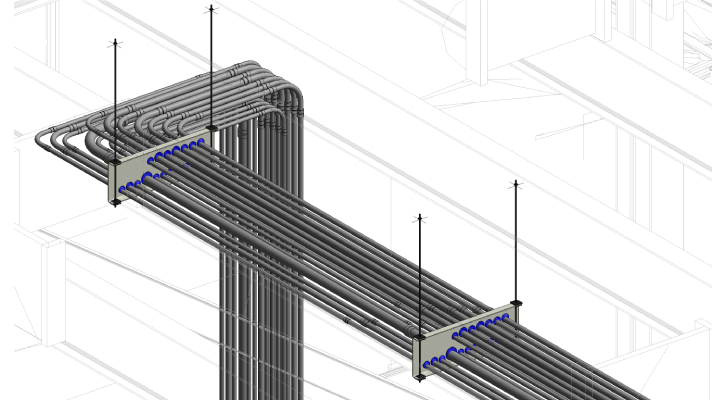
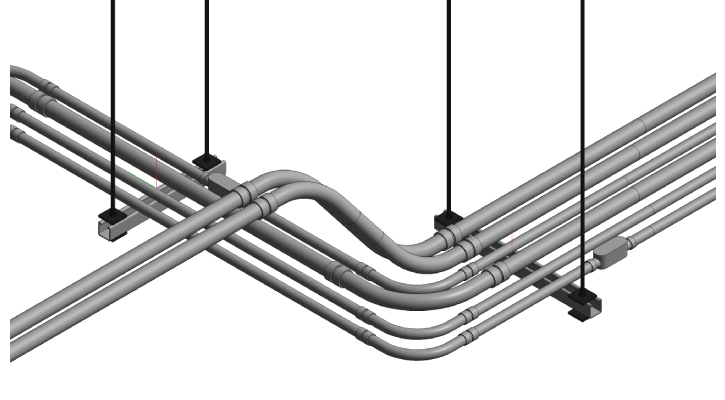
ACP Solution Closeup
Ninety percent of the team is made of computer scientists who specialize in machine learning, mathematical optimization, physics, applied mathematics, computer graphics, computational geometry, user interfaces, and design. Because we are a group of engineers and computer scientists, the expertise in the field of electrical engineering or general construction came from our partners. For example, we partnered with a company called Interstates in the US and worked very closely together to develop the software in a way that works for them.
“When software gets “parachuted” in from the sky, it is clearly made by software people, and not people in the industry, therefore it might not speak their “language”. We developed this software from the ground up to comply with their processes, mindset, and workflows, so we really developed this jointly. All the other modules of ACP will also be developed in the same way.”
Is it just for the electrical components of buildings at this stage? What other stages are planned?
Our ambition is to design entire buildings essentially automatically, from bottom to top. The aesthetic freedom for allocation of space and creation of shape will remain, however, we aim to automate most of the “guts” of the building, where a massive amount of time and cost is allocated.
After the electrical component is complete, we are going to work on plumbing and everything that has to do with water and other fluids. Then mechanical, including air flow, heating, and cooling. Then, we are going to develop a module for structural design. This will create the ‘core’ that goes into buildings of any kind.
Our aim is to have at least a preliminary version of the platform that includes all the modules in late 2024. It is impossible to pretend that the modules will do everything from day one, but they will progressively build up to include all types of buildings.
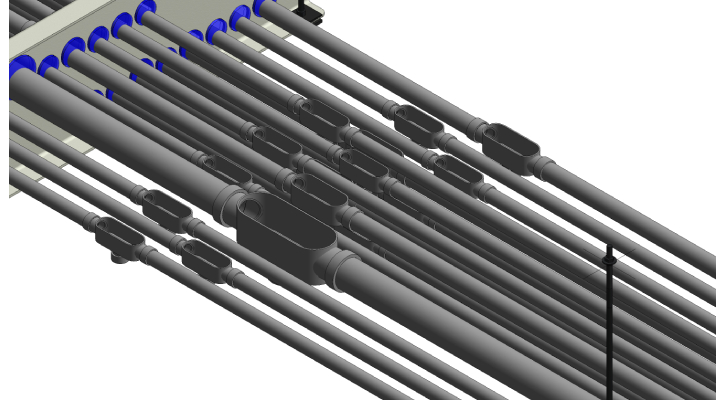
ACP Solution Closeup
What is the Electrical System Design (EDS) module based on and can it be used in Canada? What happens if building codes change?
“Initially, when we roll it out, the ACP will be dedicated to the United States market, but shortly thereafter we will release a version that complies with the Canadian code. The Canadian Electrical Code and the US National Electrical Code are not that different. The system is designed to be modular therefore we can adapt it to codes from anywhere in the world.”
Our goal is to make it as easy as possible to accommodate changes or updates. Like tax software every year, people buy the new version, or they keep subscribing to the service, and they get the newer rules updated every year. Essentially it is transparent, and we want to give people the ability to customize.
For example, in the US, the code not only exists as a national body or standard, but each municipality or city sometimes has small variations to the code. Clients can even have their own requests that exceed code. The system is designed to allow everyone to express these types of specifications in a way that they can apply to the projects they are working on. We will not necessarily supply a different module per city, instead we will allow people to customize the rules to comply with very specific, local regulations.
How does the Augmenta Construction Platform improve sustainability?
There are three avenues in the way that Augmenta Construction Platform improves sustainability. First, especially on larger projects, we see the design that the system produces will use fewer materials. Second, and very critical for the construction industry, is that using ACP allows for a level of certainty in what is being designed that standard workflow really does not.
ACP creates designs that are fully detailed, producing exact bills of materials, which is something that is not normally possible to do with traditional design processes. It is prohibitive in terms of time and cost to have an engineering firm create the equivalent of an ACP design and be able to know, with certainty and in advance, how many nuts, bolts, pieces of conduit, etc. a project will require.
ACP Conduit and Cable Tray Cost Study
“The reality is that estimations are vague, and that uncertainty leads to purchasing more materials than necessary and everything that remains goes to a landfill. The amount of material that goes to landfill is disproportionate in construction compared to pretty much any other field. Using ACP will give people the ability to take extremely precise looks at what they are going to have to buy to construct their design very early on, much earlier than is currently possible. This will benefit the supply chain, reduce costs, improve the fabrication ability of everyone involved and reduce the amount of material that goes to waste.”
Thirdly, the systems that the ACP designs are generally more efficient than what is drawn by hand, especially on larger projects. The ACP can consider physics in any portion of the design process that it performs, and this leads to more efficient designs that use less energy.
With an HVAC system for example, the shape and size of the ducts determines how much heating energy a heat exchanger needs to put into the building to heat or cool it. What the ACP does is uses computational fluid dynamics to understand and design the most appropriate shapes and sizes of the ducting, such that the smallest possible heat exchanger that is necessary to obtain the required temperature across the building is selected.
How does the Augmenta Construction Platform affect the work of people in the construction industry? What are the benefits and what are the limitations?
There are many facets to this question. The most intense difference is in the design and construction phases. It influences several players, from the relationship that an architect has with the engineering firms to the contractor who bids on the projects. For example, the engineering firms using our system can provide a lot more options and can explore variants with the architect, which is something that an engineering firm usually does not do because of cost.
Then of course, from a contractor’s point of view, it dramatically reduces the time it takes to bid and put together meaningful estimates to bid on projects. Therefore, with the time they save, they can design or participate in more projects, or consider high-level prerogatives that come from their clients.
ACP Solution Closeup
By shrinking the amount of effort needed to do detailed design, the ACP reduces the time to complete a project overall and the cost as well. Moreover, it really provides the players in the construction industry with a new way of working together because they can react to changes that come from market situations.
For example, if the price of a particular material suddenly spikes, you can redesign your project entirely using a different material within hours. This is something that is just not possible today. It really changes the dynamics between these organizations, and they can work much more closely than before.
Relative to what exists today, there really are no disadvantages. The idea is that the ACP will “supercharge” people’s abilities in the construction industry. People using it will be able to do more and focus on higher priorities. Rather than clicking a mouse and dragging it to draw lines, experts in this industry can be thinking about the overall efficiency of the project. In this field, there is a dramatic shortage of talent.
“The process of using traditional tools will never scale. It is impossible to train enough people to be adept design engineers, however the demands placed on the construction industry keep increasing, making this conundrum impossible to solve any other way. We need to take the people that do exist in this industry and boost their ability. Our name, “Augmenta,” comes from that idea, our intention is to extend people’s abilities, not eliminate them.”
What do you want people to take away from this article?
What we are bringing to the market is a revolution to the way that buildings are designed. We are not trying to boil the ocean; we are not going through it all at once. We are going module by module, step by step, and maintaining high level of integration with the current workflow.
“We truly believe it is one of the few circumstances where the industry can be improved in a non-incremental fashion. This is the type of technology that only comes around once every decade or two, and there is a real opportunity to improve the profitability and the sustainability of the industry in a way that is not a point of a percentage. This can have substantial effects and the more it is deployed and developed the more substantial the effect is going to be.”
Francesco Iorio, CEO and co-founder of Augmenta
Thank you, Francesco, for taking the time to share your knowledge. To learn more about the Augmenta Construction Platform, visit their website by clicking here
September 17, 2024 In mechatronics, software plays a pivotal role, acting as the central nervous system that orchestrates and controls the interactions between mechanical and electronic components. The development and implementation of software in mechatronic systems encompass several key areas: Software’s Role in Control: Software is integral to controlling mechatronic systems, from simple feedback loops…
February 11, 2025 As automotive manufacturing continues to grow, with North American production projected to increase by 5% annually through 2031, manufacturers are under pressure to optimize workflows, reduce costs, and enhance efficiency. To stay competitive in 2025, they need flexible industrial automation solutions that can adapt to evolving production needs and enable smarter operations….
September 22, 2026 Bossard Americas, a global leader in fastening and assembly technology and part of the Bossard Group, will exhibit at FABTECH 2026, North America’s largest metal forming, fabricating, welding, and finishing event, taking place October 21-23, 2026, at the Las Vegas Convention Center in Las Vegas, Nevada. Attendees can visit them at Booth…
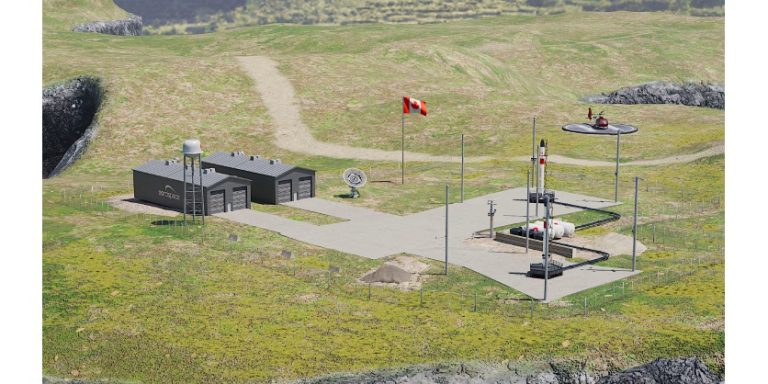
July 31, 2024 Spaceport Canada is being developed to support NordSpace’s Tundra launch vehicle and enable sovereign launch as the nation’s first operational spaceport. On July 31, 2024, Ontario-based NordSpace Corp. announced that it will be investing $5M towards the development of the first phase of Spaceport Canada, a mission critical component of the company’s end-to-end space…
September 29, 2025 Intelligent power management company Eaton is collaborating with Xendee Corporation, a provider of the leading design and operation platform for distributed energy and microgrid systems. Xendee’s cutting-edge microgrid modeling and operations platform combined with Eaton’s engineering expertise and proven power distribution technologies deliver a fully integrated microgrid solution. Eaton led a Series…
January 9, 2024 Bosch Rexroth knows it’s critical that their products are available to customers when and where they need them. So, to improve the availability of their products and the delivery speed, they’re continuously developing their regionally balanced Bosch Rexroth production network, while also aiming to create high-performing, resilient and sustainable supply chains. In…
Weidmüller’s u-control 2000: The Automation Controller
Weidmüller’s scalable engineering software, u-control 2000, adapts individually to your requirements. And, the u-control is powerful, compact and fully compatible with Weidmüller’s I/O system u-remote. This article looks at what makes u-control the heart of your automation.
Programmable logic controllers (PLCs) are one of the main components of any automated system. A typical control system has inputs, outputs, controllers (i.e., PLCs), and some type of human interaction with the system, a human machine interface (HMI), for example.
September 21, 2026 When it comes to reliable, efficient power distribution in challenging industrial environments, IPD (Installation Power Distribution) connectors represent a revolutionary leap forward in connectivity technology. At Proax, they understand that modern industrial installations demand solutions that combine speed, reliability, and versatility – exactly what IPD connectors deliver. As part of their comprehensive… Read More…
September 15, 2026 When an industrial application requires more power than a single DIN rail power supply can deliver, connecting several units in parallel is an obvious solution. The technical challenge is to distribute the load evenly without compromising the output voltage. For more information on the parallel connection and redundancy of power supplies and… Read More…