Omron’s Technology Lets You Read Up to 64 RFID Tags with a Single PLC Read Command and No Duplicates
June 16, 2020
Radio-frequency identification (RFID) can be an excellent option for traceability, particularly when there’s a need to write information as well as read it. Common RFID applications include detecting passing pallets of product in a warehouse and tracking the location of vehicles in an automotive plant.
One of the advantages of RFID-based traceability is that dozens of tags can be scanned simultaneously, while for barcodes typically only a few codes that are within the scanner’s field of view can be read at one time. However, there’s a limit to how many RFID tags can be read in a single read command.
Also, based on the orientation of the tag in relation to the RFID antenna, a single antenna may not allow all tags to reliably be read. Omron’s latest RFID technology has focused on managing the reading of a large number of tags while avoiding duplicate tag reads, thereby allowing a large number of tags to be read efficiently.
Get to know the V780
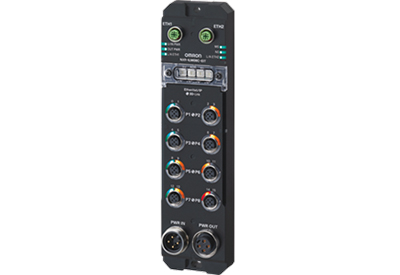
Omron’s V780 Series slave reader/writer reduces the cost of creating a system with an expanded antenna read range. Up to eight reader/writers can be linked, with one set as master and the others used as slave units.
When the host device sends commands to the master, the eight reader/writers work as a single one with a much broader and more flexible read/write range and orientation compared to a single-antenna system.
To simultaneously inspect a number of stacked pallets passing through a portal, end users can install V780 Series reader/writers on both the left, right, and top sides of the portal to read tags placed on individual items making up a pallet, or a tag mounted to the side of a pallet or tote.
How sessions eliminate duplicates
To ensure that a tag isn’t counted twice, Omron’s RFID systems employ what are known as “sessions.” A session is a tag reading “inventory process” between a reader (such as the V780) and the RFID tags. The reader chooses one of four sessions (denoted S0, S1, S2, and S3), and the tags maintain a different inventoried flag depending on which session is chosen.
What’s an inventoried flag? Basically, it’s a status that has two possible states. State A is when the RFID tag is energized and ready to be inventoried (or read) by the reader. In state B, the tag is de-energized after being inventoried by the reader.
When the reader inventories a tag, its inventoried flag status will change from A to B and then – after some time – back to A. The time period when the tag is in state B reverting back to state A is called persistence.
Getting to 64 tag reads with a single command
Thanks to the possibility of connecting up to eight V780 slaves in one system and the session strategy’s ability to avoid duplicates, manufacturers can read up to 64 RFID tags with a single PLC read command to V780 and then read the second set of 64 tags with a second command without communicating any duplicate info.
This would enable – for example – the reading of all 120 tags on a pallet that passes two to four V780 reader/writers connected in a master/slave configuration. With the proper setup, all tags can be successfully read without duplicating their data, which can subsequently be communicated via a PLC to a software application or SQL database.