

Fluke: Pyrometers for High Temperatures and Various Fieldbuses
October 27, 2020

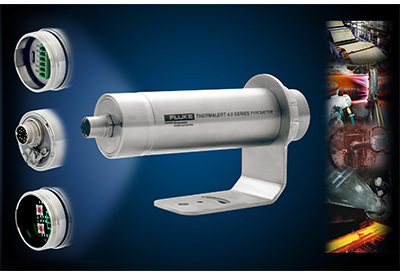
Fluke Process Instruments extends its Thermalert 4.0 spot pyrometer series, adding new shortwave versions and various additional interface options. The compact, extremely robust infrared thermometers provide noncontact, automatic temperature monitoring. Three new spectral models measuring at wavelengths of 1 µm, 1.6 µm, and 2.3 µm have been primarily designed for high-temperature applications and are particularly suitable for monitoring metal, steel, and glass. The full Thermalert 4.0 lineup covers measuring temperatures between -40 °C and 2300 °C and offers various different spectral models and focus distances.

All models are now available with connectivity options for Ethernet, EtherNet/IP, and PROFINET IO, in addition to analog or RS485 interfaces. Voltage can be supplied via Power over Ethernet (PoE). The Thermalert 4.0 series features an outstanding high maximum operating temperature of 85 °C. Users can therefore save costs by setting up many measuring points without cooling. The rugged IP65 infrared thermometers exhibit best-in-class repeatabilities, response times, and accuracies. An integrated laser focus facilitates alignment. In addition, the manufacturer also offers a pyrometer without laser for particularly cost-sensitive applications.

This model with an 8 µm to 14 µm spectral response has all the other advantages of the series and is suitable for a wide range of measurement tasks between -40 °C and 1000 °C.

Source

Related Articles


Editor’s Pick: Featured Article

Weidmüller’s u-control 2000: The Automation Controller

Weidmüller’s u-control 2000: The Automation Controller

Weidmüller’s scalable engineering software, u-control 2000, adapts individually to your requirements. And, the u-control is powerful, compact and fully compatible with Weidmüller’s I/O system u-remote. This article looks at what makes u-control the heart of your automation.

Programmable logic controllers (PLCs) are one of the main components of any automated system. A typical control system has inputs, outputs, controllers (i.e., PLCs), and some type of human interaction with the system, a human machine interface (HMI), for example.

Read More


Latest Articles

  • Labeling Cables and Wires

    February 3, 2026 Choosing the right wire marker or cable label Cable and wire labeling is critical in the identification, assembly, and repair of electrical control panels, wire harnesses, and data/telecommunications systems. It is an upfront cost that saves time and labor expenses when changes or repairs need to occur to the systems you work Read More…

  • ITC 101: Understanding NEMA Ratings for Electrical Enclosures

    February 3, 2026 Understanding NEMA Ratings for Electrical Enclosures NEMA Ratings are an essential classification system used across North America to define the environmental and mechanical protection provided by electrical enclosures. Developed by the National Electrical Manufacturers Association (NEMA), these ratings help engineers, installers, and specifiers identify the appropriate enclosure type for industrial, commercial, and outdoor Read More…