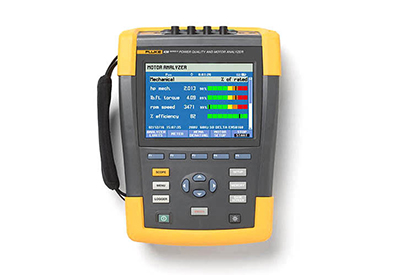
Discover motor performance, without mechanical sensors: Fluke 438-II Power Quality and Motor Analyzer
January 3, 2019

Troubleshoot direct-on-line motors while in service, without mechanical sensors—so you don’t sacrifice uptime.

The 438-II Power Quality and Motor Analyzer can help troubleshoot power quality problems in three-phase and single-phase power distribution systems, while giving you the mechanical and electrical information you need effectively evaluate motor performance.

  • Measure key parameters on direct-on-line motors and motors driven by voltage sourced inverters (VFD) including torque, RPM and mechanical power
  • Calculate Mechanical Power and Efficiency without the need of mechanical sensors, while the motor is in service using three-phase input measurements
  • Perform dynamic motor analysis by plotting of motor de-rating factor against load according to NEMA guidelines

Fluke 434-II, 435-II and 437-II users can add these great motor analysis capabilities and features to their existing analyzers today with a product upgrade option. Existing 438-II users can upgrade their firmware to include the variable frequency drive enhancements at no cost on the Fluke website. Existing 438-II users can upgrade their firmware to include the variable frequency drive enhancements at no cost on the Fluke website. 
Related Articles


Editor’s Pick: Featured Article

Weidmüller’s u-control 2000: The Automation Controller

Weidmüller’s u-control 2000: The Automation Controller

Weidmüller’s scalable engineering software, u-control 2000, adapts individually to your requirements. And, the u-control is powerful, compact and fully compatible with Weidmüller’s I/O system u-remote. This article looks at what makes u-control the heart of your automation.

Programmable logic controllers (PLCs) are one of the main components of any automated system. A typical control system has inputs, outputs, controllers (i.e., PLCs), and some type of human interaction with the system, a human machine interface (HMI), for example.

Read More


Latest Articles

  • Applications of Physical AI in Canadian Sectors

    June 23, 2026 Physical AI — the convergence of artificial intelligence with robotics and autonomous motion systems — is reshaping how Canadian industries operate. Across sectors from healthcare to mining, AI-enabled machines are performing tasks that were once entirely dependent on human intervention. But deploying Physical AI effectively requires more than sophisticated algorithms: it demands… Read More…

  • Case Study: Optimizing Harmonic Mitigation in Wastewater Treatment

    June 22, 2026 Segment and Application In a municipality, wastewater treatment plants typically stand out as the main consumers of electricity. The operational processes exhibit significant load variations throughout a 24-hour cycle, necessitating the use of AC drives to regulate pumps, blowers, and other motorized equipment in response to fluctuating demand. In one wastewater treatment… Read More…