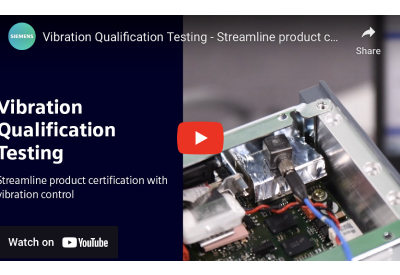
Vibration Qualification Testing – Streamline Product Certification with Vibration Control
November 25, 2022
 

{videobox}6ija35tyaSo{/videobox}


Vibration qualification testing is a crucial step in a product’s validation process, assuring that the component or assembly can withstand the vibrations occurring during the real-life operating conditions it is designed for. Engineers need to comply with various vibration qualification standards and environments to certify an extensive range of devices of different scales and sizes, making it paramount to have in place a safe, highly efficient, and flexible process.

In this video, Siemens uses an industrial PC to show how they test the reliability of the electronics against vibration damage.The Simcenter vibration qualification testing solution is compatible with any shaker. An affordable, entry-level 4/8-channel Simcenter SCADAS Mobile is perfect for vibration qualification testing of components and consumer products. An easy-to-use, multi-tasker, it can easily handle all noise, vibration or durability testing campaigns.


To learn more, click here
 

Related Articles


Editor’s Pick: Featured Article

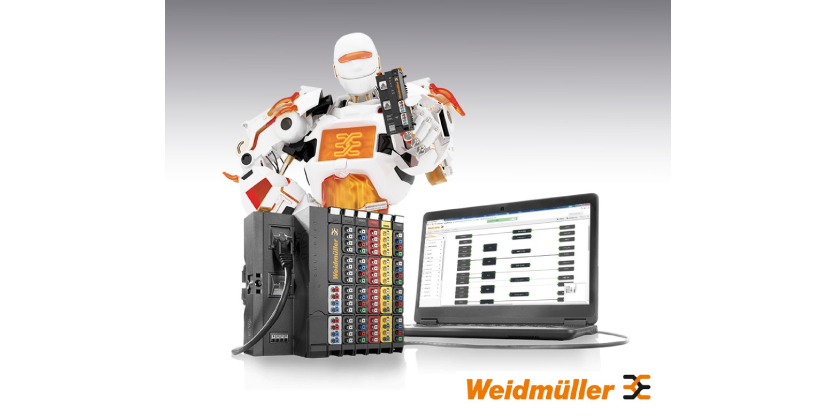
Weidmüller’s u-control 2000: The Automation Controller

Weidmüller’s u-control 2000: The Automation Controller

Weidmüller’s scalable engineering software, u-control 2000, adapts individually to your requirements. And, the u-control is powerful, compact and fully compatible with Weidmüller’s I/O system u-remote. This article looks at what makes u-control the heart of your automation.

Programmable logic controllers (PLCs) are one of the main components of any automated system. A typical control system has inputs, outputs, controllers (i.e., PLCs), and some type of human interaction with the system, a human machine interface (HMI), for example.

Read More


Latest Articles

  • UL Certification Requirements for OEMs: Essential Guide for Renewable Energy Projects

    May 5, 2026 In today’s fast-evolving energy and manufacturing landscapes, product safety, performance, and reliability are under greater scrutiny than ever before. For OEMs (Original Equipment Manufacturers) and players in the renewable energy sector, one certification has emerged as a gold standard—UL certification.  Although not legally mandatory in all regions of North America, UL (Underwriters Laboratories) certification is Read More…

  • Case Study: Improving Transformer Reliability for Underground Mining Power Systems

    May 5, 2026 Segment and Application The customer is a regional provider of engineered electrical solutions for mining and industrial applications in Mexico. They design and integrate customized power distribution equipment and electrical systems for harsh environments, including underground mining operations. As part of this work, they required compact power solutions for underground mining skids Read More…