Nidec Develops AC Servo Motor Equipped with Zignear®, the Location Detection Technology that Accommodates 17-bit Resolution, for the Industrial Robot Market
June 9, 2022
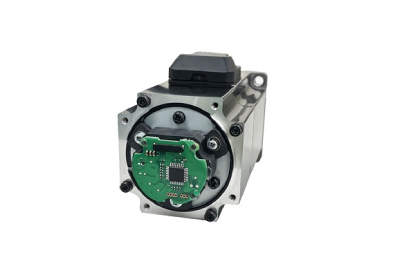
Nidec Corporation recently announced that it and Nidec Sankyo Corporation have jointly developed an AC servo motor (resolution: 17bit) equipped with Zignear®, the position detection technology that can be applied to industrial robots and replace encoders.
About this motor:
- •Uses a similar number of components to a magnetic encoder, with similar location detection and tracking capabilities of an optical encoder;
- •Boasts the maximum accuracy in mechanical angles for location detection errors (less than ±0.02°)*;
- •Can operate similarly to a conventional 17bit‐AC servo motor (demonstrated in a system test with a Zignear-equipped motor to drive an automated guided vehicle (AGV));
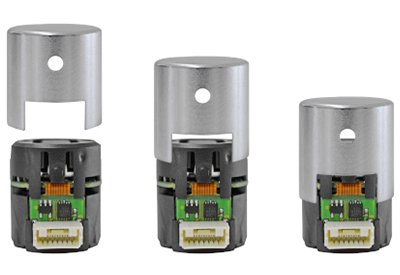
- •Is of an identical shape to a conventional magnetic encoder, making replacements between the two easy;
- •Uses a general-purpose microcomputer to accommodate a wide variety of output formats, including the ABZ phase output that is outputted by an optical encoder, and formats common in magnetic encoders, such as serial
- •Is intended for industrial robots and AGVs among others.
An encoder, which is a sensor used to detect the rotation of a brushless DC motor mainly, is essential in adjusting a motor to an intended location, and keeping its rotation consistent. Conventionally, a brushless DC motor has required an encoder, as it has been difficult to detect its accurate location due to the “inconsistency” in the magnetic sensor, or the installation of a hall sensor and sensitivity in particular. Now, however, after developing an algorithm that corrects such inconsistency, Nidec has successfully improved the location detection accuracy with the use of general-purpose microcomputers.
Despite its high accuracy and capability to operate in a strong magnetic field, an optical encoder tends to become larger in proportion to its accuracy, requiring precise positioning. This is why an optical encoder tends to be costly due to its code wheel and other components, and installation cost, and to deteriorate in an environment full of dust, oil, etc.
Meanwhile, a magnetic encoder operates even in a dusty environment, and is cost-competitive as it works with a relatively inexpensive IC chip, but the encoder’s accuracy is lower than that of an optical counterpart. Nidec’s Zignear®, which requires as small a number of components (only a hall sensor and a general-purpose microcomputer) as does a magnetic encoder, uses software to maintain location detection and tracking capabilities that are equal to those of an optical encoder.
Going forward, in the fields of industrial robot and mobility system that are becoming increasingly innovative and diverse, Zignear®-equipped AC servo motors will contribute to meeting the needs for high-level accuracy, diverse forms of communication, and replacing conventional products.

To learn more about Zignear®, the location detection technology, click here