Canadian Plants Face a Bearing Problem Most U.S. Guides Miss
November 24, 2026
VFD Bearing Damage: Why Canadian Plants Face Higher Risk
Why 575V systems, long cable runs and remote sites raise VFD bearing damage risk in Canadian plants, and how to stop bearing fluting before it fails.
Variable frequency drives can leave stray voltage on the motor shaft that discharges through the bearings, pitting the races until they fail years early. Canadian plants face a higher risk because of 575V systems, long cable runs, and remote sites where downtime costs more. To protect motors, keep the carrier frequency as low as practical and add bearing protection, such as a shaft grounding ring, insulated bearings or a CoolBLUE® inductive absorber sized to the drive.
Why do VFDs damage motor bearings?
Ask any maintenance team what fails most often on their motors, and the answer is bearings. The data agrees. The IEEE’s survey of industrial and commercial motors found bearings behind 44% of failures, well ahead of windings and rotors.¹
Most plants have a playbook for this: grease on schedule, align carefully, balance the load, and trend vibration. These are good practices, but they target mechanical causes. There is a second way bearings fail, and it hides in plain sight.
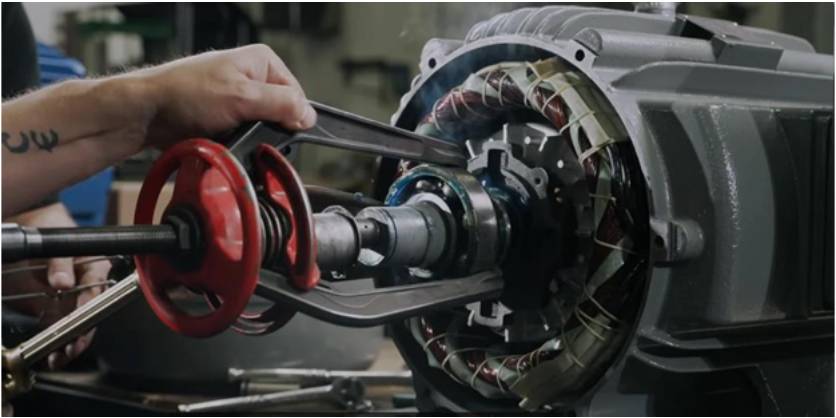
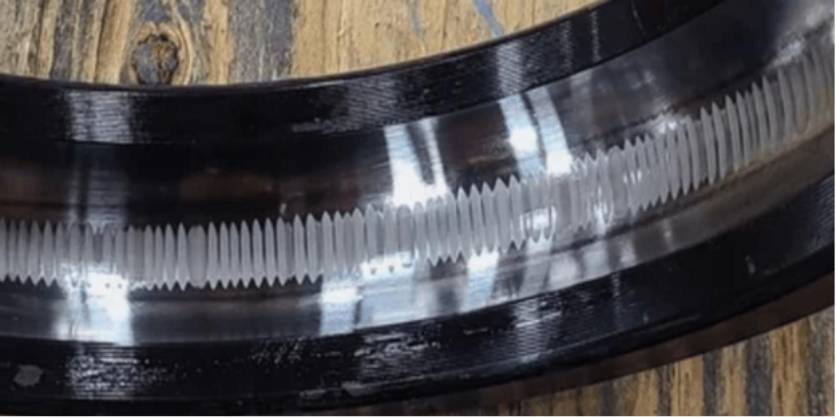
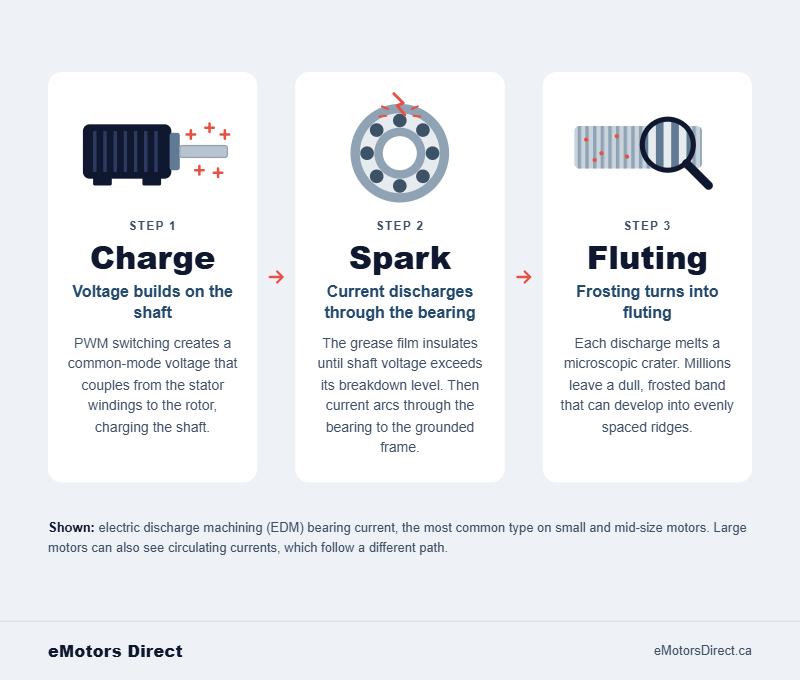
When a motor runs on a variable frequency drive, stray voltage can build up on the motor shaft and discharges through the bearing to reach ground. The effect tends to become more pronounced at higher motor voltages, such as 575V. Each discharge is a tiny spark across the grease film. Millions of them etch microscopic pits into the race, which eventually form a washboard pattern called bearing fluting. A plant can do everything right mechanically and still replace the same bearing years too early, which contributes to unplanned downtime.
Why are Canadian plants at higher risk?
Most published guidance on VFD bearing damage is written for U.S. plants. But three conditions common in Canadian operations raise the risk, and U.S.-based guides can easily miss them.
- Higher voltage. Many Canadian facilities run at 575V, while most U.S. guidance assumes 460V or 480V. A 575V system runs a higher DC bus voltage inside the drive (about 25% higher than 460V). As a result, each PWM switching transition produces a larger voltage step, which puts more stress on motor insulation and more energy behind each discharge through the bearing.
- Long cable runs. Mining, oil and gas, aggregate, and agricultural sites often place the drive in an electrical room far from the motor. Long cables add capacitance and can cause voltage reflections at the motor terminals, which makes the problem worse. The resulting increase in shaft voltage can lead to more frequent bearing current discharges and shorter bearing life.
- Remote sites. Near a major centre, a failed motor might cost a few hours. At a remote mine in northwestern Ontario, hours from the nearest supplier, it can mean days waiting for a replacement. Each failure costs more, so preventing it is worth more.
None of this means Canadian plants should avoid VFDs. Drives save energy, improve process control, and reduce mechanical stress in many applications. It means a maintenance program built on U.S. assumptions may underestimate the risk here.
Why is VFD bearing damage getting worse?
Bearing currents aren’t new. Engineers have studied them since fast-switching IGBT drives became standard in the 1990s. What has changed is how many motors are exposed, and where drive technology is heading.
- More motors run on drives. Drives keep getting smaller and cheaper, and many now come built into the motor. Applications that ran across the line a decade ago now run on a VFD, often in plants whose maintenance programs were originally designed for across-the-line motors.
- Carrier frequency gets turned up. A drive creates its output waveform by switching its transistors on and off thousands of times per second. The rate of these switching events is known as the carrier frequency. Installers often raise it to quiet motor whine and smooth motor operation, especially in occupied buildings and food plants. But every switching event can create an opportunity for a bearing-current discharge, so going from 4 kHz to 12 kHz roughly triples the number of switching events per second. Higher settings also make the drive run hotter, and many drives must be derated.
- The next generation switches even faster. New drives are starting to use silicon carbide (SiC) transistors, which switch faster and waste less energy than today’s silicon designs. The trade-off is faster voltage rise times (higher dV/dt), which can increase shaft-voltage stress and bearing-current activity.² However, most drives still use conventional silicon technology.
“We see it all the time in the field. Someone turns up the carrier frequency to quiet a noisy motor, and a few months later we’re replacing the bearings or the whole motor,” says Chris Beaton, technical specialist at eMotors Direct.
Practical tip: use the lowest carrier frequency your application can tolerate. If noise forces it higher, or your next build includes a SiC-based or motor-mounted drive, plan bearing protection from the start.
How do you stop VFD bearing damage?
Start by confirming the cause. Four warning signs can be checked without downtime: bearing noise that rises over weeks, vibration readings that point to the outer race, repeat failures concentrated on VFD-driven motors, and unexpected failures in connected gearboxes, pumps or encoders. A removed bearing gives the definitive answer: a dull, frosted band on the race, or the washboard ridges of fluting.
For all seven warning signs and how to check each one, see the full guide.
Once bearing current is the suspect, there are three main ways to protect the motor.
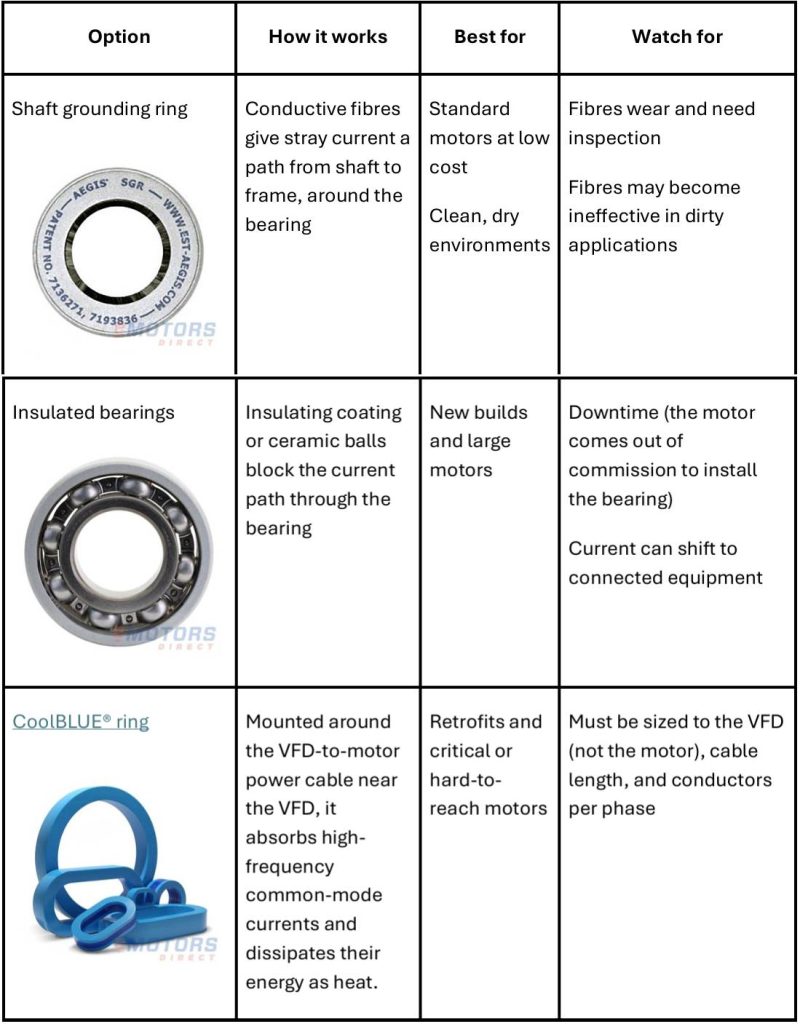
For retrofits, CoolBLUE® is often the simplest, fastest, and most effective solution. CoolBLUE® installs on the cables, so the motor and shaft stay untouched, and it has no brushes or fibres to wear out. Because it reduces stray current at the source, it also protects gearboxes, pumps, couplings and encoders downstream.
It also has limits worth knowing:
- It won’t repair a damaged bearing. Replace any bearing that shows frosting or fluting first.
- It doesn’t replace proper grounding and suitable motor cables.
- It must be sized correctly. Incorrect sizing or too few core can reduce performance and cause core overheating.³
- Very large motors may need more than one method, such as CoolBLUE® combined with an insulated bearing.
How do I get help sizing CoolBLUE®?
eMotors Direct is an authorized CoolBLUE® distributor in Canada, and our technical team can help you size it for any application. Send us your VFD horsepower rating, cable length, conductors per phase (usually one on motors under 50HP) and drive model, and they will recommend the right configuration.
Not sure bearing current is the culprit? Send a photo of a removed bearing, and they will help you read it.
About the authors: Ashish Patel is a Control Sales & Application Specialist, and Jill Wallace is the Director of Marketing at eMotors Direct, a Canadian-operated distributor of electric motors, drives and gear reducers with over 20,000 items in inventory across its Canadian distribution centres.
References
- IEEE-IAS Motor Reliability Working Group, “Report of Large Motor Reliability Survey of Industrial and Commercial Installations,” IEEE Transactions on Industry Applications, vol. IA-21, no. 4, 1985.
- W. Zhu et al., “A Review of Modeling and Mitigation Techniques for Bearing Currents in Electrical Machines With Variable-Frequency Drives”, IEEE Access, 2022.
- MH&W International, CoolBLUE® and NaLA® Filter Design Guide for Motor Bearing and Stray Ground Currents, Rev. 3.2