Seismic Resilience: What Compliance Really Means for Electrical Infrastructure
February 17, 2026
When a seismic event strikes, every second counts. Electrical infrastructure must not only endure the physical shock but be ready to return to operation as soon as possible. That’s why seismic compliance isn’t just a checkbox, it’s a powerful statement about a product’s resilience and reliability.
For critical industries that rely on clean, stable power like hospitals, data centers, wastewater and industrial plants having seismic-compliant equipment can mean the difference between hours of costly downtime and a swift return to business as usual.
What Is Seismic Compliance?
Seismic compliance verifies that electrical equipment can endure the physical stresses of an earthquake and still function as intended. Testing is typically conducted using shake tables that simulate the forces generated by seismic activity. Compliance standards are often based on guidelines from the International Building Code (IBC) or regional bodies like OSHPD (Office of Statewide Health Planning and Development) in California.
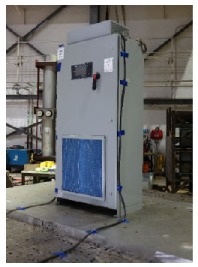
The AHF Type 1 Seismic is an Active Harmonic Filter that mitigates harmonics, improves power quality, and provides load balancing – now fully tested in accordance with IBC 2018 and ASCE 7-16 standards (SDS = 2.0, Ip = 1.5, z/h = 1).
But it’s not just about surviving a shake. To be qualified, equipment must demonstrate that it can be re-energized and return to service without requiring manufacturer re-testing or additional verification.
Why It Matters for Active Harmonic Filters
AHFs play a critical role in maintaining power quality by mitigating harmonics and correcting power factor in environments with variable frequency drives (VFDs) or non-linear loads. In the aftermath of a seismic event, when other systems are already under stress, voltage sags, transients, and harmonic distortion can become more pronounced, especially if mitigation equipment like AHFs is damaged or offline.
Non-linear loads such as VFDs, UPS systems, and motors can emit harmonics during unstable conditions, which increases current distortion. This can lead to overheating in cables and transformers, misfiring in drives, malfunctions in control systems, and up to a 20% rise in system losses. Without filtering and correction, these cascading issues can overload backup systems and sensitive electronics, compounding the effects of the initial event and delaying full system recovery.
A seismic-qualified AHF helps ensure that clean, stable power continues to flow when it’s needed most without introducing delays for inspection or replacement.
Tested and Trusted: Re-Energize with Confidence
Hammond Power Solutions’ seismic-compliant Active Harmonic Filter has passed rigorous shake testing and is approved for re-energization following a seismic event. There is no need to send it back to the manufacturer for verification. For you this means reduced downtime, faster overall recovery and greater peace of mind.
Whether it’s a healthcare facility relying on sensitive diagnostic equipment, or an industrial operation with tight production windows, having an AHF that’s ready to go post seismic event can significantly reduce operational disruptions.
Final Thoughts
Seismic events are unpredictable, but your infrastructure’s response shouldn’t be. HPS’ seismic-compliant Active Harmonic Filter is built not just to withstand the shock, but to help you recover faster and with fewer disruptions.
More Information
Learn more about Hammond Power Solutions’ seismic-compliant AHF
Related Story
Microgrids & Power Quality: Designing Resilient, Clean Facility Power
In an era of extreme weather, aging infrastructure, and ever‑rising energy demands, many facility managers are rethinking their relationship with the grid. Microgrids offer a way to take control and operate autonomously when necessary. A microgrid is more than just backup, when designed properly, it becomes a platform for resiliency, efficiency, and sustainability.