Festo Didactic’s Semiconductor Training Supports Industry and Educators with Lab Equipment, Curriculum, and Certification
January 14, 2026
Festo Didactic Brings Semiconductor Manufacturing Training to Fill the Skills Gap
By Krystie Johnston
Festo Didactic knows that education is the key to shaping future change and driving innovation. For 60 years, they have helped empower the skilled workers of today and tomorrow with their learning concepts so they can meet new challenges. Last month, at the ACTE CareerTech VISION Conference, Festo highlighted their next-generation Industry 4.0 and AI Training Systems to learners, academics, and industry professionals.
ACTE CareerTech VISION Conference 2025
The ACTE CareerTech VISION Conference is a premiere event for career and technical education (CTE) professionals that draw more than 6,000 attendees from around the world. In 2026, they will celebrate a century of leadership, innovation, and impact on CTE and the future of the workforce. In 2025, Festo (the global parent company to Festo Didactic), celebrated their centennial milestone as well. Ted Rozier, Director of Digital Advanced Technology and Robotics at Festo Didactic North America has attended the conference at least a dozen times, demonstrating to customers that Festo can deliver educational training modules on the leading edge of technology and innovation in smart manufacturing.
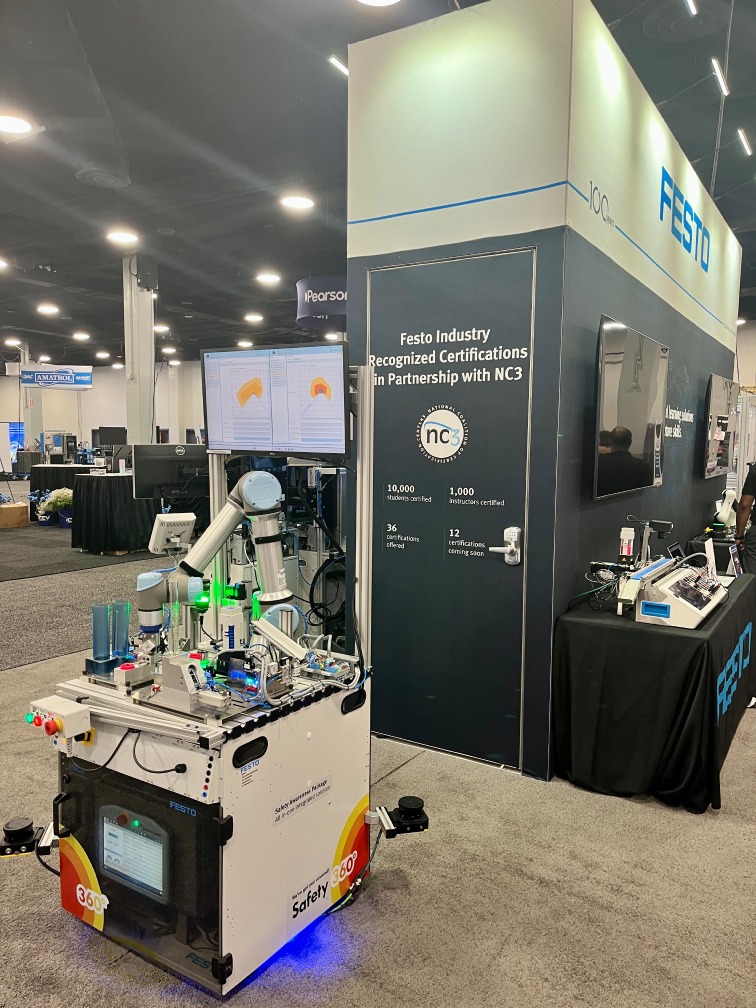
Last year Festo Didactic focused on three pillars: artificial intelligence (AI), semiconductors, and electric mobility. Rozier says part of their participation at the ACTE CareerTech VISION and other conferences involves demystifying buzzwords like AI and ML (machine learning) by demonstrating them with practical examples. “In education, it is important to be clear about AI, what it is, and how it can be used in manufacturing.”
Festo’s AX
“Festo has a product called the Festo AX Learning Experience. This is a software package that is used for predictive maintenance and energy efficiency used in industry by parent industrial company FESTO Automation. We have taken this software package into the educational space to help students understand what predictive maintenance looks like. They can manipulate the data in real-time. And when you look at data management, there are two parts: condition monitoring and image processing,” he says.
Condition monitoring and image processing are both integral to predictive maintenance – classifying images and interpreting the signals that come off a machine helps students determine if it is running properly. Rozier explains that at the ACTE CareerTech VISION 2025, Festo’s AX software was paired with their curriculum to demonstrate how it can be used in the semiconductor, electromobility, or robotics industries so students can gain practical skills with hands-on experience.
The semiconductor industry, for example, is one of the fastest-growing, most innovative-driven sectors in advanced manufacturing, and students are often underprepared for the realities of this highly specialized environment. Rozier says the Semiconductor Learning Factory from Festo Didactic addresses this gap. “When you look at the overall solution we have put together, it is important that it is clearly understood that semiconductor manufacturing requires a complete program. It is important to know that it has lab equipment, curriculum, and certification.”
The lab equipment
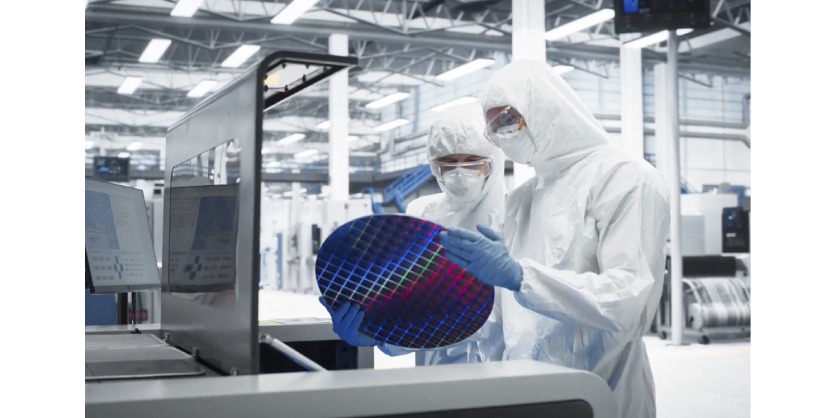
Rozier says that Festo’s solution starts students off in a mock cleanroom that resembles a professional fabrication setting more than a traditional classroom. From the beginning, students practice hands-on, highly skilled training such as gowning and precise air quality management. “Once they have that information, they can move on to the process of inspecting the wafers and proceeding through the different competencies that come along with the semiconductor industry.”
The curriculum
Festo’s solution can be brought into classrooms and institutions to prepare trainees and employees for the future of work. For example, Rozier points out a case study where their lab equipment was installed at Portland Community College. “They have been great partners. They have a clean room. They were funded by a US $1.6 million state workforce grant. The installation allows students to gain hands-on experience using the same tools and technology that the local industry uses,” he says. “This essential investment bridges the gap between education and industry – and it is strengthening Oregon’s future workforce.”
The certification
Certification is the third element in Festo’s Semiconductor Learning Factory that will set their program apart in 2026; they work closely with NC3 to provide it. “We have been in the business of automation manufacturing components for 100 years. This is something that we know very well. But it is important that we have a neutral, third party who can assess our curriculum content and our training methods, validate them, and hand it over to the educational institution.” He adds that working with the NC3 means students can take this certification to an employer and be recognized as having the skills needed to work in this highly specialized industry.
The future of career and technical education
Festo Didactic builds solutions for training and workforce development, and they know how important it is to connect with educators and industry. Rozier says that the ACTE CareerTech VISION Conference is a great way to keep the pulse on the industry, and he has watched it evolve over the years. “If you go back 12 years, the conference was dominated by K-12 attendees, but we are seeing more community colleges becoming a part of it, and even industry, where industry is looking to strengthen the incumbent workforce.”
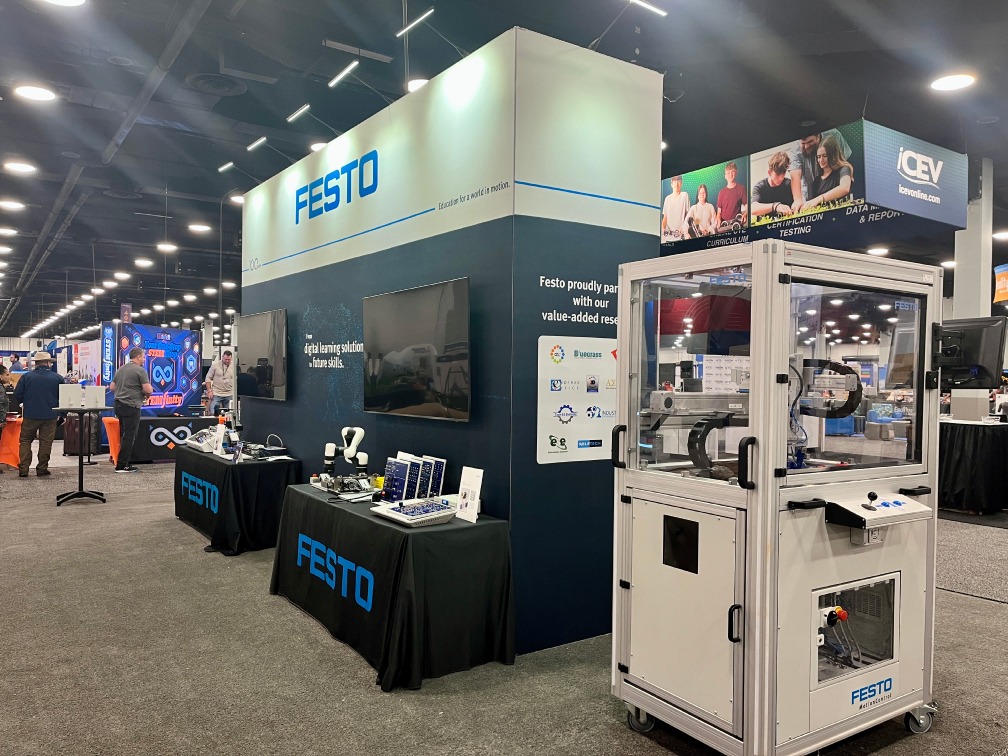
“Connecting with educators allows us to engage with secondary and post-secondary educators and administrators who are actively seeking training systems and up-to-date curriculum,” Rozier says. “I can say that again, up-to-date curriculum, because everyone wants to talk about the leading edge of technology and the changes in technology, but typically, the curriculum falls behind. Educators want to know when the curriculum was last updated, and when they can see that [it was recently], they are excited.”
CTE programs are under increasing pressure to address the skills gap, and Festo Didactic acts as a solution provider to help these programs keep pace with rapid industrial innovation. Furthermore, their solutions enhance employability by providing industry-aligned learning solutions and help educators lead students towards boosting their marketable skill sets, ensuring they will be ready for the workforce upon graduation. Rozier says attending this conference helps them keep the pulse on these imperatives to offer a product that sees the big picture and is a complete solution.
More Information
Interested in learning more? Visit Festo Didactic today!
Related Story
Festo’s Legacy of Innovation and Technical Education Forges New Pathways to Lifelong Learning
Festo has a long history of innovation in technology, automation, and education. This year, the global company celebrates its 100th anniversary, and Festo Didactic, the training arm of the company, celebrates 60 years. When Festo began in 1925, automation was unheard of. They helped shape it by developing innovative technologies and teaching others how to use them. Today, Festo is a leader in motion and technical training, with more than 20,000 employees in over 60 countries.
Becoming a leader in these areas has taken decades of practice and partnerships with industry, educational institutions, and organizations like WorldSkills and SkillsUSA, where a shared vision to create a better society helps to solve the challenges of our time. In this article, Daniel Rodriguez, Director of Sales for Festo Didactic North America, discusses some of Festo’s innovations in automation and technical training. Rodriguez holds a BS in Industrial Engineering and an MS in Engineering Management, and has been with Festo for about forty years, working in engineering, product development, and leading global education initiatives.