Magna Develops and Pilots Autonomous, On-Road Last-Mile Delivery Solution
September 19, 2022
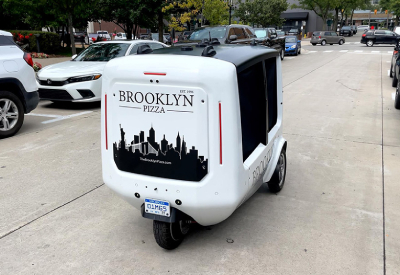
Delivery Bot driving down street
- •Targeting reductions in delivery cost and carbon emissions for “last mile” delivery
- •Magna-developed autonomous driving system and delivery software
- •Pilot demonstrates options for different business models, including robot-as-a-service
Recently, at the North American International Auto Show in Detroit, Mich., Magna revealed how it is leveraging its expertise in automotive electrification and autonomy to develop new mobility business opportunities. The company has successfully developed and is piloting a novel “last mile” delivery solution for urban environments.
The solution integrates a:
- •Purpose-built, on-road, lightweight, electric robot.
- •Magna-developed low-speed autonomous driving system; and
- •Delivery software.
With the goal of significantly reducing last mile delivery costs and carbon emissions in cities, the Magna new mobility team built a “full-stack” solution, from the ground up, leveraging hardware and software from our automotive products. Magna’s solution enables retailers and other stakeholders to offer end-to-end last mile delivery across a range of potential business models.
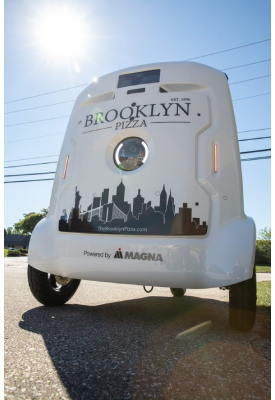
Rear view of Delivery Bot
The Magna-developed robot was launched on a pilot basis with a pizza restaurant in the Detroit area in March 2022. Since then, it has delivered hundreds of pizzas to residential and commercial locations near the restaurant. Magna is using data and consumer feedback to refine the service.
Magna’s robot can travel at speeds of up to 20 mph on public streets and the Magna-developed low-speed autonomous driving system uses cameras, radar, LIDAR and other hardware.
“Expanding into the growing world of new mobility is a key part of our ‘Go Forward’ strategy that takes Magna beyond its existing technical strength in automotive and vehicle systems, and into entirely new markets and business models,” said Matteo Del Sorbo, Executive Vice President, Magna International and Global Lead for Magna New Mobility. “The next phase in this pilot program is to apply our learnings to further refine the solution for a broader range of applications and use cases, scale, and unlocking innovative new business models.”
This development and pilot program follows two additional new mobility announcements recently made by Magna:
Expansion into the fast-growing micro mobility market through investment of $77 million in Yulu, India’s largest electrified shared mobility provider, and scaling the battery swapping infrastructure required to help accelerate the electrification of India’s two-wheeler fleet.
Collaboration with Cartken, an autonomous robotics company that has developed autonomous sidewalk delivery and materials handling robots, for a robot-as-a-service business model with contract manufacturing, this includes Magna’s use of Cartken’s platform for different applications.
“Our expertise lies in the ability to design, engineer and scale at higher volumes. Additionally, we want to explore opportunities to generate additional revenue streams,” Del Sorbo adds. “These moves allow us to enter a space where we could offer mobility as a service, not just a point-of-sale product.”