Cobot Gripper FAQ: Selection, Specs, and Comparison
August 31, 2026
Electromate carries cobot gripper lines from Robotiq, OnRobot, SoftGripping, and Mecademic. In this article, they present some frequently asked questions about gripper selection.
What is a collaborative robot gripper?
A cobot gripper is the end-of-arm tool that mounts to a collaborative robot’s wrist and performs the grasp, hold, and release function in an automated cell. Selection is driven by four numbers: payload (kg), stroke (mm), gripping force (N), and repeatability (mm) — not by gripper category alone.
Electromate’s cobot-compatible lines:
| Gripper | Type | Stroke | Force range | Payload |
|---|---|---|---|---|
| Robotiq 2F-85 | Adaptive parallel, electric | 85 mm | 20–235 N (4.5–50 lbf) | 5 kg |
| Robotiq Hand-E | Parallel, electric, sealed | 50 mm | 20–185 N | 7 kg |
| Robotiq 3-Finger Adaptive | 3-finger adaptive, electric | 155 mm (encompassing grip) | 30–70 N (programmable) | 10 kg (form-fit) / 2.5 kg (friction) |
| Robotiq EPick | Vacuum, electric (no external air) | N/A — cup-based | 12 L/min vacuum flow @ 80% vacuum | Material/surface dependent |
| OnRobot RG2 | 2-finger parallel, electric | Up to 110 mm (adjustable) | Not stated on current OnRobot product page | 2 kg |
| OnRobot RG6 | 2-finger parallel, electric | Up to 160 mm (adjustable) | 25–120 N | 6 kg (force fit) / 10 kg (form fit) |
| OnRobot 2FG7 | 2-finger parallel, electric, compact | Up to 73 mm (external grip width) | 20–140 N | 7 kg (force fit) / 11 kg (form fit) |
| OnRobot 2FG14 | 2-finger parallel, electric | Up to 50 mm | Up to 280 N | Up to 14 kg |
| OnRobot MG10 | Magnetic, electric | N/A | Up to 300 N pulling force (10-step adjustable) | Part-dependent, up to 10 kg |
| OnRobot VGP20 | Vacuum, electric | N/A — cup-based | High-flow electric pump | Up to 20 kg |
| OnRobot VGP30 | Vacuum, pneumatic | N/A — cup-based | Compressed-air actuated, 440 L/min flow | Up to 30 kg |
| SoftGripping Soft Grippers | Pneumatic, compliant silicone fingers | Finger-deformation based, parallel or centric motion | Low-bar pneumatic pressure range | 300 g–1200 g depending on finger count |
| Mecademic MEGP 25E | Parallel, electric, compact | 3 mm stroke per jaw | −40 N to +40 N | Micromanipulation-scale (~200 g recommended) |
Adaptive gripper vs. parallel gripper: what is the actual difference?
| Adaptive gripper | Parallel gripper | |
|---|---|---|
| Finger motion | Conforms to varying part geometry | Synchronized straight-line, fixed-axis travel |
| Best for | High-mix part handling, machine tending | Precision assembly, repeatable part geometry |
| Example | Robotiq 3-Finger Adaptive (4 grip modes) | Robotiq Hand-E (50 mm stroke, ISO/TS 15066 compliant) |
| Tradeoff | Slower changeover savings, less precision per cycle | Higher repeatability, narrower part-size range |
The Hand-E’s 50 mm stroke and sealed design make it suited to CNC machine tending where coolant and chips are present. The 3-Finger Adaptive’s per-finger force/position/speed control (155 mm encompassing-grip stroke, 30–70 N programmable force) suits research and high-mix manufacturing where part geometry changes run to run.
What stroke, force, and payload do common 2-finger electric grippers offer?
2-finger electric parallel grippers are available in several stroke/force/payload combinations depending on application needs:
| Gripper | Stroke | Force | Payload | Sealing |
|---|---|---|---|---|
| Robotiq 2F-85 | 85 mm | 20–235 N | 5 kg | IP40 |
| Robotiq Hand-E | 50 mm | 20–185 N | 7 kg | IP67 |
| OnRobot RG6 | Up to 160 mm | 25–120 N | 6 kg (force fit) / 10 kg (form fit) | TÜV certified (IP rating not stated on current OnRobot page) |
| OnRobot 2FG7 | Up to 73 mm (external) | 20–140 N | 7 kg (force fit) / 11 kg (form fit) | IP67 |
| OnRobot 2FG14 | Up to 50 mm | Up to 280 N | Up to 14 kg | IP67 |
Selection comes down to which spec matters most for the application: stroke for part-size range, force for grip security on heavier or harder-to-hold parts, payload for total mass handled, and IP rating for exposure to coolant, dust, or washdown.
Electric vs. pneumatic grippers on a cobot: what changes operationally?
Electric grippers (all Electromate cobot gripper offerings are electric) draw power directly from the robot’s tool output — no compressor, no air prep unit, no line pressure to maintain. This changes three things at the integration level:
- Force control: Programmable force setpoint per cycle (e.g., 2F-85: 20–235 N user-selectable) vs. a fixed regulator-set pneumatic force.
- Feedback: Position and force feedback over digital I/O or fieldbus, enabling part-presence detection and grip-quality verification in the robot program.
- Installation: No air line routing to the end-of-arm tool; power and signal only.
The EPick vacuum gripper applies this same principle to suction handling — it integrates an electric vacuum generator at the tool, removing the need for a shop air vacuum ejector.
When should I use a vacuum gripper instead of a finger gripper on a cobot?
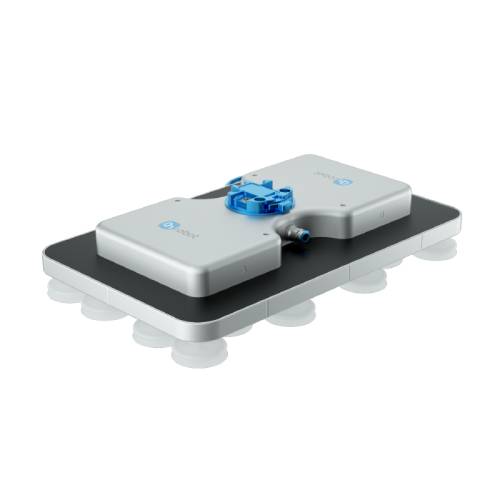
Vacuum grippers handle flat, non-porous, or fragile surfaces that finger grippers cannot grip without marking or crushing: cartons, bags, sheet stock, glass, film. The Robotiq EPick uses an adjustable vacuum flow setting (up to 12 L/min at 80% vacuum) and runs without external compressed air, drawing instead from the robot’s onboard supply.
OnRobot’s vacuum line splits by payload and air source: the VGP20 is electric (no compressed air) and rated to 20 kg, while the VGP30 is pneumatic, using external compressed air to deliver a 440 L/min flow rate, and rated to 30 kg — the higher payload tier requires shop air.
Finger grippers remain the correct choice when the part has a graspable edge or feature and requires positive mechanical retention (e.g., during a press-fit or insertion step) rather than surface contact.
What is a magnetic gripper used for, and when does it replace vacuum?
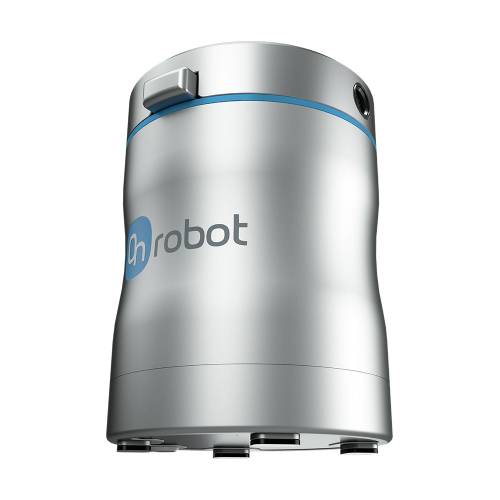
Magnetic grippers, such as the OnRobot MG10, grip ferromagnetic parts directly using adjustable magnet strength rather than suction or mechanical clamping. The MG10 offers 10-step adjustable force, up to 300 N pulling force, IP67 sealing, a payload rating up to 10 kg, and built-in part-detection via a proximity sensor.
Magnetic gripping replaces vacuum in three specific cases:
- Perforated, abrasive, or dusty parts — conditions that break vacuum seal integrity
- Sheet metal destacking — separating thin stacked blanks where vacuum cups risk lifting multiple sheets
- Power-loss safety requirements — the MG10 maintains grip during power loss or e-stop, which a vacuum system loses immediately without a check valve
Magnetic gripping is payload-sensitive to air gap: pulling force drops sharply as the distance between magnet face and part increases, so flatness and surface contact matter more than with vacuum.
What is a soft robotic gripper, and how does it differ from a rigid finger gripper?
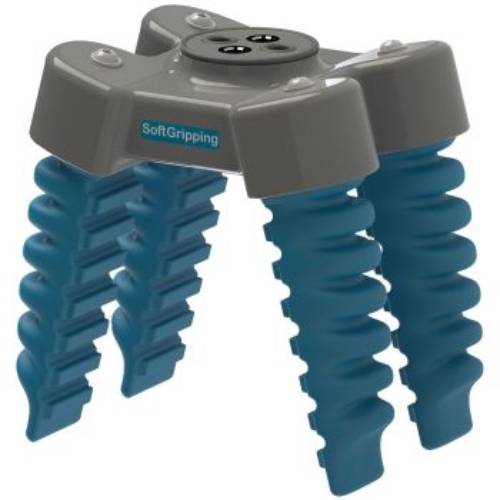
SoftGripping’s pneumatic grippers use molded silicone fingers with internal air chambers. Controlled air pressure deforms the fingers, creating compliant contact distributed across a larger surface area rather than a fixed mechanical pinch point. This removes rigid mechanical joints from the contact surface entirely, which is well suited to delicate, irregular, or food-grade items where a hard pinch point risks bruising or marking the part.
SoftGripping’s current catalog rates payload by finger count: 2-finger parallel grippers up to roughly 300 g, 3-finger centric up to roughly 450 g, and 6- or 8-finger configurations up to roughly 1,200 g.
Rigid finger grippers, such as Robotiq’s 3-Finger Adaptive, use motor-driven fingers with discrete mechanical contact points and programmable force/position feedback per finger (30–70 N, 155 mm encompassing-grip stroke). This suits industrial parts where defined grip force, part-presence detection, and repeatable positioning matter more than surface compliance.
SoftGripping’s 3-finger centric configuration is suited to round or asymmetrical items (strawberries, apples, eggs, small vials), where radially symmetric closing force improves centering without requiring precise pre-alignment of the part.
Can one gripper handle multiple part sizes without a tool change?
Yes, within the gripper’s stroke and force envelope. The Robotiq 2F-85’s 85 mm programmable stroke and 20–235 N force range cover a wide part-size band without re-tooling. This is the primary reason adaptive parallel grippers dominate high-mix, low-volume cells. The 3-Finger Adaptive extends this further across irregular geometries using its four grip modes and 155 mm encompassing-grip stroke. Outside the stroke/force envelope, a tool change or different gripper SKU is required.
What industries use these cobot gripper configurations?
Automotive supply, electronics assembly, medical device manufacturing, food and beverage packaging, logistics, and general metalworking are the primary sectors Electromate supports with cobot grippers, typically paired with Universal Robots arms also available through Electromate.
This article is original content created and posted by Electromate. Please do not re-post this content without prior approval from Electromate. “
More Information
Related Story
The Emergence of Mechatronic Subsystems and Their Importance in Product Deployment
As automation systems become more complex and project timelines compress, the role of mechatronic subsystems has shifted from convenience to a necessity for many OEMs. From modular robotic actuators to fully integrated motion systems, subsystem-level design is enabling manufacturers to accelerate development cycles, reduce risk, and concentrate internal resources on differentiation rather than reinvention.
In this Q&A, Warren Osak, President and Founder of Electromate, discusses the emergence of mechatronic subsystems, their impact on deployment timelines, and why more OEMs are adopting integrated solutions over traditional component sourcing.