50 Years of Power Supplies: From the 50 Hz Transformer to Highly Efficient Industrial Power Supplies
August 31, 2026

In this blog article, PULS looks at the technological and market development of industrial DC power supplies over the past 50 years — and at the next steps that can further improve efficiency, size, and reliability.
Few components in industrial applications operate as unobtrusively yet play such a decisive role as the power supply. It forms the basis for stable processes, reliable automation, and high system availability. At the same time, the technology behind DC power supplies has changed fundamentally over the past five decades.
Bernhard Erdl, founder and CEO of the PULS Group, has been developing and manufacturing power supplies for more than 50 years. As early as 1968, he built a laboratory power supply as a student; since 1974, the development of power supplies has shaped his professional life. His perspective shows that the history of power supplies is not just a history of technical components, but also a history of market changes, specialisation, increasing efficiency, and continuous development work.
The Changing Market: From In-House Production to Specialisation
The power supply industry began undergoing a decisive change in the 1970s. The transition from linearly regulated power supplies with 50 Hz transformers to switch-mode power supplies triggered a wave of new company formations. The new technology was more knowledge- and development-driven than the previous series-regulator technology, which was primarily characterised by large, heavy components and manufacturing expertise.
Many companies that had previously manufactured power supplies for their own needs increasingly handed this task over to specialised suppliers. One striking example: for a time, IBM was the world’s largest manufacturer of power supplies — solely to meet the needs of its own mainframes. As the technology became more complex, however, development increasingly became the task of specialised companies.
The first major applications of switched-mode technology were in the IT sector. Although switch-mode power supplies were originally developed for military applications and aircraft, where weight was a critical factor, they quickly found commercial use in computers, monitors, and printers. An early example was the programmable HP 9100A desktop calculator from 1972; the Apple II followed in 1977 and operated without a fan.
New Designs, New Markets
The designs of industrial power supplies have also changed considerably over the decades. In the past, open PCBs, L- or U-shaped brackets, enclosed fan-cooled housings, and large plug-in units dominated the market. Standardised 1U and 2U plug-in units later became important in server applications; in other areas, conduction-cooled power supplies gained significance.
A particularly important step for industrial automation was the DIN-rail power supply. In 1991, PULS launched its first products that could be snapped directly onto the DIN rail. From 1997 onward, PULS focused entirely on this design. Today, DIN-rail power supplies are an indispensable part of control cabinets and automation systems.
At the same time, it became clear that there is no single, uniform market for power supplies. Requirements vary greatly depending on the application: fan cooling is common in IT, while convection cooling dominates in automation. Service life, product availability, and distribution channels also differ significantly. In the industrial sector, product life cycles and availability over many years can be critical; in IT, much shorter cycles are the norm.
Technological Progress: Efficiency as the Central Development Path
Fifty years ago, power supply technology was at a turning point. Linearly regulated power supplies with 50 Hz transformers were robust, but inefficient, large, and heavy. The linear regulator essentially worked like a variable resistor: it regulated the voltage by converting excess power into heat. Bernhard Erdl illustrates this with the image of a car whose accelerator is fixed at full throttle and whose speed is controlled solely by using the brakes. At that time, the efficiency of a 5 V power supply was around 25%.
The transition to switch-mode power supplies was therefore a fundamental technological advance. The first switch-mode power supplies already achieved efficiencies of around 65%. For a long time, 75% was considered a good value; later, efficiencies exceeded 85%. Today, modern industrial power supplies are well above 90% efficient. PULS’s top-performing product currently achieves an efficiency of 97%.
This development was only possible because components, circuit topologies, and manufacturing technologies evolved together. Progress in power electronics is always the result of an interplay between new semiconductors, new concepts, and their consistent implementation in robust products.
Semiconductors, Topologies, and the End of Supposed Limits
New semiconductors played a decisive role. Initially, bipolar high-voltage transistors were used; they had originally been developed for the horizontal deflection circuits in televisions. For developers, this meant a great deal of new fundamental work: drive circuits, switching behaviour, magnetic components, high-frequency transformers, the skin effect, and the proximity effect all had to be understood and mastered.
The first MOSFETs appeared in the 1980s. They were considerably easier to drive and more robust against secondary breakdown, but initially had high conduction losses. Later, the superjunction transistor broke through supposed physical limits and enabled significantly lower on-resistance at high blocking voltages.
At the same time, circuit topologies changed. Flyback, forward, and push-pull converters dominated in the past. Today, resonant switching topologies such as the LLC converter are widespread. Replacing rectifier diodes with MOSFETs used as synchronous rectifiers also made a major contribution to increasing efficiency.
More Power in Less Space
In addition to efficiency, power density is one of the most visible indicators of progress. The development of industrial power supplies clearly shows how much more power can now be delivered in a significantly smaller space.
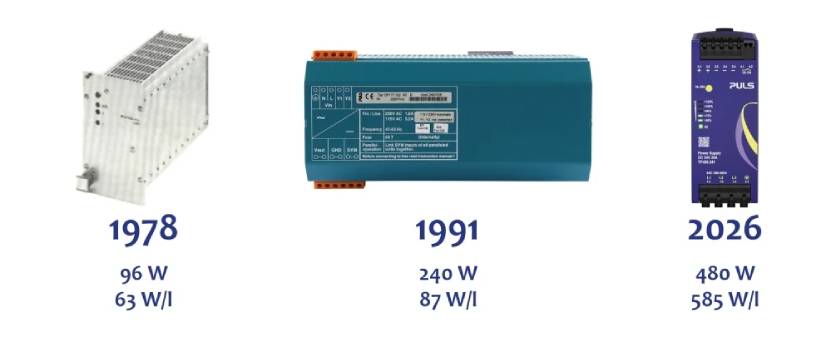
The graphic shown in the article compares three stages of development: in 1978, a 96 W PULS power supply achieved a power density of 63 W/l; in 1991, a 240 W power supply already reached 87 W/l; and in 2026, the latest 480 W version achieves as much as 585 W/l. This illustrates not only technological progress, but also the growing demands placed on modern control cabinets: more power, less space, lower power dissipation, and greater reliability.
Why Industrial Power Supplies have their Own Requirements
The requirements in industrial automation differ significantly from those of other markets. While IT applications often use fans and accept shorter product cycles, industrial applications depend on long service life, high availability, robust construction, and, in many cases, fanless convection cooling.
Especially in automation, the power supply is not an interchangeable secondary component. It affects the availability of the entire system. A reliable power supply must be thermally robust, electrically stable, efficient, and available over the long term. As power density increases, thermal design also becomes more demanding. Lower power dissipation means less heat in the control cabinet—and therefore better conditions for a long service life and stable system availability.
The Outlook: Many Small Improvements with a Major Impact
Even after 50 years, the development of industrial power supplies is not complete. Bernhard Erdl does not expect a single major technological breakthrough. The technology has become too mature for that. Instead, the cumulative effect of many small improvements will be decisive.
These include wide-bandgap materials such as SiC and GaN, new chip packages with improved cooling, cost-effective microcontrollers for complex control and drive concepts, more precise current sensing, more compact multilayer ceramic capacitors, improved electrolytic capacitors, optimised ferrites, and additional SMD designs. All of these developments give engineers new degrees of freedom to further optimise efficiency, size, reliability, and cost.
The Next Major Step: From AC to DC Grids
One particularly significant step for the future could be the transition from AC grids to DC grids. DC infrastructures have the potential to reduce conversion losses, make systems more compact, and further increase reliability. Especially in applications with many electronic loads, battery storage systems, renewable energy sources, or DC links, a DC-based infrastructure can offer technical advantages.
However, getting there will require substantial investment in development. New components, new protection concepts, new standards, and new system architectures will need to work together. Companies with the necessary development expertise, scale, and willingness to invest for the long term will play a key role in shaping this transformation.
Progress is Driven by Depth, Experience, and Consistent Development
The past 50 years show just how dramatically industrial power supplies have changed: from heavy, inefficient 50 Hz systems to compact, highly efficient switch-mode power supplies with high power density. This development was not the result of a single technological leap, but of continuous work on components, topologies, thermal design, manufacturing, and application expertise.
PULS has been actively shaping this development for decades—from early switch-mode power supplies and its consistent focus on DIN-rail power supplies to new power supply categories such as Field Power Supplies. High efficiency and power density are always key focuses of all PULS products.
Power supplies will remain a key building block of industrial systems in the future. With its experience, development expertise, and clear focus on efficiency, reliability, and industrial requirements, PULS will continue to play a major role in shaping the power supply landscape.
Related Story
Rittal and PULS Enter Technology Partnership
Two technology leaders are joining forces to accelerate panel building: Rittal and PULS have agreed on a new technology partnership to drive more efficiency and speed in machine and plant engineering.
The partnership was signed in November 2025 at SPS in Nuremberg and focuses on innovations that simplify and speed up panel building for the European and international market. The foundation is Rittals’ RiLineX as a new standard platform for busbar systems combined with PULS’ market-leading power supplies. As part of this collaboration, PULS is the first technology partner in the RiLineX functional group “Power Supplies.”