Vention and Teradyne Robotics Collaborate on Digital Twin Creation Platform Optimized for UR Robotic Cells
June 22, 2026
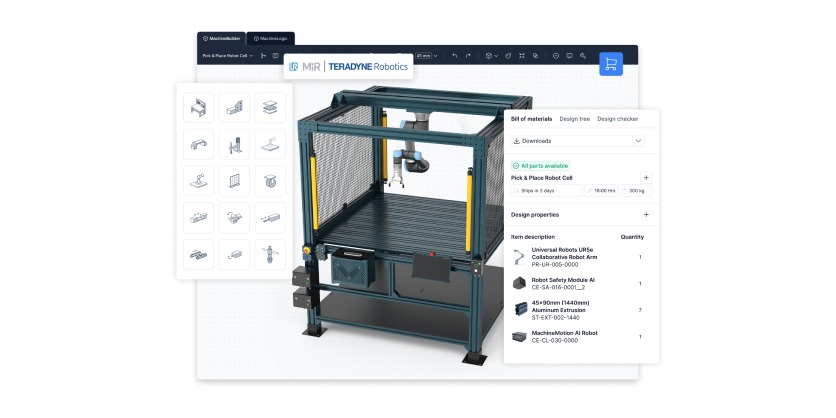
- Strategic collaboration between Vention and Teradyne Robotics accelerates the design and deployment of robot cells by leveraging Vention’s digital twin technology optimized for the Universal Robots (UR) platform.
- Built on Vention’s MachineBuilder technology, the platform streamlines the transition from initial concept to production-ready automation for Universal Robots deployments.
- Modular platform that simplifies the creation of custom robotic work cells, accelerating the path to deployment through digital-first design and simulation.
- Collaboration will help Teradyne Robotics’ customers with solution design and demonstrations
- Live demonstrations at Automate 2026 showcase the integration, featuring Vention’s Rapid Operator AI, powered by NVIDIA Isaac open robotics platform, and advanced welding applications enabled by Universal Robots’ UR12e and UR20 cobot models.
Vention, the leading digital-first industrial automation platform, and Teradyne Robotics, announced a strategic collaboration to accelerate the deployment of modular automation on June 22, 2026. Built on Vention’s MachineBuilder software and centered around Universal Robots’ family of collaborative industrial robots (cobots), the initiative extends Vention’s MachineBuilder to create a specialized platform that allows manufacturers to design, program, and operate modular work cells within a unified digital environment.
While much of the robotics industry remains fragmented between hardware and software, this collaboration delivers an integrated, end-to-end automation solution built around an application-specific approach. By leveraging Vention’s proven technology, Teradyne Robotics can provide its customers with a ready-to-configure digital environment. This eliminates the traditional trial-and-error phase of automation, allowing users to validate reach and modular framing before a single bolt is tightened.
“This collaboration reflects our conviction that robotics adoption must become faster, simpler, and more scalable for manufacturers of all sizes. By combining Vention’s digital twin expertise with the Universal Robots capabilities, we are creating a new way to design modular robotic cells — one that shortens time to value while maintaining the flexibility required in modern manufacturing,” said Étienne Lacroix, Chief Executive Officer of Vention.
Justin Brown, Chief Commercial Officer of Teradyne Robotics said: “For our customers, the real breakthrough is moving from concept to a production‑ready solution with confidence. This collaboration enables us to create high‑fidelity simulations for our customers that reflect real‑world kinematics. That means less trial and error, faster validation, and a shorter path from design to deployment.”
Deepening the Digital-First Experience
Building on a successful multi-year collaboration, this next phase moves beyond hardware compatibility to deliver a deeply integrated digital experience tailored to the needs of collaborative robot users.
- UR-Optimized Design Environment: A dedicated interface within Vention’s platform that is pre-loaded with the technical specifications and capabilities of the entire UR cobot line. This ensures that every design is “build-ready” and technically viable.
- Exclusive Automation Marketplace: Access Vention’s ecosystem of Universal Robots-vetted UR+ components, from end-of-arm tooling to 7th-axis systems
- Empowering Customers: Universal Robots’ global teams can now provide customers with high-fidelity, 3D simulations in minutes. This enables closer collaboration during the design phase and a significantly faster path to proof of concept.
- Library of Validated Templates: The platform features a suite of pre-configured automation templates for the highest-demand manufacturing applications—including end-of-line solutions, machine tending, pick-and-place, and overhead linear-axis systems—all optimized for UR cobots.
- Initially rolling out across North America and Europe, this collaboration gives Universal Robots customers a fully integrated automation foundation that connects robot selection, digital twin design, controls, and modular infrastructure into a single, seamless deployment workflow.
Live Demonstrations at Automate 2026
Teradyne Robotics and Vention will both be displaying their technology at Automate 2026 this week in Chicago:
- Teradyne Robotics (Universal Robots and MiR) (Booth #1250): Showcasing Rapid Operator AI, an NVIDIA-powered bin picking solution developed on the open Isaac platform that enables autonomous decision-making.
- Vention (Booth #2848): Featuring a UR12e running AI-driven bin picking and a UR20 on an overhead range extender, demonstrating advanced, large-scale welding.
Contact
Christine Boivin
Christine.boivin@vention.cc
+1.514.293.3423
About Vention
Vention is leading the future of industrial automation with the world’s only AI-powered full-stack platform, unifying hardware, software, and physical AI into one seamless experience. With over 25,000 machines deployed worldwide and a community of more than 4,000 factories, Vention enables businesses to design, program, deploy, and operate turnkey or custom automation solutions in just days. Vention brings together intelligent software and modular hardware to deliver automation that works right the first time.
Visit Vention.com to learn more.
About Teradyne Robotics
Teradyne Robotics is a global leader in advanced robotics solutions, dedicated to revolutionizing manufacturing processes through innovation in collaborative and mobile robotic technology. Teradyne Robotics companies, Universal Robots and Mobile Industrial Robots (MiR) empower businesses of all sizes to enhance operational efficiency by integrating the power of machines with human talent.
Teradyne Robotics’ comprehensive range of solutions enables companies to optimize manufacturing processes, leading to improved product quality, and increased productivity, while greatly improving worker safety. Teradyne Robotics is a division of Teradyne, Inc. (NASDAQ: TER), a leading provider of automated test equipment and advanced robotics.
For more information, visit teradyne.com. Teradyne® is a registered trademark of Teradyne, Inc. in the U.S. and other countries
Related Story
Vention Raises the Bar for Automating Automation with New Funding and Solutions
Vention is on a journey to democratize automation, and they are picking up speed. Already, in Q1 of 2026, they have made two announcements that will accelerate their trajectory towards automating automation: they have raised $100M USD ($150M CAD) to accelerate physical AI deployment across global manufacturing, and they introduced GRIIPTM, a generalized physical AI pipeline for manufacturing automation. Their momentum is more than just exciting; it is ushering in a new era of manufacturing.