Vention and FANUC America Join Forces to Bring Industrial Robots to Vention’s AI-Driven Hardware and Software Platform
June 22, 2026
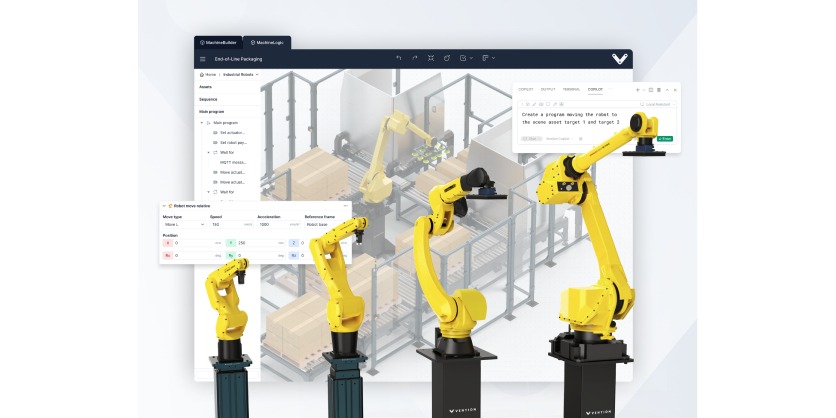
- Expanded Vention’s AI-powered automation platform from collaborative robotics to industrial robot applications through support for FANUC America’s industrial robot portfolio.
- Unified platform enables manufacturers to design, program, simulate, deploy, and operate collaborative and industrial robotic applications from a single digital environment.
- Built-in high-performance collision-free motion planning reduces commissioning complexity while enabling faster and more flexible automation deployment.Goal-driven robotic programming allows operators to define start and end targets while the system automatically generates optimal collision-free robot motion.
- Live demonstrations at Automate 2026 feature FANUC CRX10iA and LR Mate 200iD robots powered by Vention’s MachineMotion AI and MachineLogic software for machine tending and adaptive robotic motion applications.
Vention, the leading digital-first industrial automation platform, and FANUC America, the global leader in industrial robotics and factory automation, announced an expanded collaboration focused on simplifying industrial robot deployment through AI-powered programming, digital twin technology, and modular automation on June 22, 2026.
The collaboration combines FANUC’s industrial and collaborative robot portfolio with Vention’s unified automation platform, enabling manufacturers to design, simulate, deploy, and operate robotic systems from a unified environment. The expanded platform now supports multiple FANUC robot families, including CRX collaborative robots, LR Mate industrial robots, LR-10iA series robots, M-710iD series robots, and M-20iD series robots.
By integrating collision-free path planning , no-code and Python programming capabilities, the companies are helping manufacturers reduce commissioning complexity while accelerating automation adoption. Powered by Foundation Stereo,an NVIDIA Isaac open model that helps robots see depth using stereo cameras, the system generates a real-time 3D understanding of the workspace using a zero-shot stereo depth estimation, enabling MachineMotion AI to build a digital twin and automatically compute collision-free robot paths.
These capabilities now extend across FANUC’s robotic portfolio, enabling manufacturers to deploy a wide range of applications, from machine tending and pick-and-place to palletizing, welding, and high-speed industrial automation.
Unlike traditional robotic systems that require extensive manual programming and custom integration, the combined solution enables users to design automation systems using modular, pre-validated components that work together seamlessly. Manufacturers can easily generate and validate logic, realistically simulate robotic motion, and test cell interactions before deployment, significantly reducing integration risk and accelerating production ramp-up.
“By extending Vention’s platform to FANUC industrial robots, enterprise manufacturers in heavy industry can move from automation design to production much faster,” said Étienne Lacroix. “Combined with FANUC’s proven reliability and long-standing track record in industrial automation, this partnership gives manufacturers a dependable path to scaling production automation.”
“We’re seeing strong demand from manufacturers for automation that’s easier to deploy and faster to bring online, especially as labor challenges continue,” said Dick Motley, Director, Authorized System Integrator Network at FANUC America. “Many companies want to automate but are looking for solutions that reduce complexity and are easier to implement. Vention’s AI-powered platform helps customers deploy FANUC’s industrial and collaborative robots, allowing them to get up and running more quickly while maintaining the performance and reliability they expect from FANUC.”
Advancing Goal-Driven Industrial Automation
The announcement highlights Vention’s MachineMotion AI and MachineLogic ecosystem, introducing a new approach to robotic programming for both collaborative and industrial robots.
Rather than manually programming robot paths waypoint by waypoint, operators simply define start and end targets. The system then automatically scans the workspace and computes the optimal collision-free path between the two points without requiring manual waypoint programming.
This goal-driven approach enables manufacturers to deploy more adaptive robotic applications that respond dynamically to changing production conditions, mixed-SKU operations, and evolving factory layouts. The platform enables manufacturers to validate robotic motion and automation logic before deployment while accelerating commissioning and adapting more quickly to changing production requirements.
Built on modular hardware and software components, the platform enables faster commissioning and scalable automation deployments that can quickly respond to new SKUs, fixtures, and production layouts. Powered by MachineMotion AI, the system combines machine vision and intelligent motion control to enable flexible robotic automation in dynamic manufacturing environments.
Live Demonstrations at Automate 2026
The power of this collaboration is on display this week in Chicago:
● FANUC (Booth #1001): Featuring a FANUC CRX10iA collaborative robot running Vention’s Click & Customize Machine Tending Solution powered by MachineMotion AI, demonstrating automated CNC machine loading and unloading with configurable end-of-arm tooling.
● Vention (Booth #2848): Showcasing a FANUC LR Mate industrial robot powered by MachineMotion AI and programmed through MachineLogic, demonstrating collision-free path planning using on-arm vision and autonomous motion generation.
Contact
Christine Boivin Christine.boivin@vention.cc +1.514.293.3423
About Vention
Vention is leading the future of industrial automation with the world’s only AI-powered full-stack platform, unifying hardware, software, and physical AI into one seamless experience. With over 25,000 machines deployed worldwide and a community of more than 4,000 factories, Vention enables businesses to design, program, deploy, and operate turnkey or custom automation solutions in just days. Vention brings together intelligent software and modular hardware to deliver automation that works right the first time.
Visit Vention to learn more.
About FANUC
FANUC America Corporation is a subsidiary of FANUC CORPORATION in Japan, and provides industry-leading CNC systems, robotics and ROBOMACHINEs. FANUC’s innovative technologies and proven expertise help manufacturers in the Americas maximize productivity, reliability and profitability. Headquartered in Rochester Hills, Mich., FANUC America has facilities throughout North and South America.
Visit www.fanucamerica.com for more information or explore the CRX line of cobots at CRX.FANUCAmerica.com.
Related Story
Vention Raises the Bar for Automating Automation with New Funding and Solutions
Vention is on a journey to democratize automation, and they are picking up speed. Already, in Q1 of 2026, they have made two announcements that will accelerate their trajectory towards automating automation: they have raised $100M USD ($150M CAD) to accelerate physical AI deployment across global manufacturing, and they introduced GRIIPTM, a generalized physical AI pipeline for manufacturing automation. Their momentum is more than just exciting; it is ushering in a new era of manufacturing.