Festo Engineers a Hardened Linear Axis for Low-Temperature Logistics
July 28, 2026
The ELGA-TB actuator operates down to -30°C, removing the need for heated enclosures and oversized motors.
The primary point of failure in cold-chain automation is mechanical: standard handling and conveying systems seize and crack in sub-zero environments. To keep grocery supply chains moving, logistics engineers rely on costly, inefficient compromises – either wrapping electric axes and motors in insulated heating jackets or using high-torque drive systems to force components through frozen, stiffened grease.
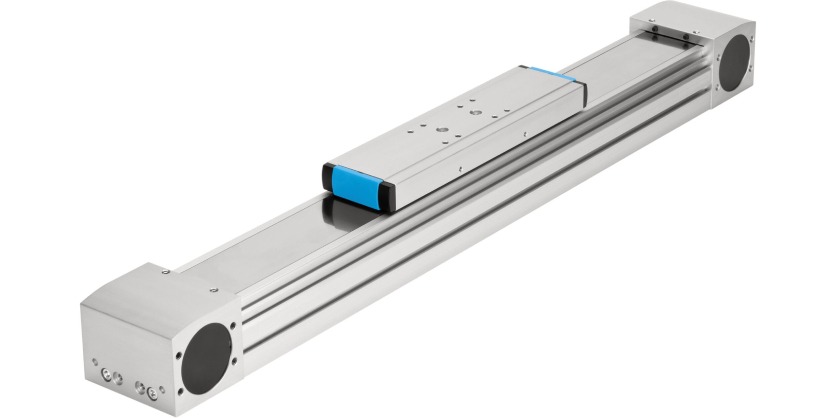
The Festo ELGA-TB electric axis bypasses these mechanical workarounds entirely. Globally certified for deep-freeze environments, this linear actuator pairs a flexible chloroprene rubber belt with a low-viscosity lubricant to maintain high-speed handling dynamics inside sub-zero fulfillment zones.
ELGA-TB operational thresholds:
- Temperature range: Certified to a -30°C (-22°F) ambient operational baseline.
- Speed and force: Travel speeds up to 10 m/s driven by a 1,300 N peak feed force.
- Repeatability: Positional repeatability within ± 0.08 mm (0.003 in.) across a scalable 8.5-meter stroke.
- Lifecycle Endurance: A factory-rated maintenance interval spanning 10 million meters of travel.
The Unified Intralogistics Ecosystem
Intralogistics systems rely on a strategic mix of dual technologies: electric motion for precision, long-stroke handling, and pneumatic power for rapid sorting, clamping, and vacuum-driven picking. Historically, combining these distinct mechanical platforms has multiplied engineering overhead, requiring disparate vendor sourcing, separate control architectures, and fragmented commissioning software that drive up assembly time, cost, and the required engineering skill sets.
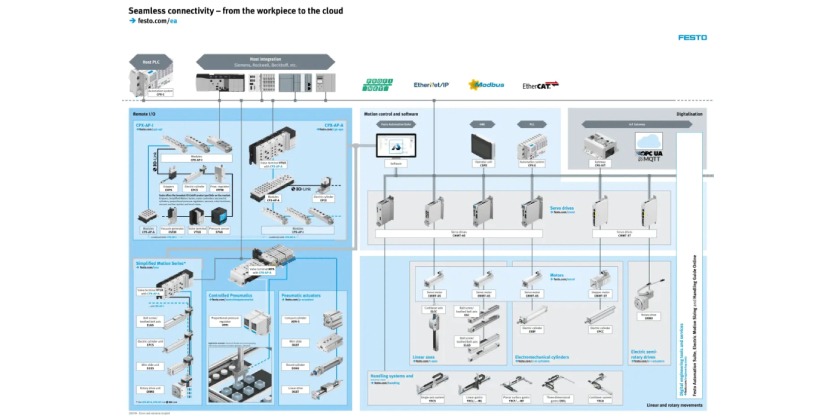
Festo resolves this operational divide by bridging its electric and pneumatic product lines under a single, seamless control architecture. This unified ecosystem allows machine builders and system integrators to pair high-speed electric gantries directly with pneumatic actuators, eliminating the programming friction of disparate software environments and split control logic.
This unified architecture synchronizes directly at the device level. Through multi-protocol communication and adaptable motor-mounting interfaces, Festo allows system integrators to standardize their control and mechanical architectures across an entire facility while communicating with the plant’s existing master PLC environment.
Running parallel to this electric backbone is Festo’s decentralized pneumatic architecture. Utilizing the CPX-AP remote I/O platform and multi-protocol network interfaces, this pneumatic infrastructure seamlessly blends into the same control loop as the electric motion systems. This allows high-speed valves and vacuum-driven picking modules to be mapped, commissioned, and monitored under a single, unified network topology.
Rather than managing disparate vendor pipelines, engineers can design, size, and commission this entire multi-technology footprint through the Festo Automation Suite. Backed by a standardized global supply chain, this ecosystem eliminates engineering friction from the initial conceptual design down to long-term facility maintenance and spare parts logistics.
More Information
For additional information on the Festo ELGA-TB cold-rated electric axis, contact a Festo sales representative or distributor. For more information on the company’s range of pneumatic and motion control and I/O solutions, visit www.festo.com.
Related Story
Festo Addresses Automation Integration Challenges at Automate 2026
Automation projects are placing greater demands on OEMs and system integrators as machines incorporate more devices, networks, and flexible production requirements. Startup schedules continue to shrink while engineering teams are expected to reduce troubleshooting, simplify interoperability, and keep projects moving despite limited technical resources.