Fundamental Thermoelectric Technology Patent Granted to DTP Thermoelectrics
October 12, 2022
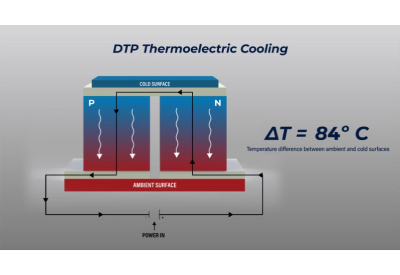
DTP Thermoelectrics has been awarded a patent that opens the door for solid-state deep cooling thermal management. The patent is based on theoretical and analytical models that have been validated through the fabrication and characterization of thermoelectric devices that use Distributed Transport Properties (DTP) thermoelectric materials.
Sample tests, using standard protocols, demonstrate significant increases in maximum cooling temperature, efficiency (COP) and cooling power, confirming that DTP devices can cool to lower temperatures, improving performance and functionality. Until now, these capabilities were only possible using much larger and heavier mechanical cooling systems.
“There is no better performing thermoelectric material system than what we have fabricated with our DTP technology,” says Dr. Lon E. Bell, President and CEO. “This mass-producible, proprietary technology increases cooling capacity at efficiencies greater than what is possible with other thermoelectric devices. DTP technology has the potential to improve cooling and thermal management system performance and cost effectiveness in Lidar, infrared sensors, electronics, cold chain storage, medical devices, battery thermal management and vision systems.”
“Our technology has been partially enabled by recent advances in semiconductor material manufacturing,” says Dr. Douglas Crane, Chief Technology Officer. “Using both modifications to available thermoelectric materials and advanced manufacturing technology, we can generate precise performance outputs. By starting with our higher efficiency thermoelectric systems and controlling the relationship between power density and COP that DTP technology enables, we can tailor performance to specific applications.”
The patent for “Thermoelectric Systems Employing Distributed Transport Properties to Increase Cooling and Heating Performance” (number 11,421,919 by the United States Patent and Trademark Office) covers DTP technology and its ability to increase cooling and heating performance in solid-state heat pumps. Details of the patent are found here.
For more information about DTP Thermoelectrics, visit https://dtpthermoelectrics.com