What Is the Best Way to Protect Network Equipment in a Warehouse?
April 23, 2026
What is the best way to protect network equipment in a warehouse? The best approach depends on the environment, but in many cases:
👉 A wall-mounted cabinet with filtered airflow provides an effective solution
This approach:
- protects equipment from dust and debris
- maintains airflow for cooling
- keeps installations simple and accessible
What Types of Enclosures Can Be Used?
- Open racks: Best for clean environments. Not recommended for warehouses.
- Sealed enclosures: Provide maximum protection, but may restrict airflow and increase cost.
- Filtered enclosures: A practical middle ground that reduces dust ingress, allows airflow, and supports real-world environments.
👉 For most warehouse applications, filtered enclosures are the preferred solution.
How Do Filtered Cabinets Work?
Filtered cabinets use vent openings combined with filter kits to control airflow.
Air enters the cabinet through filtered vents, which:
- trap dust and particles
- allow air circulation
- help maintain equipment temperature
This helps extend equipment life without requiring a fully sealed system.
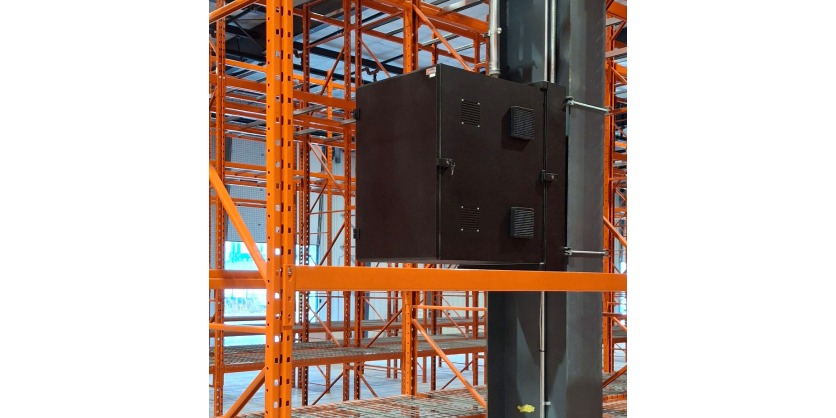
Example: Wall-Mounted Cabinet in a Warehouse
In this type of installation:
- A wall-mounted cabinet is attached to a structural column
- Filter kits are installed on vent openings
- Network equipment is enclosed and protected
Why this works:
- Space-efficient: Mounting to a column keeps equipment off the floor and out of the way.
- Dust protection: Filtered airflow reduces contamination inside the cabinet.
- Accessible: Technicians can easily access equipment for maintenance.
- Repeatable: This approach can be standardized across multiple locations.
When Should You Use a Filtered Cabinet?
Filtered cabinets are ideal when:
- the environment contains dust or debris
- airflow is still required
- full environmental sealing is not necessary
- a practical and cost-effective solution is needed
Common applications include:
- warehouses
- distribution centers
- retail backrooms
- light industrial environments
Do You Always Need a Fully Sealed Enclosure?
No. A common misconception is that dusty environments require fully sealed enclosures.
In reality: Many applications benefit more from filtered airflow than full sealing
Fully sealed enclosures:
- can trap heat
- may require active cooling
- add complexity and cost
Filtered solutions often provide the right balance.
How Do You Balance Protection and Airflow?
This is one of the most important considerations. The goal is to:
- reduce dust exposure
- maintain airflow
- avoid overheating
- keep the solution simple
Filtered cabinets are designed to meet all of these requirements in practical environments.
How Does Hammond Support These Applications?
Hammond provides enclosure solutions designed for real-world conditions, including:
- wall-mounted cabinets for flexible installation
- filter kits that reduce dust ingress
- designs that support airflow and accessibility
Rather than focusing only on ideal environments, the goal is to support how equipment is actually deployed.
Key Takeaway
If you are installing network equipment in a warehouse:
👉 You do not always need a sealed enclosure
👉 You do need protection from dust
👉 You must maintain airflow
In many cases, a filtered wall-mounted cabinet is the most practical and effective solution
Learn More About Practical Enclosure Solutions
If you are working in warehouse or industrial environments, it is important to choose solutions that match real-world conditions.
👉 Explore Hammond wall-mounted cabinets and filter options to see how they can support your application.
Frequently Asked Questions
- What is the best cabinet for a dusty environment? A filtered enclosure is typically the best option because it reduces dust while maintaining airflow.
- Can dust damage network equipment? Yes. Dust can block airflow, increase temperature, and lead to premature failure.
- Do I need a sealed cabinet in a warehouse? Not always. In many cases, filtered cabinets provide sufficient protection without the drawbacks of sealed enclosures.
- Where should cabinets be installed in a warehouse? Common options include mounting to walls or structural columns to save space and improve accessibility.
More Information
Learn more about Hammond Manufacturing’s HWC with HWCF for real-world environments.
Related Story
Hammond Manufacturing Expands Western Canada Presence with New Calgary Distribution Centre
Hammond Manufacturing, a leading North American manufacturer of electrical enclosures, is pleased to announce the opening of its new Western Canada Regional Distribution Centre in Calgary, Alberta.
This new 55,000 square-foot facility represents a significant investment in Hammond’s commitment to service excellence, product availability, and reliable lead times across Western Canada.