Posital’s Programmable Position Sensors: Cost-Efficient Versatility for Packaging Applications
September 24, 2021
Getting exactly the right position sensor for a specific packaging application can be challenging, but with POSITAL’s programmable rotary encoders, users have a cost-effective and convenient way of configuring sensors to deliver exactly what’s needed.
With programmable IXARC encoders, key performance characteristics such as resolution, communications interfaces and measurement ranges can be set up through firmware updates, with no need for mechanical changes. This helps users fine-tune their devices for optimal performance. It also benefits distributors and machine builders who can reduce parts inventories while still offering a wide range of performance characteristics. POSITAL’s UBIFAST programming tool provides an easy-to-use wireless interface for making software updates.
For POSITAL’s programmable incremental encoders, resolution (anywhere between one to 16384 pulses per revolution), direction and communications interface driver (HTL or TTL) can all be defined through software parameters. In the case of absolute encoders with analog interfaces, their outputs – current or voltage – can be ‘scaled’ so that a predetermined range of mechanical motion (anything from a fraction of a turn to several hundred rotations) can be set span the full electrical output range, significantly improving accuracy for simple analog control systems.
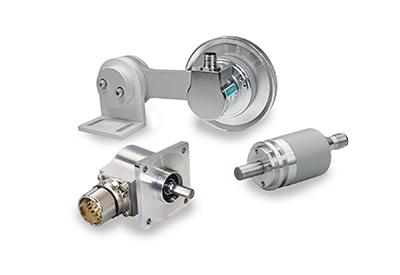
The versatility of POSITAL’s encoders is further enhanced by accessories such as measurement wheels and draw-wire mechanisms. These transform rotary encoders into accurate linear measurement tools. For conveyer belt systems, for example, wheel-equipped encoders can take measurements directly from the moving surface to provide precise speed and position feedback. For cut-to-length applications, wheel/encoder assemblies can measure position directly from the surface of materials such as fabric, paper, wire, or sheet metal. Accuracy in this operation will improve productivity and reduce scrap losses.
Like other POSITAL sensors, programmable encoders are available in a wide range of mechanical variants. Find the one that’s best for your application at www.posital.com.