Festo’s Bionic Flower – A Bionically Inspired Robot Teaching Aid
December 14, 2020
Festo is renowned for its bionic creatures – robotic fauna that fly, crawl, scamper or swim and point the way to possible commercial developments that mimic actions in nature. Now, Festo Didactic, the leader in basic and advanced training solutions for industry, has unveiled the Bionic Flower, a construction kit for today’s young STEM students inspired by the world of flora.
Festo Didactic developed Bionic Flower in cooperation with SkySpirit, basing it on models of mimosa plants and water lilies. The Bionic Flower opens and closes its petals as a reaction to external influences such as touch, proximity or light. These mechanisms can be discovered by pupils using sensors and control technology integrated in the Bionic Flower. The design, as well as the transfer of principles from the plant world, encompasses multiple curriculum topics in STEM (Science, Technology, Engineering, and Mathematics) education. The topic of biodiversity can also be discussed in class.
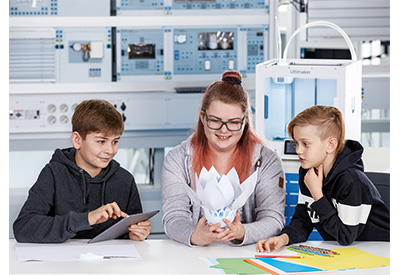
One Bionic Flower can be used by up to three students aged 10 and over. The petals contain the first bionic topic: the folding technique. The petals gain the necessary mechanical stiffness by folding. The mechanism for opening and closing the petals is electrically actuated with a stepper motor which opens and closes the petals one by one. The movement and the light effects are controlled via Wi-Fi-enabled smartphones, tablets or PCs. If required, the microcontroller can be programmed with the graphic coding interface “Open Roberta”. Experienced students can also program their Bionic Flower in C++. The code is open source. In addition to assembling the Bionic Flower, students can customize and expand on the Bionic Flower by using 3D printers, other materials, hardware and software.
Accompanying teaching material, as well as the assembly manual, can be downloaded free of charge.
With the Bionic Flower, students learn different aspects of STEM in a digital, creative and interdisciplinary way. Working with the device promotes the educational 4Cs –collaboration, communication, critical thinking and creativity – to prepare learners for the digital world of tomorrow.
For more information, visit www.festo.com.