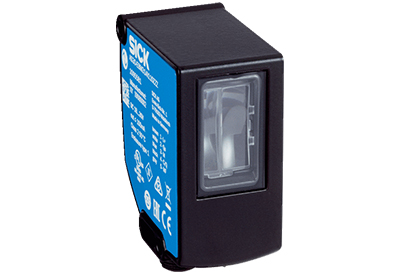
SICK: Array sensors AS30 – More flexibility and efficient communication
September 3, 2019

Your Benefits

  • Higher reliability and more stable processes thanks to teach-in of contrast edges
  • TFT display for flexible configuration options and easy commissioning
  • Various operating modes provide the right defaults for every application
  • High repeatability of up to 30 µm
  • No fine positioning of the sensor required thanks to the large field of view of up to 50 mm
  • IO-Link and the SOPAS ET software ensure easy configuration
  • Efficient communication and predictive maintenance through smart sensor functionality

More flexibility and efficient communication

The AS30 array sensor operates on the proximity scanning principle. It detects even the slightest differences in grayscale values within the field-of-view. Positioning of, for example, a paper web based on the web edge or a contrast line is only one of many possible applications. Widths, diameters, and gaps can also be detected. In reflector mode, the AS30 can even detect transparent materials.

At a glance

  • Teach-in of selected edges possible
  • Full color TFT display
  • Various operating modes for different applications
  • Core and Prime variant for different fields of application
  • Large measuring range of up to 50 mm
  • Sensing distance of 25 mm or 100 mm
  • Repeatability of up to 30 µm

Source

Related Articles


Editor’s Pick: Featured Article

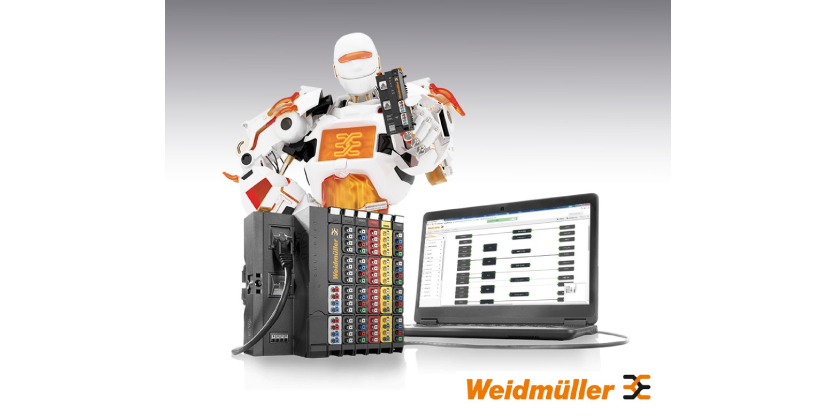
Weidmüller’s u-control 2000: The Automation Controller

Weidmüller’s u-control 2000: The Automation Controller

Weidmüller’s scalable engineering software, u-control 2000, adapts individually to your requirements. And, the u-control is powerful, compact and fully compatible with Weidmüller’s I/O system u-remote. This article looks at what makes u-control the heart of your automation.

Programmable logic controllers (PLCs) are one of the main components of any automated system. A typical control system has inputs, outputs, controllers (i.e., PLCs), and some type of human interaction with the system, a human machine interface (HMI), for example.

Read More


Latest Articles

  • Applications of Physical AI in Canadian Sectors

    June 23, 2026 Physical AI — the convergence of artificial intelligence with robotics and autonomous motion systems — is reshaping how Canadian industries operate. Across sectors from healthcare to mining, AI-enabled machines are performing tasks that were once entirely dependent on human intervention. But deploying Physical AI effectively requires more than sophisticated algorithms: it demands… Read More…

  • Case Study: Optimizing Harmonic Mitigation in Wastewater Treatment

    June 22, 2026 Segment and Application In a municipality, wastewater treatment plants typically stand out as the main consumers of electricity. The operational processes exhibit significant load variations throughout a 24-hour cycle, necessitating the use of AC drives to regulate pumps, blowers, and other motorized equipment in response to fluctuating demand. In one wastewater treatment… Read More…