| |

The New KRT 3C Contrast Sensor from Leuze. Put Into the Right Light
April 10, 2023

The New KRT 3C Contrast Sensor from Leuze. Put Into the Right Light
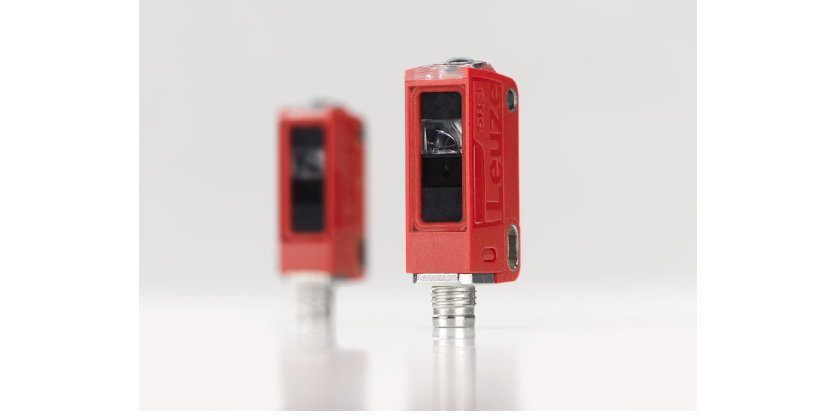
Because the emitted light color determines the reliability with which contrast markers are detected, the new KRT 3C contrast sensors from Leuze use three different light types. This allows customers to select the appropriate light source for each type of material and for each contrast marker color in packaging or labeling processe

Many light types and a compact housing: The new KRT 3C contrast sensor from Leuze can be flexibly integrated into packaging processes thanks to its multicolor capability and small size.

With the KRT 3C contrast sensor, Leuze is presenting the smallest contrast sensor it has ever made for the packaging industry. Plant operators benefit from a compact device that can be used in many different ways: The KRT 3C detects reliably and position-accurately even if there are only small contrast differences and with glossy surfaces or highly reflective materials. This is made possible by the multicolor functionality: red, green, and blue light as well as white and laser red light will not allow any object or printed label to pass through unnoticed. This allows users to select the right light source for any material and contrast mark color for their packaging and labeling processes.
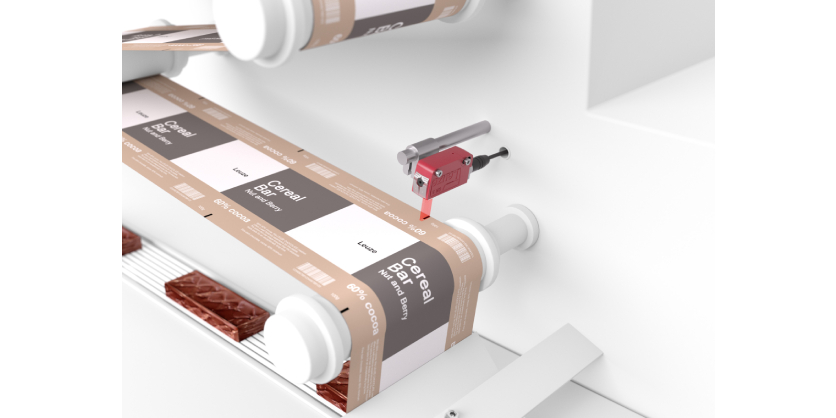
The new KRT 3C contrast sensor from Leuze
In the packaging industry, products are often packaged into tubular bags. Sensors detect the printed contrast markers and determine when the packaging film is cut. With the KRT 3C contrast sensors, this is always possible thanks to the multicolor functionality, even with materials with different color or gray value combinations

Tight space? No problem!

The KRT 3C detects contrasts very precisely and reliably and with a short response time of only 50 µs (laser: 125 µs) and minimal signal jitter. This helps to achieve optimal machine throughput. Advantage in small spaces: With its small dimensions of 11 x 32 x 17 mm, the sensor is designed for tight installation spaces. This means it can be fitted almost anywhere. Users can easily setup the KRT 3C via the integrated IO-Link interface. This also speeds up product format changeovers.
The New KRT 3C Contrast Sensor from Leuze. Put Into the Right Light
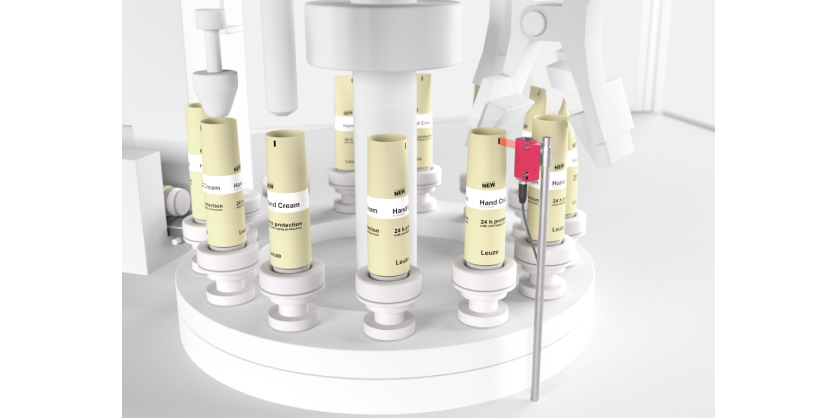
When things get tight, the compact size of the KRT 3C contrast sensor from Leuze is the right choice. The sensor reliably and highly precisely detects contrast markers of different colors even on round objects and different materials

Really resilient

The housing is robust: It meets degrees of protection IP67 and IP69K. The KRT 3C is also ECOLAB-certified. So it can even handle aggressive cleaning agents.

More Information

KRT 3C Contrast Sensor

Related Product

Leuze Sets New Standard for Compact Positioning System

The AMS 100i from Leuze is one of the smallest laser positioning systems available on the market. This makes it the perfect solution for tight installations spaces.
Related Articles


Editor’s Pick: Featured Article

Weidmüller’s u-control 2000: The Automation Controller

Weidmüller’s u-control 2000: The Automation Controller

Weidmüller’s scalable engineering software, u-control 2000, adapts individually to your requirements. And, the u-control is powerful, compact and fully compatible with Weidmüller’s I/O system u-remote. This article looks at what makes u-control the heart of your automation.

Programmable logic controllers (PLCs) are one of the main components of any automated system. A typical control system has inputs, outputs, controllers (i.e., PLCs), and some type of human interaction with the system, a human machine interface (HMI), for example.

Read More


Latest Articles

  • Applications of Physical AI in Canadian Sectors

    June 23, 2026 Physical AI — the convergence of artificial intelligence with robotics and autonomous motion systems — is reshaping how Canadian industries operate. Across sectors from healthcare to mining, AI-enabled machines are performing tasks that were once entirely dependent on human intervention. But deploying Physical AI effectively requires more than sophisticated algorithms: it demands… Read More…

  • Case Study: Optimizing Harmonic Mitigation in Wastewater Treatment

    June 22, 2026 Segment and Application In a municipality, wastewater treatment plants typically stand out as the main consumers of electricity. The operational processes exhibit significant load variations throughout a 24-hour cycle, necessitating the use of AC drives to regulate pumps, blowers, and other motorized equipment in response to fluctuating demand. In one wastewater treatment… Read More…