Linux®-Based Real-Time Control with TwinCAT from Beckhoff
July 4, 2024
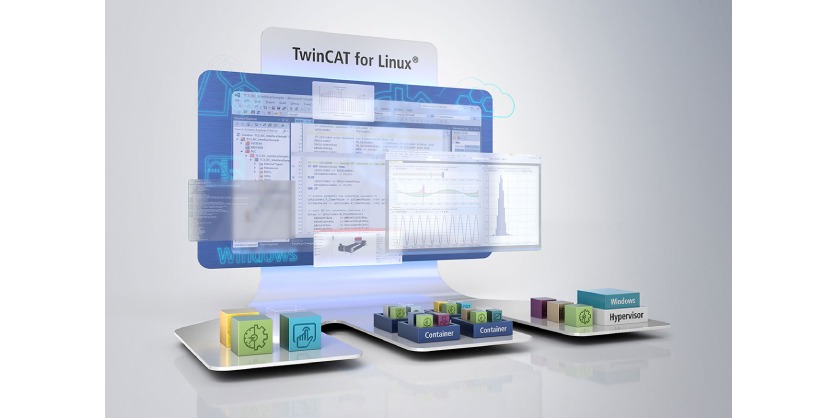
With the TwinCAT Runtime for Linux®, Beckhoff is opening up new application possibilities for real-time control. In the future, several TwinCAT Runtimes can be executed on a single industrial PC for the first time, enabling users to combine different system parts on one large computer, for example. With this hardware consolidation, computing resources are better utilized. Furthermore, accessing a GPU (graphics card) from the real-time environment will be possible, which is used as a hardware accelerator for particularly computing-intensive applications such as vision.
TwinCAT Runtime for Linux® is based on Beckhoff’s own Linux® distribution, which expands the choice of operating systems in addition to Windows and TwinCAT/BSD. The distribution was developed using the free Debian operating system and includes a Linux® real-time kernel as standard for real-time execution of the runtime. The Debian package system also makes it easy to install additional software. Initially, the new CX82x0 and CX9240 Arm®-based Embedded PCs will be offered with Linux® runtime. The Beckhoff Linux® distribution will then be successively rolled out for all other industrial and embedded PCs.
Features
- TwinCAT Runtime for stable real-time control based on Linux®
- modularization of machine and other control applications
- support for container technology such as Docker®, Podman, or LXC
- individual execution of several TwinCAT Runtimes on a single industrial PC
- hardware consolidation through improved utilization of computing capacity
- freer coupling of software and machine modules
- Multi-tasking capable operating system facilitates software modularization.
Advantages for real-time control
- new options in TwinCAT automation for Linux® users
- unchanged application programming with TwinCAT
- optimized execution of multiple real-time applications using one CPU
- increased user flexibility through modular control code
- easy to add or replace application modules
- targeted implementation of updates for individual applications
- reduced work and costs for engineering
The registered trademark Linux® is used pursuant to a sublicense from the Linux Foundation, the exclusive licensee of Linus Torvalds, owner of the mark on a worldwide basis.
Docker and the Docker logo are trademarks or registered trademarks of Docker, Inc. in the United States and/or other countries. Docker, Inc. and other parties may also have trademark rights in other terms used herein.
Product status: product announcement | estimated market release 2nd quarter 2024
Related Story
Beckhoff’s TwinCAT Automation Software
When Beckhoff launched its PC-based control technology, it created a global standard for automation. In terms of software, the core of the control system has taken the form of The Windows Control and Automation Technology – or TwinCAT – automation suite since 1996. In combination with TwinCAT, the Beckhoff portfolio results in optimally coordinated automation concepts that fulfill the basic principles of an open and highly scalable control system.