Festo Introduces Two-Finger Pneumatic Gripper for Cobot Applications
June 26, 2026
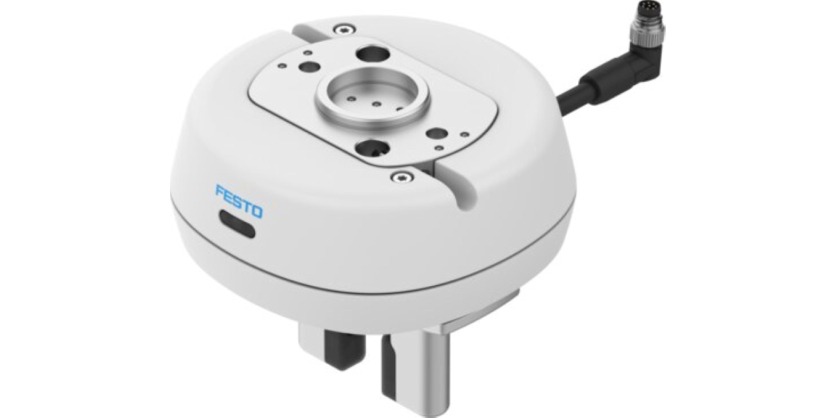
Festo’s integrated design reduces wiring and weight while supporting safe collaborative operation.
Collaborative robots operate within strict payload and mounting constraints. Pneumatic gripper installations that rely on external valves, sensors, and wiring add weight, increase footprint, and complicate routing along compact cobot arms.
To address these constraints, Festo introduces the HPPH two-finger pneumatic parallel gripper, a compact, lightweight design that integrates control, sensing, and collaborative safety functions directly into the gripper body. By reducing external components, the HPPH preserves payload capacity and simplifies mounting and wiring on collaborative robot platforms. The HPPH is available through Festo and the Universal Robotics Marketplace.
The HPPH gripper is designed for collaborative handling tasks in electronics manufacturing, medical and laboratory automation, packaging, automotive subassembly, and semiconductor back-end operations. Typical applications include machine loading and unloading, computer numerical control (CNC) part handling, part insertion and removal, sorting, and tray-to-tray transfer.
The HPPH integrates the pneumatic control valve, position sensors, and electrical interface directly into the gripper body, reducing the number of external components required for operation. This functional integration simplifies ordering, minimizes wiring complexity, and shortens installation and commissioning time. An IO-Link version is available for enhanced diagnostics and remote configuration. The HPPH joins more than 30,000 pneumatic, electric, and software products designed for interoperability across Festo’s automation portfolio.
The compact, lightweight design weighs 1.5 lb (.68 kg) and helps preserve robot payload capacity while reducing mechanical load on smaller collaborative robots. The maximum gripper opening is .63 in (16 mm). The HPPH is suitable for handling objects weighing up to 2.2 lb (1 kg).
The HPPH was developed in accordance with ISO/TS 15066 for collaborative robot safety and meets TÜV Süd-certification when used with HAFH-B30-16-45-N gripper fingers. The components features a force-limited gripping mode of 31.5 lbf (140 newtons), roughly the equivalent of a firm handshake, to help reduce the risk of injury during close-proximity operation. Smooth housing contours further support safer interaction with humans by minimizing sharp edges and pinch points. When higher gripping force is required, the force limit can be disabled to support non-collaborative applications with gripping forces up to approximately 40.5 lbf (180 newtons).
The HPPH is not suitable for machining or environments with aggressive media, grinding dust, or welding splatter.
For more information about the HPPH two-finger pneumatic parallel gripper and Festo’s broader automation ecosystem of pneumatic, electric, and digital motion solutions, visit https://www.festo.com. Festo also offers online engineering tools, pneumatic and electric automation components, and application support through its Customer Solutions teams to help OEMs and system integrators streamline specification, ordering, and commissioning.
More Information
For more information on Festo’s automation solutions and engineering tools, visit http://www.festo.com/
Related Story
Festo Addresses Automation Integration Challenges at Automate 2026
Automation projects are placing greater demands on OEMs and system integrators as machines incorporate more devices, networks, and flexible production requirements. Startup schedules continue to shrink while engineering teams are expected to reduce troubleshooting, simplify interoperability, and keep projects moving despite limited technical resources.
At Automate 2026, Festo showcases initiatives and technologies focused on solving these deployment and integration challenges. Exhibits include motion control, handling systems, connectivity, engineering tools, and workforce development technologies that improve startup visibility, reduce integration effort, and help manufacturers adapt more quickly to changing production requirements. Automate 2026, June 22–25, McCormick Place, Chicago. Festo Booth #831.
Beyond the booth #831, Festo personnel will participate in several educational sessions during Automate 2026 that focus on motion control selection, workforce development, robotic safety, and responsible AI in automation.