Camera, Lights, Action: New SWIR Cameras, Lights, and Controllers Make Cost-Effective Multispectral Imaging a Reality
December 1, 2020
Recently, Smart Vision Lights was pleased to introduce three separate lines of short wave infrared (SWIR) LED-based machine vision lights. These lights perfectly complement the recently introduced Sony IMX990 and IMX991 SenSWIR line of cost-effective imaging sensors as well as the quantum-dot SWIR Vision Systems CQD sensor line.
Sony’s IMX990 and IMX991 image sensors for industrial equipment are the first products to use the company’s new SenSWIR technology, in which photodiodes form on an indium gallium arsenide (InGaAs) compound semiconductor layer connected to the silicon (Si) readout layer via Cu-Cu bonding — a design that enables high sensitivity over a broad range of wavelengths. The SenSWIR design yields a SWIR image sensor that is compact yet capable of delivering seamless image capture over wavelengths ranging from 0.4 μm to 1.7 μm. With individual sensor pricing starting below US$1000, chips like the SenSWIR line and the recently introduced CQD sensor are poised to reshape the machine vision industry through a new era of cost-effective multispectral sortation and inspection systems.
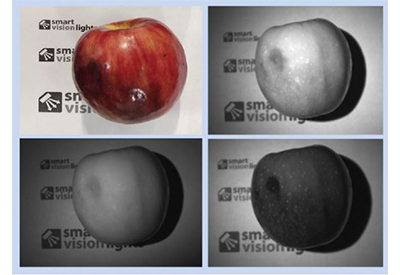
Sony’s release specifically mentions using different colored lights to capture both surface information and subsurface information using consecutive images under different illumination wavelengths. “When Sony says ‘switching light sources,’ they are referring to SWIR LED lighting where the emission spectrum is relatively narrow and allows easy selection as well as visible light for surface characteristics,” explains Steve Kinney, Director of Engineering at Smart Vision Lights. “The machine vision industry has waited a long time to realize the full potential of cost-effective, multi-wavelength and multi-spectral imaging systems,” explains Matt Pinter, founder and Chief Technical Officer (CTO) at Smart Vision Lights. “In recent years, SVL has introduced more SWIR wavelengths – ranging from 1050 to 1550 nm – than any other machine vision lighting company. We’ve also led the industry’s development of multi-zone lights that combine different wavelengths in a single housing, as well as multi-light controllers, such as the LLM with Smart Vision Link wireless Bluetooth control technology, to bring all the elements together. When combined with cameras made from the SenSWIR or CQD sensor lines, our SWIR products empower machine vision system designers to develop powerful multispectral machine vision solutions for about the same price as a traditional color imaging machine vision solution. That’s a game changer, and we’re excited to be part of it.”
Smart Vision Lights offers five different SWIR wavelengths — 1050 nm, 1200 nm, 1300 nm, 1450 nm, and 1550 nm — in three different form factors: linear, brick, and proximity spotlights.