Beckhoff Boosts Analog I/O Flexibility with New Multifunctional Terminal
June 12, 2024
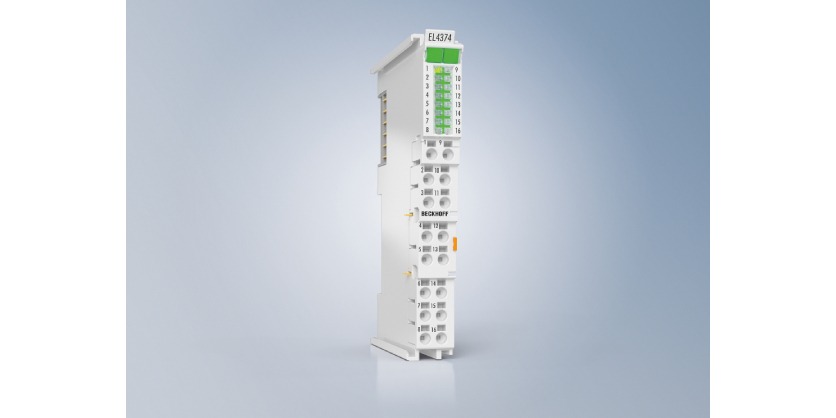
The EL4374 EtherCAT Terminal offers a powerful and parameterizable combined input/output for 10 V/20 mA signals
With the EL4374 EtherCAT Terminal, Beckhoff introduces a powerful analog I/O module to increase system flexibility and simplify parts management. The EL4374 is a multipurpose, combined input/output for -10/0 to +10 V or -20/0/+4 to +20 mA signals that can be used for standard automation tasks at a rate of 1 ksps per channel.
The ability to measure such a wide range of signals enables companies to use a single terminal in place of multiple specialized terminals, reducing cost and space requirements in I/O systems. As a result, engineers can easily adapt to evolving application requirements and stock fewer part numbers while improving readiness for unforeseen challenges and future application changes.
The EL4374 terminal combines two analog inputs and two analog outputs in a compact 12-millimeter housing. Engineers can individually parameterize these channels for current or voltage mode using Beckhoff’s TwinCAT 3 automation software. The analog inputs and outputs are digitized with a resolution of 16 bits and transmitted to the higher-level automation device under galvanic isolation.
With a signal measuring range of +107% of the nominal range, the EL4374 terminal also supports commissioning with sensor values in the limit range and evaluation in accordance with NAMUR NE43. The outputs can provide up to 107% of the nominal value. In addition, the high output power allows a load of up to 750 Ω at 20 mA.
More Information
Related Story
Beckhoff’s TwinCAT Automation Software
When Beckhoff launched its PC-based control technology, it created a global standard for automation. In terms of software, the core of the control system has taken the form of The Windows Control and Automation Technology – or TwinCAT – automation suite since 1996. In combination with TwinCAT, the Beckhoff portfolio results in optimally coordinated automation concepts that fulfill the basic principles of an open and highly scalable control system.