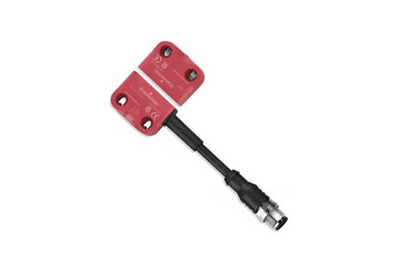
Altech New SRF Series Non-Contact Safety Sensors With Innovative Diagnostic System
March 28, 2022


The SRF (Safety RFID) is a non-contact safety sensor that monitors movable safety guards, such as doors, gates, panels, and hoods. This compact sensor protects operators from injuries by shutting down or preventing the start-up of machines when the safety guards are not properly closed.

Benefits

  • •Compact: Small and Flexible;
  • •Smart: Suitable for Industry 4.0 with Intelligent Diagnostic System;
  • •Cost-Saving: Four-Wire Unshielded Standard Connection Cable from Sensor to Sensor;
  • •Safe: Up to PL -e, Even in Series Connection with High Defeat Protection;


Features

  • •M12 Plug-In Installation;
  • •Up to 32 Switches in Series;
  • •Cat4/PLe/SIL CL3;
  • •PNP or Daisy Chain Diagnostics;
  • •IO-Link and NFC Communications;
  • •Low, High, or Unique Coding;
  • •All Protection Class IP69;

MC Altech New SRF Series Con Contact Safety Sensor 2 400


 To learn more about Altec’s new SRF Series Non-Contact Safety Sensors, download the datasheet here, or visit Allied Electronics & Automation here
 

Related Articles


Editor’s Pick: Featured Article

Weidmüller’s u-control 2000: The Automation Controller

Weidmüller’s u-control 2000: The Automation Controller

Weidmüller’s scalable engineering software, u-control 2000, adapts individually to your requirements. And, the u-control is powerful, compact and fully compatible with Weidmüller’s I/O system u-remote. This article looks at what makes u-control the heart of your automation.

Programmable logic controllers (PLCs) are one of the main components of any automated system. A typical control system has inputs, outputs, controllers (i.e., PLCs), and some type of human interaction with the system, a human machine interface (HMI), for example.

Read More


Latest Articles

  • Applications of Physical AI in Canadian Sectors

    June 23, 2026 Physical AI — the convergence of artificial intelligence with robotics and autonomous motion systems — is reshaping how Canadian industries operate. Across sectors from healthcare to mining, AI-enabled machines are performing tasks that were once entirely dependent on human intervention. But deploying Physical AI effectively requires more than sophisticated algorithms: it demands… Read More…

  • Case Study: Optimizing Harmonic Mitigation in Wastewater Treatment

    June 22, 2026 Segment and Application In a municipality, wastewater treatment plants typically stand out as the main consumers of electricity. The operational processes exhibit significant load variations throughout a 24-hour cycle, necessitating the use of AC drives to regulate pumps, blowers, and other motorized equipment in response to fluctuating demand. In one wastewater treatment… Read More…