A Cobot Gripper in the Fight Against Corona
December 24, 2020

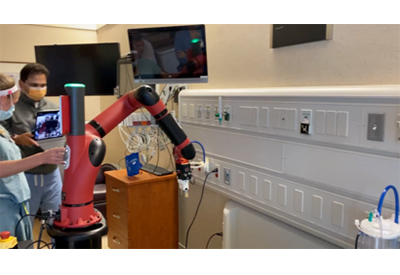
Social Distancing is probably one of the most frequently used terms at the moment. Distance should not only be kept when shopping, but of course especially in hospitals. Cobots can help with an appropriate gripping system. In an application of the company Cobot Team a simulation is shown how a collaborative robot of Rethink Robotics GmbH (Sawyer) equipped with an HRC gripper of the Zimmer Group can support the hospital staff in adjusting the oxygen level for a COVID-19 patient. The safety requirements for robot and gripper are strict. For example, all HRC grippers of the Zimmer Group are certified by BG / DGUV and are meeting the safety requirements in the human-robot collaboration (ISO / TS15066).

The team of nurses, doctors and employees succeeded in programming the robot to perform basic tasks in a very short time by itself – with live video conferencing support from the Cobot Team company and without prior technical experience in “robot programming”. The idea is that hospital staff can program a robot to perform basic tasks in a room with a “high risk of exposure” so that the nursing staff can be relieved.
Source

Related Articles


Editor’s Pick: Featured Article

Weidmüller’s u-control 2000: The Automation Controller

Weidmüller’s u-control 2000: The Automation Controller

Weidmüller’s scalable engineering software, u-control 2000, adapts individually to your requirements. And, the u-control is powerful, compact and fully compatible with Weidmüller’s I/O system u-remote. This article looks at what makes u-control the heart of your automation.

Programmable logic controllers (PLCs) are one of the main components of any automated system. A typical control system has inputs, outputs, controllers (i.e., PLCs), and some type of human interaction with the system, a human machine interface (HMI), for example.

Read More


Latest Articles

  • Applications of Physical AI in Canadian Sectors

    June 23, 2026 Physical AI — the convergence of artificial intelligence with robotics and autonomous motion systems — is reshaping how Canadian industries operate. Across sectors from healthcare to mining, AI-enabled machines are performing tasks that were once entirely dependent on human intervention. But deploying Physical AI effectively requires more than sophisticated algorithms: it demands… Read More…

  • Case Study: Optimizing Harmonic Mitigation in Wastewater Treatment

    June 22, 2026 Segment and Application In a municipality, wastewater treatment plants typically stand out as the main consumers of electricity. The operational processes exhibit significant load variations throughout a 24-hour cycle, necessitating the use of AC drives to regulate pumps, blowers, and other motorized equipment in response to fluctuating demand. In one wastewater treatment… Read More…