Geothermal Energy: The Huge Energy Potential Beneath Our Feet
August 18, 2025

Geothermal energy is not a new phenomenon. For millennia, humans have been using the naturally occurring heat beneath the Earth’s surface to cook food, take warm baths and more. The first commercial geothermal power plant was developed in Italy in 1913.
So why is it making headlines today?
Geothermal energy currently meets about 1% of global electricity demand. Conventional geothermal remains a location-specific, niche technology, with most installed capacity in countries that have either have volcanic activity or straddle tectonic fault lines, which make resources easier to access.
But thanks to new technologies, the outlook is evolving quickly. The IEA’s recent special report finds that geothermal energy could meet 15% of global electricity demand growth between now and 2050 with continued technological improvements and reductions in project costs. This would mean the deployment of as much as 800 gigawatts of geothermal capacity worldwide – delivering annual output equivalent to the current electricity demand of the United States and India combined.
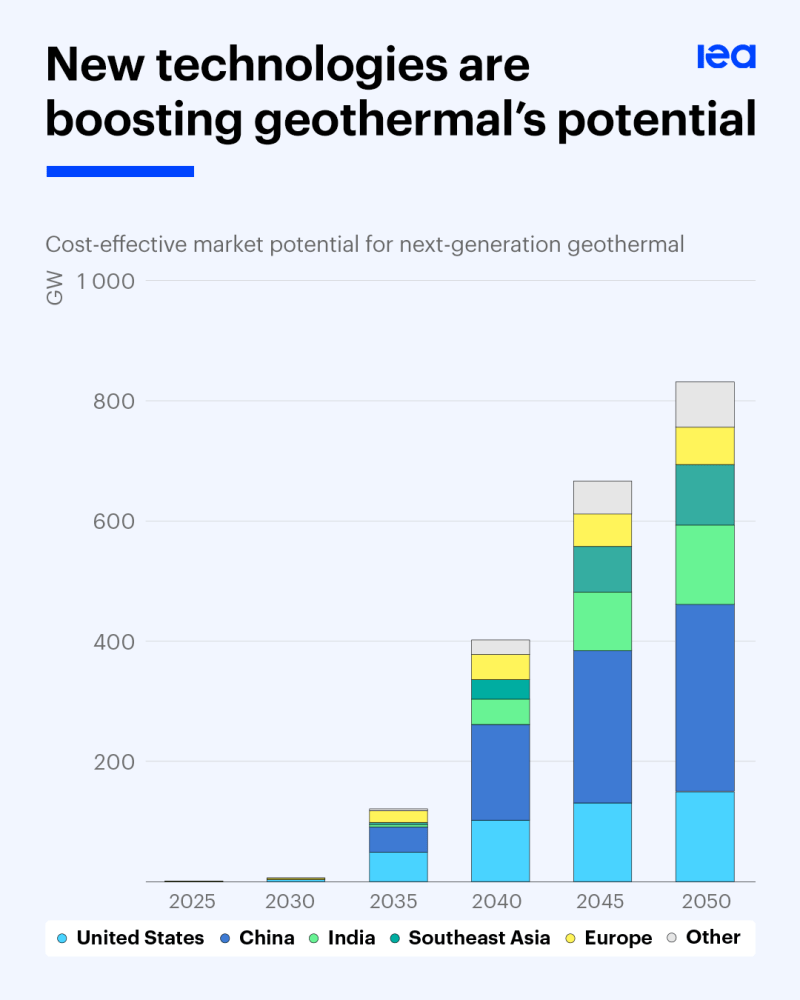
With global electricity demand set to grow strongly in the coming years, geothermal energy’s significant potential is generating interest from governments, energy and tech companies, and investors.
Geothermal energy offers abundant, stable, highly flexible and clean electricity supplies that can support variable renewable technologies, such as wind and solar, while complementing other low-emissions sources like nuclear. And new country-level analysis, conducted in collaboration with Project InnerSpace, shows that next-generation geothermal technologies could, in principle, meet global electricity and heat demand many times over.
In this context, total investment in geothermal could reach $1 trillion by 2035 and $2.5 trillion by 2050.
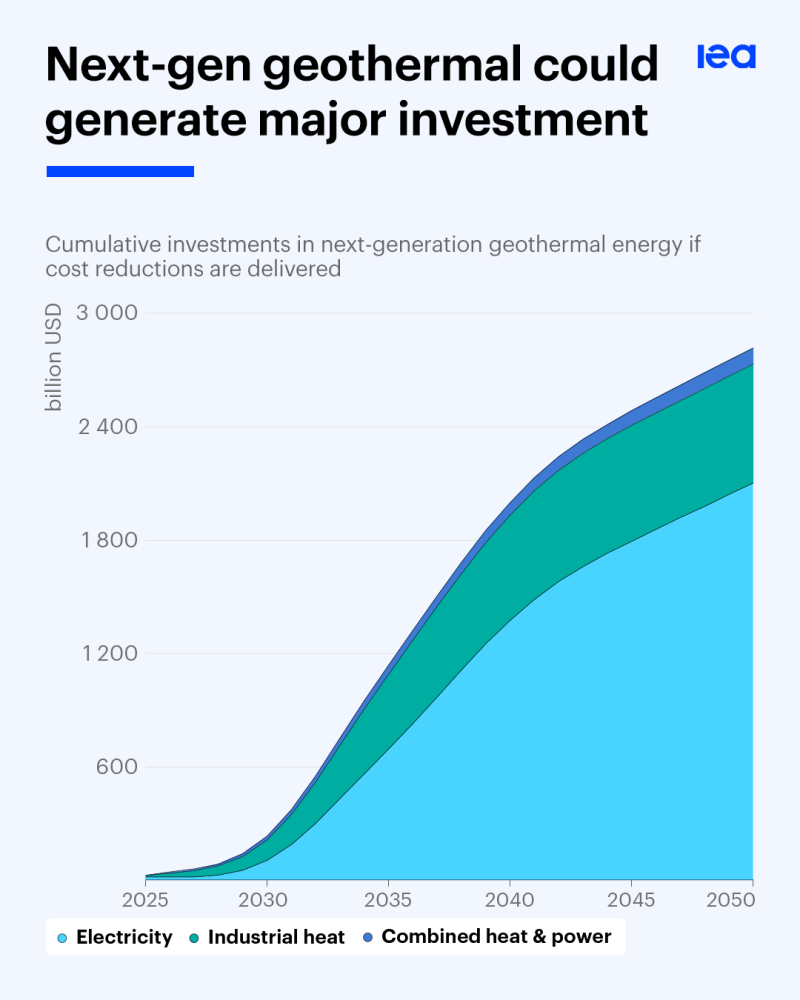
However, to make this a reality, several factors are needed. One is clear, long-term regulatory visibility, which would help mitigate risks for investors in early-stage development and provide visibility on returns. As a result, costs could fall by 80% over the next decade – making geothermal the cheapest source of dispatchable low-emissions electricity. At this price level, it would be on a par with existing hydropower and nuclear installations and highly competitive with solar PV and wind paired with battery storage.
Permitting and administrative red-tape are also proving to be a major barrier to geothermal projects, which can take up to a decade to fully commission. The IEA’s report suggests governments could simplify permitting processes by consolidating and accelerating the administrative steps involved.
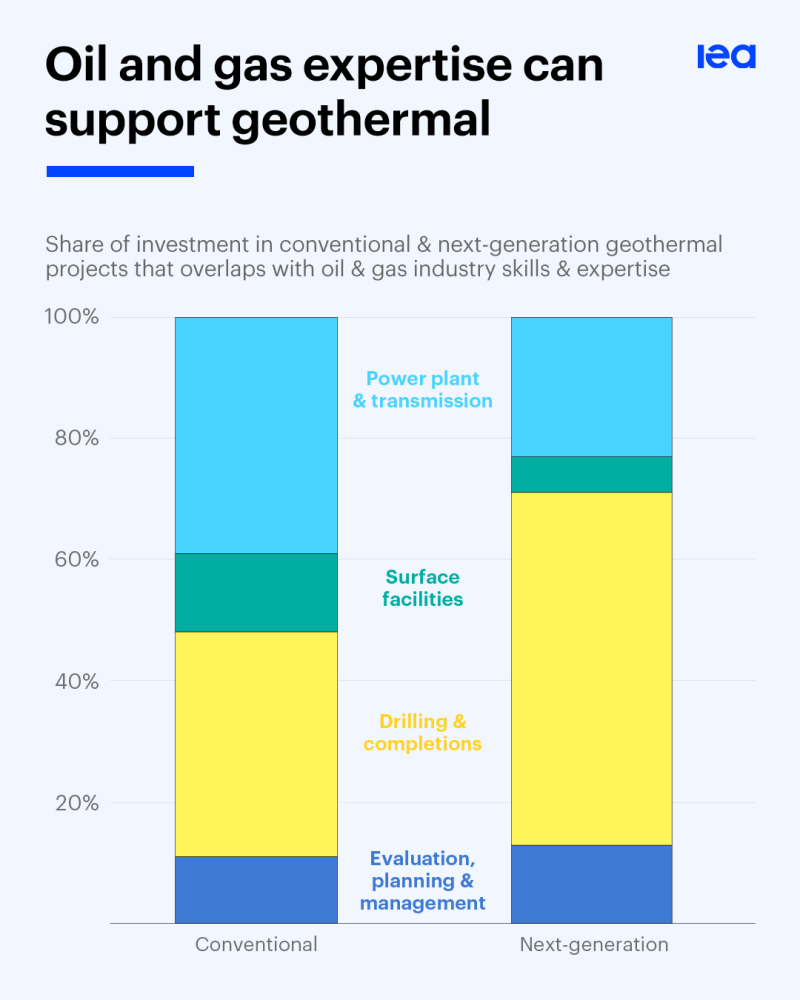
Additionally, the oil and gas industry can play a key role in making geothermal more competitive. Many next-generation geothermal technologies use techniques that were honed by the sector in North America, such as horizontal drilling and hydraulic fracturing. Up to 80% of the investment required in geothermal involves capacity and skills that are transferrable from existing oil and gas operations.
More Information
To learn more, read the IEA report, The Future of Geothermal Energy. They also dug into geothermal’s potential in a recent episode of their Everything Energy podcast. You can listen to it here.
Related Story
Energy Technology Perspectives 2023
The energy world is at the dawn of a new industrial age – the age of clean energy technology manufacturing – that is creating major new markets and millions of jobs but also raising new risks, prompting countries across the globe to devise industrial strategies to secure their place in the new global energy economy, according to a major new IEA report.