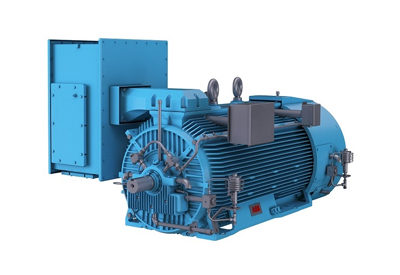
ABB’s new AXR Large AC motors offer power-dense design for hazardous locations
August 19, 2019

ABB’s AXR 5000 and 5800 motors offer more HP (horse power) per pound than conventional TEFC (totally enclosed fan cooled) motors but with a smaller frame size in some power ratings. This helps save space, up to 8 inches in overall length in some cases, which enables more compact installations on oil platforms and in refineries.

The new AXR motors also offer improved cooling, a critical factor to extend the life of the motor. An internal cooling loop circulates air inside the motor, moving heat to the frame. An external fan blows air over the frame to remove the heat.

“The new cooling configuration offers a more thermally equalized motor, eliminating hot spots that have been seen in TEFC motors,” says Charles Blankenship, Large AC Motor Product Manager, ABB. “Better cooling reduces the thermal stresses on the insulation system, which helps improve the motor’s longevity.”

As the main terminal box and auxiliary box can be mounted in several positions, installation and maintenance are easy. This also means fewer spares are needed, which saves money. The rigid frame increases stability so that the motor can meet the stringent API vibration limit specifications.

AXR motors also feature sleeve bearings that operate at cooler temperatures, last longer and are easy to maintain. These motors are available with up to an IP56 rating, for protection against contaminates and dust ingress.

Learn More

Related Articles


Editor’s Pick: Featured Article

Weidmüller’s u-control 2000: The Automation Controller

Weidmüller’s u-control 2000: The Automation Controller

Weidmüller’s scalable engineering software, u-control 2000, adapts individually to your requirements. And, the u-control is powerful, compact and fully compatible with Weidmüller’s I/O system u-remote. This article looks at what makes u-control the heart of your automation.

Programmable logic controllers (PLCs) are one of the main components of any automated system. A typical control system has inputs, outputs, controllers (i.e., PLCs), and some type of human interaction with the system, a human machine interface (HMI), for example.

Read More


Latest Articles

  • Teaching Machines to See: Why Sensor Fusion Demands a System-Level Approach

    March 16, 2026 By David Doria, Director of Engineering, Automated Driving, Magna Electronics, March 16, 2026 For years, progress in advanced driver assistance systems (ADAS) were driven by improving individual sensors. Higher resolution cameras. Longer-range radars. More precise lidars. Each step delivered incremental gains. But optimizing sensors in isolation only goes so far. As ADAS Read More…

  • Vention Raises the Bar for Automating Automation with New Funding and Solutions

    March 9, 2026 By Krystie Johnston Vention accelerates democratization of automation with new funding and GRIIPTM, sets sites on Enterprise clients, reaches more industries and geographies Vention is on a journey to democratize automation, and they are picking up speed. Already, in Q1 of 2026, they have made two announcements that will accelerate their trajectory Read More…