Ensure Food Safety With Clean Compressed Air
June 11, 2024
Current Good Manufacturing Practices (cGMP), which fall under the Food Safety Modernization Act (FSMA), stipulate the cleanability and cross-contamination standards that food processing plants must follow, ensuring food is safe for consumption. One easy way to meet cGMP and FSMA guidelines is to upgrade your pneumatic systems with proper air filtration systems.
When it comes to food safety, proper air filtration is the first line of defense. Already, ambient air contains lots of impurities. Add to that all the adulterating and allergenic particles found in food plants. Compressed air systems, which are often used in direct contact with food and in motion control systems, increase the density of these contaminants, making it vital that the compressed air be as clean as possible.
Ensure Compressed Air Doesn’t Contaminate Food
Because cGMP doesn’t define compressed air quality for food production, it is up to the end user. While many end users have their own air quality requirements, others may be uncertain of the recommended purity. That’s why organizations like Safe Quality Food (SQF) have published recommendations for air quality requirements, recommending a final filtration stage of 0.01 micron (µm) with a filtration efficiency of 99.999% at the point of food contact.
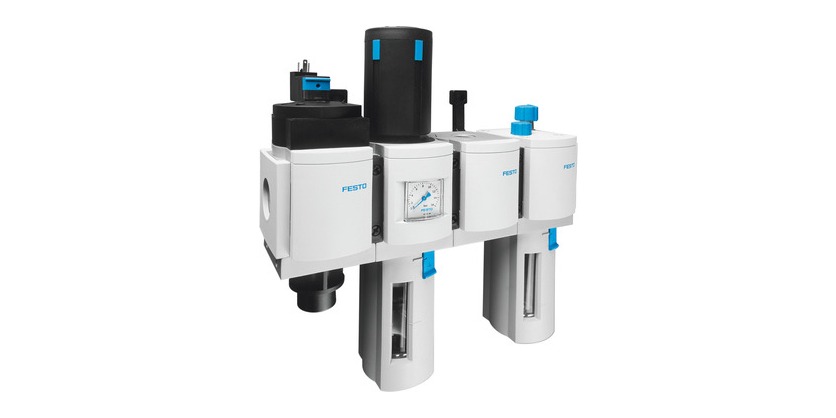
To ensure you comply with these guidelines for compressed air, we offer multiple air filtration units that are designed for direct contact with food. One example is the MSB6 compressed air preparation unit, which features a three-stage filtration system with a final 0.01 µm filter and 99.9999% filtration efficiency. Units include a lockable rotary knob, offering protection against tampering, as well as visual indicators for checking pressure ranges and filter status. We can provide the MSB6 as a complete preconfigured solution with a combination of filter regulator, filter, lubricator, ON/OFF valve, soft-start valve, branching module and many more options — depending on your application.
Evaluate Additional Sources of Contamination From Compressed Air
While compressed air intended for direct food contact necessitates proper filtration, there are several ways compressed air can come into contact with food indirectly. For example, leaking fittings and tubing will cause air to exhaust in unexpected areas. This means not only checking air nozzles and cylinders, but also finding and stopping leaks.
Ongoing leak detection can therefore lower the risk of indirect contamination and even reduce energy costs. The MSE6-E2M module, for example, is an automated component for detecting leaks in a machine. Once there is a baseline of air usage, the E2M alerts personnel when too much air is consumed. It also automatically lowers pressure when a machine is idle, lowering energy consumption. By monitoring compressed air usage, you can discover leaks as soon as they occur, avoiding potential contamination issues.
Another unintentional source of compressed air contamination is the exhaust from the valves that control pneumatic components. It’s important to distance the exhaust as much as possible from food and packaging and eliminate leaks that may blow contaminants into the atmosphere. The quick exhaust, located on a pneumatic actuator, will also vent compressed air — often near food zones. IP69K valve manifolds like the Festo MPA-C significantly reduce the tubing lengths, improving machine speed and eliminating the need for a quick exhaust.
More Information
To learn more about how to promote food safety with the right air preparation solutions, please visit www.festo.com/foodsafety.
Related Story
Festo Pre-Assembled Filtration Units Ensure Clean Compressed Air in Food Zones
Festo introduces the MS series of filtration products that lower the risk of particle contamination when compressed air comes into direct contact with food or packaging in the food zone. The MS series meets or exceeds the highest industry standards for clean air. Always in stock with guaranteed fast shipping, MS filters arrive assembled with safety and total productive maintenance features typically found as custom add-ons. The units install easily and are priced competitively.