Comparing maxon EC-i vs ECX Motors: Which One Fits Your Design?
August 19, 2025
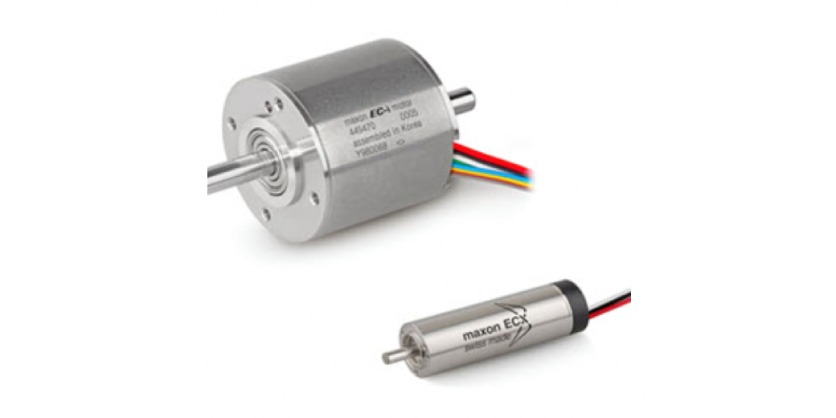
The choice between maxon’s EC-i and ECX motor series depends on whether the application prioritizes torque or speed, rugged durability or quick responsiveness, and high load-handling capability or low-inertia performance.
Both maxon product lines use brushless DC motor technology but are engineered with distinct rotor architectures and performance envelopes. This comparison outlines the mechanical, electrical, and application-level differences to guide system engineers toward the right fit.
Series Overview
maxon EC-i: Iron-Core, High-Torque Motors
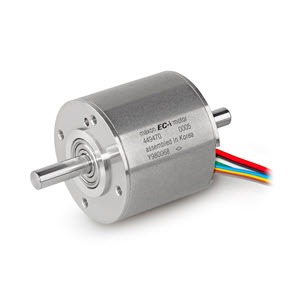
The EC-i series features an iron-core rotor design that yields high torque density in a compact footprint. These motors are designed for industrial and robotic applications where space is limited but torque and durability are critical.
maxon ECX: Ironless, High-Speed Motors
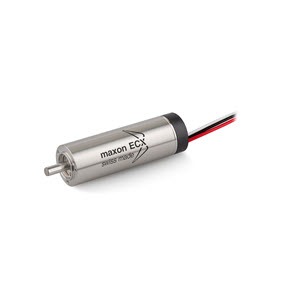
The ECX series is built around a coreless (ironless) winding architecture, resulting in low rotor inertia, no cogging torque, and extremely high rotational speeds. These motors are ideal for precision positioning, small-scale automation, and high-dynamic-response systems.
Technical Comparison: EC-i vs. ECX
| Rotor Type | Iron‑core (slotless or slotted) | Ironless, self‑supporting winding |
| Cogging Torque | Present (minimized via design) | None |
| Max Speed | ~10,000–15,000 rpm (varies by model) | Up to 120,000 rpm (depending on size and winding) |
| Torque Output | High continuous and peak torque | Lower torque; optimized for rapid changes in velocity |
| Inertia | Higher rotor inertia for load damping | Very low inertia for fast acceleration/deceleration |
| Motor Diameter Range | 30 mm to 52 mm | 4 mm to 40 mm |
| Motor Lengths | Short and robust | Compact and elongated options |
| Efficiency | High; optimized for torque output | Very high at light loads and high speeds |
| Noise and Vibration | Moderate mechanical vibration from core interaction | Extremely quiet due to ironless design |
| Thermal Management | Excellent; designed for continuous‑duty with high current | Good; requires attention in continuous high‑load applications |
| Customization Options | Wide range of windings, gearheads, encoders, and custom shafts | Available with special sterilizable versions and medical‑grade components |
Performance Considerations by Use Case
Use EC-i When:
- Load inertia is high and torque ripple is acceptable.
- System requires long-term reliability under heavy duty cycles.
- Application needs strong holding torque or operation against resistive loads.
- Target industries: Industrial automation, collaborative robots, AGVs, logistics actuators, power tools.
Use ECX When:
- Cog-free motion is required for positioning accuracy or sensitive feedback loops.
- Application demands miniaturization or ultralight design.
- System benefits from ultra-high acceleration or very fast start/stop cycles.
- Target industries: Medical devices, laboratory instruments, surgical tools, wearable tech, aerospace micro-mechanisms.
Integration with Drives and Encoders
Both motor families are fully compatible with maxon’s control ecosystem:
- EPOS controllers support digital communication (CANopen, EtherCAT) and precise multi-axis coordination.
- ESCON analog controllers offer compact, cost-effective servo performance.
- Encoder options up to 1024 CPT (magnetic or optical) are available for both series.
- Gearboxes: Planetary and spur gearheads are designed to match the shaft and torque profile of both EC-i and ECX variants.
Selection Summary
| If You Need… | Go With… |
|---|---|
| Compact high-torque motor for continuous duty | EC-i Series |
| Vibration-free operation at high RPM | ECX Series |
| Excellent thermal capacity for sealed environments | EC-i Series |
| Miniature design with fast dynamics | ECX Series |
| Simplified integration with robust gearing | EC-i Series |
| Smooth, precise low-torque control | ECX Series |
Related Story
Electromate Introduces maxon HEJ 70 High-Efficiency Joint for Mobile Robotics
Electromate Inc., Canada’s exclusive distributor of maxon precision mechatronic components, announces the release of the HEJ 70 High-Efficiency Joint actuator. This compact, fully integrated robotic joint actuator is engineered to meet the demanding performance needs of mobile and manipulation robots.