New All-Electric Niagara Falls Tour Ferries Powered by ABB Enter Service
October 6, 2020
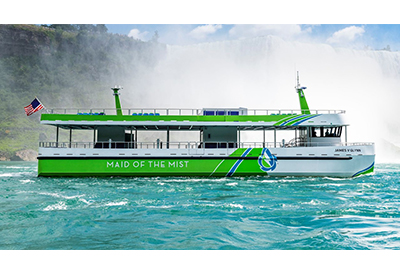
Tour boat passengers will be able to experience one of the wonders of the natural world undisturbed by exhaust fumes, engine noise or vibrations, after a pair of vessels installed with all-electric propulsion from ABB have been approved to enter service on October 6, 2020.
The zero-emission ferries – named the James V. Glynn and the Nikola Tesla, respectively in honor of the Maid of the Mist chairman and the renowned energy pioneer – are the first all-electric vessels built in the US, with power drawn from a high-capacity battery pack supplied and integrated by ABB. In addition to batteries, ABB has supplied a comprehensive integrated power and propulsion solution for the newbuild vessels, including an onshore charging system, enabling sustainable operation with maximum reliability.
“Maid of the Mist has always evolved with the technology, and we are thrilled to open a new page in our company’s history, moving our fleet to zero-emission operation,” said Christopher M. Glynn, President of Maid of the Mist Corp. “Close collaboration with ABB has been instrumental in making this project a success, and we are proud of what we were able to accomplish together.”
{videobox}NJIRY9hP75M{/videobox}
“As well as allowing passengers to enjoy the spectacular experience of Niagara Falls and safeguarding the environment, the vessels confirm growing acceptance of all-electric vessel propulsion,” said Juha Koskela, ABB Marine & Ports Division President. “We applaud Maid of the Mist’s decision to move to zero-emission operation and are honored to have worked with this forward-thinking company on implementing the electric power and propulsion solution.”
James V. Glynn and Nikola Tesla are each powered by a pair of battery packs providing 316 kWh total capacity divided across two catamaran hulls, offering a level of redundancy that helps to safeguard operations. The batteries allow the electric propulsion motors to reach an output of up to 400 kW, with the power setup controlled by ABB’s Power and Energy Management System. They are charged using locally produced hydroelectricity – ensuring that the energy cycle for the operation of the Maid of the Mist ferries is entirely emissions free – in a process that takes just seven minutes during disembarkation and boarding.
Having installed the ship-to-shore battery charging connection, ABB also supplied the Glynn and the Tesla with a comprehensive scope of electric, digital and connected solutions including switchboards, drives and the integrated control system, in addition to the ABB Ability™ Marine Remote Diagnostic System for monitoring and predictive maintenance.