Magna and Cartken to Collaborate on Autonomous Delivery Robots
September 19, 2022
- •Magna to scale Cartken’s autonomous delivery robots
- •Production at a Magna facility in Michigan
- •Additional models and different use-applications expected off same platform
Global mobility technology company, Magna, and San Francisco-based autonomous robotics company, Cartken, recently announced an agreement for Magna to manufacture Cartken’s autonomous delivery robot fleet to meet growing demand for last mile delivery.
Manufacturing of Cartken’s Model C has begun in a Magna facility in Michigan. Production capacity is expected to ramp up over the next few months and as the collaboration expands the two companies plan to include additional autonomous delivery models based on the same platform for different use-applications and robot-as-a-service business models. Based on Cartken’s forecast, thousands of autonomous delivery robots are expected to be produced during the term of the agreement.
“We seek strategic partners that can accelerate the trajectory of Cartken’s growth. This partnership is a significant step toward scaling our business and getting more Model C’s into the world,” said Christian Bersch, Co-founder and CEO of Cartken. “We’re honored that Magna, as a global leader with deep systems knowledge and manufacturing excellence, recognized the potential of our robots and the quality of our technology. We’re inspired by Magna’s push into new spaces and are excited to move forward together in our effort to scale distribution.”
“We continue to identify opportunities in the new mobility ecosystem where we use our capabilities to unlock new growth areas and new business models. This collaboration with Cartken is a great example of that approach,” said Matteo Del Sorbo, Executive Vice President, Magna International and Global Lead for Magna New Mobility. “Our ability to design, engineer and manufacture complete vehicles makes Magna an ideal partner for companies looking to solve last mile delivery challenges with sustainable, autonomous and cost-effective solutions.”
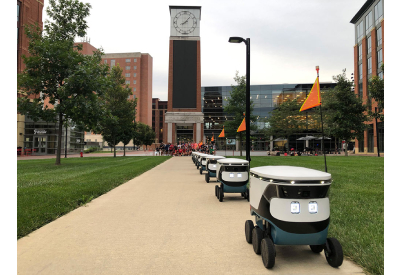
Cartken’s fully autonomous delivery robots can operate outdoors and indoors and are equipped with a remote monitoring and teleoperation system that allows for instantaneous human override if necessary, helping to ensure service levels are high. The Cartken autonomous delivery robots are fitted with multiple cameras and respond to situations in real-time using a combination of machine learning and simultaneous localization and mapping (SLAM)-based navigation algorithms. Currently, Cartken’s autonomous delivery robot fleet is in commercial operation and has been deployed for various autonomous delivery use cases in malls, hotels, universities, retail, back-of-house, and warehouses around the globe.