General Fusion Partners with Canadian Nuclear Laboratories to Advance Commercial Power Plant Design
April 5, 2024
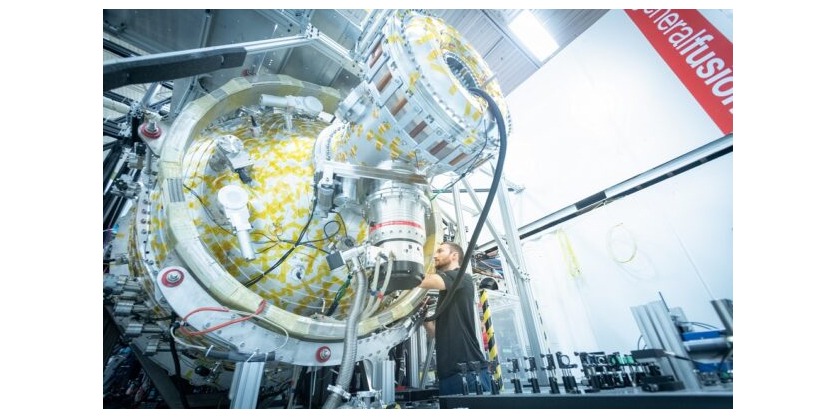
General Fusion has launched a new project in collaboration with Canadian Nuclear Laboratories (CNL), Canada’s premier nuclear science and technology organization, to advance the design of its commercial fusion power plant. Delivered through CNL’s Canadian Nuclear Research Initiative (CNRI) program, the project will examine and propose the most efficient and cost-effective designs to integrate the fusion machine, balance of plant, and power conversion systems in a power plant using General Fusion’s practical Magnetized Target Fusion (MTF) technology.
General Fusion is currently working to build a first-of-a-kind commercial pilot plant to provide electricity from clean fusion energy to the grid by the early to mid-2030s. CNL has previously supported this project through its CNRI program, providing General Fusion with recommendations related to tritium breeding technologies and tritium management facilities, which could be coupled with the company’s commercial power plant.
Now, General Fusion will leverage CNL’s expertise, capabilities, and advanced facilities in power plant design, licensing, and operations. Specifically, CNL will support the design work underway to select a tritium extraction method for an MTF commercial power plant and interconnecting technologies for all three systems. The highly detailed work will also evaluate and select specific materials and components, such as heat exchangers and power conversion technologies.
As a result, General Fusion will refine its design for a practical and economical power plant that is cost competitive. In a commercial power plant, General Fusion’s proprietary liquid metal liner in the fusion machine will be mechanically compressed by an array of pistons. This unique approach addresses the material degradation, fuel production, energy capture, and cost barriers other fusion technologies still face.
“Canada has a strong fusion ecosystem, with General Fusion leading the private sector and Canadian Nuclear Laboratories providing world-class fusion R&D,” said Greg Twinney, CEO, General Fusion. “Our LM26 fusion demonstration machine is progressing rapidly towards game-changing technical milestones in the next two years. At the same time, we’re preparing to deploy clean fusion power to the grid with our practical approach, including advancing our commercial power plant design with top experts and renowned partners like CNL.”
The CNRI program was established by CNL to accelerate the development and deployment of next-generation reactors and fusion technologies and has facilitated major research projects with partners all around the world since it was launched in 2019.
“As Canada’s national nuclear laboratory, it is within our mandate to help advance a promising pipeline of fusion technologies,” says Dr. Stephen Bushby, Vice-President, Science and Technology, CNL. “We’re thrilled to continue collaborating with General Fusion and look forward to leveraging our expertise in reactor design and tritium R&D to enable progress in this exciting area of clean energy.”
Today, at its Canadian labs, General Fusion is building Lawson Machine 26 (LM26). Designed to reach fusion conditions of over 100 million degrees Celsius by 2025 and progress towards scientific breakeven equivalent by 2026, LM26 will fast-track General Fusion’s technical progress to provide commercial fusion energy to the grid in the next decade.
About General Fusion
General Fusion is pursuing a fast and practical approach to commercial fusion energy and is headquartered in Richmond, B.C., Canada. The company was established in 2002 and is funded by a global syndicate of leading energy venture capital firms, industry leaders, and technology pioneers. Learn more at www.generalfusion.com.
About CNL
As Canada’s premier nuclear science and technology organization, CNL is a world leader in the development of innovative nuclear science and technology products and services. Guided by an ambitious corporate strategy known as Vision 2030, CNL fulfils three strategic priorities of national importance – restoring and protecting the environment, advancing clean energy technologies, and contributing to the health of Canadians.
By leveraging the assets owned by Atomic Energy of Canada Limited (AECL), CNL also serves as the nexus between government, the nuclear industry, the broader private sector and the academic community. CNL works in collaboration with these sectors to advance innovative Canadian products and services towards real-world use, including carbon-free energy, cancer treatments and other therapies, non-proliferation technologies and waste management solutions.
Related Story
United Kingdom Atomic Energy Authority and Canadian Nuclear Laboratories Partner to Accelerate Fusion Energy Development
The United Kingdom Atomic Energy Authority (UKAEA) and Canadian Nuclear Laboratories (CNL), have signed a collaboration framework agreement to partner on the development of technologies in relation to the management of tritium, a fusion energy fuel.