How Festo is Building the Next-Gen Workforce Through Technical Education & Skills Competitions
July 31, 2026
By Krystie Johnston
Festo is a leader in industrial automation and technical education. For decades, they have sponsored SkillsUSA and WorldSkills mechatronics competitions to align education and industry, supporting the workforce of the future.
Festo Didactic (the teaching arm of the Festo Group) has been an active participant and sponsor of SkillsUSA and WorldSkills since 1991. Ten years later, they were asked to design the objectives and provide state-of-the-art equipment for the Mechatronics Competition, making them the first global company to set the stage for students to compete in this multidisciplinary category. And they continue to innovate, pushing education and training forward to ensure success in today’s fourth (some might argue fifth) industrial revolution.
Alyssa Evans is a Technical Support Engineer at Festo and serves as SkillsUSA Mechatronics Technical Chair. She earned a bachelor’s degree in mechanical engineering from the New Jersey Institute of Technology as well as a master’s degree in Engineering management while working for Festo. Here, she shares her experience with Festo, the SkillsUSA Competition, and how this all ties into training the workforce of the future.
A road less travelled makes all the difference
For Evans, engineering always seemed like a natural pathway. Her technical aptitude was fostered at a young age by her family who were often engaged in some kind of hands-on activity. At school, the majority of her time was spent on theoretical learning and was mostly hands-off. Fortunately, she held on to her interests and was able to pursue them more fully in post-secondary education and apply them in her career.
“I got into engineering because I have always had a technical background,” she reflects. “Growing up, my parents hosted a Christmas light show at our house where we would build custom displays and program them to all work together. I always had that technical background and my dad always worked on cars. Engineering seemed like a natural pathway. And it led me to Festo because they were looking for interns many, many years ago.”
Technical standards equal the playing field
Becoming Technical Chair for the SkillsUSA Mechatronics Competition was an opportunity for Evans to take her passion for technology to a new level. As she explains what she does at the competition, a pile of equipment sits idle behind her, waiting for her to get back to work. “What this [being Technical Chair] means is, I work on facilitating all of our partnerships. I help coordinate the event. I figure out who is coming in to work it, and what equipment we are bringing in. I also work with a team of partners on the planning of the actual tasks and writing the technical standards for each year,” she says.
“Technical standards are essentially the framework from which teachers will train their students to participate in the SkillsUSA competitions and compete on the equipment. We have been revamping these technical standards over the last five years to align better with the Department of Labor standards for what is considered a mechatronics engineer or technician, to ensure that as students are leaving school, they are actually understanding the job responsibilities before they even get into the role.”
The geology of mountains and gaps in industrial automation
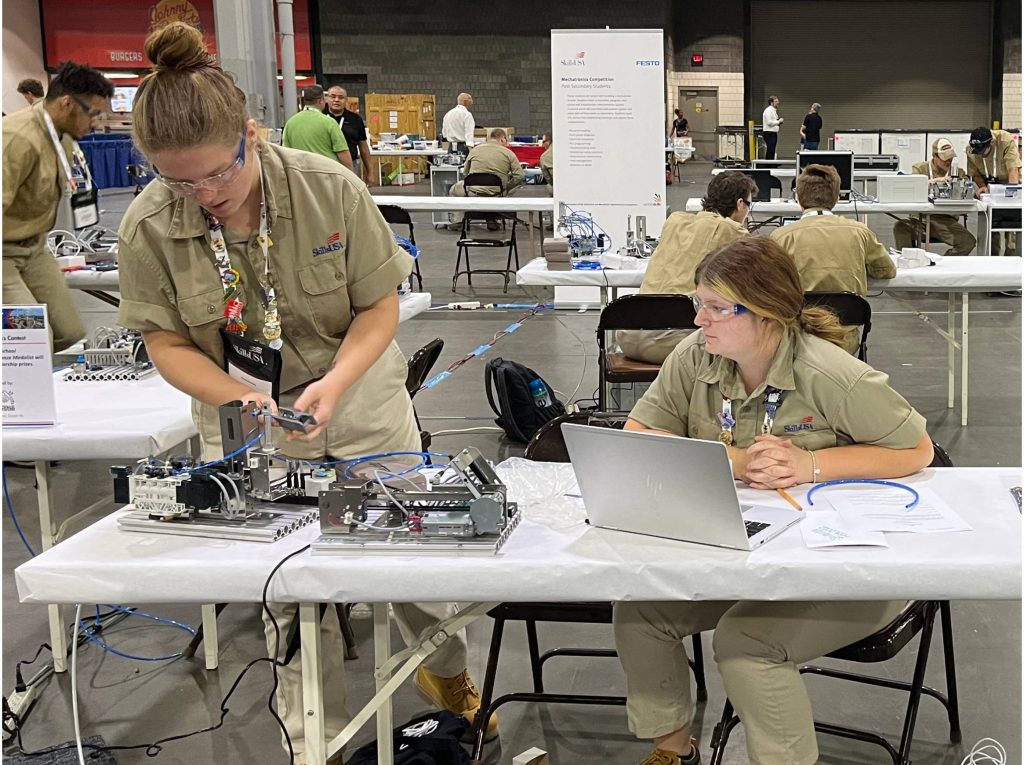
Given today’s pressures of a shortage of skilled labour and a resurgence of reshoring and manufacturing amidst an uncertain geopolitical backdrop, the importance of developing a local pool of talent cannot be understated. Especially since the tectonics of industry are always shifting. Evans is at the crest of a new wave of technical training that will bridge the gap between education (developing the skills needed) and industry (the work of the future). She has seen firsthand the disconnect between the education system and the workforce and is actively engaged in rewiring these connections.
Evans says the technical standards are key to turning the system on to be more efficient. Training needs to be aligned with the needs of industry, and this process needs to be standardized at a national – even international – level. “We have this skills gap right now between the workforce and how many people are actually getting accurately trained. There was a huge disconnect between how the technical standards used to be written and what the current workforce needs were. So, we have been working to improve these so teachers have a better idea of what they need to do to prepare their students to work.”
Practice and theory – a continuous loop
Evans is seeing a shift happen. “From my perspective, when I went to school, it was kind of like your standard courses, like mathematics and English. Nowadays, [teachers] get students into all kinds of cool topics, like robotics. I did not get to touch a robot in school. I do not know of anybody at my age that actually got to touch physical equipment. And now, my brother is going through his education, and he gets to do robotics and all these practical tasks. It is nice to see how they have moved into a different pathway where you actually get to work on physical equipment, you get to work on practical skills, not just theoretical.”
It is the effort of many hands, but Evans says this shift is due in part to the work that she and Festo are doing at SkillsUSA and similar programs to develop, adapt, and certify the technical skills needed for the workforce of the future. “It forces instructors to have their students actually work on equipment – especially now with the fact that they are having us align all our competitions with the DOL standards. I think it is great to see that students come into the SkillsUSA competitions, and they know what they are doing. They know how to use a screwdriver. They know how to use a measuring tape.”
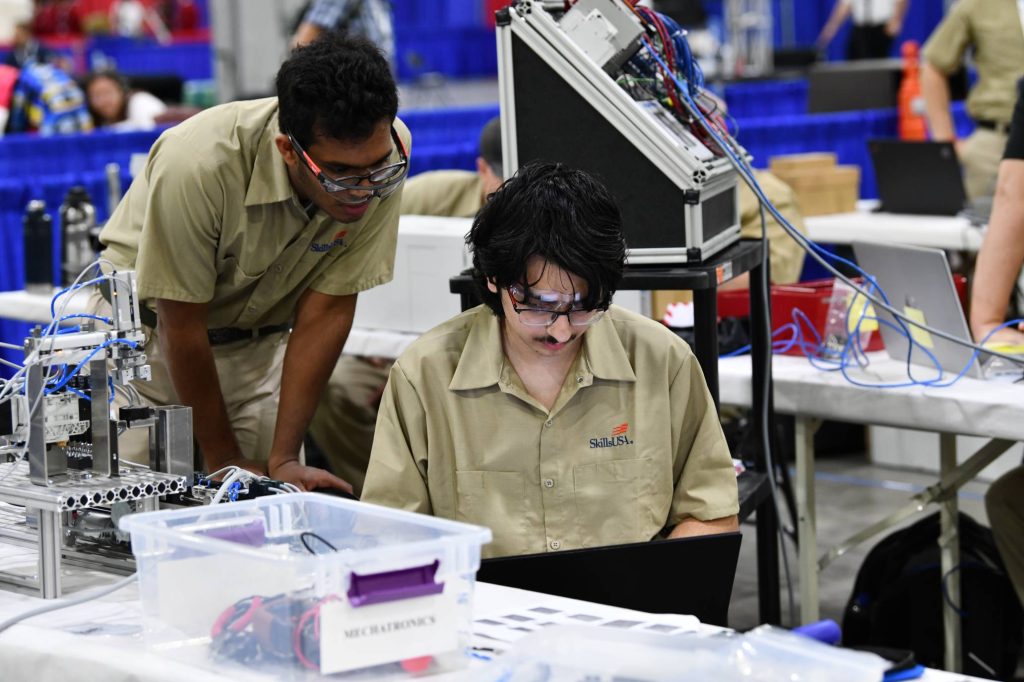
Evans says the collaboration between industry partners, educational institutions, and government is compounding and creating new matter. “When I started [doing these competitions] students did not know how to use a measuring tape or a multimeter. Now they know. They know how to program a PLC at 16 years old, which was definitely not the case 10 years ago. It has definitely become substantially more advanced, and the NC3 FICP certifications build on that, because now the instructors feel more confident since they are certified, they are able to teach the students more effectively.”
Return on investment
Over the years, Evans has seen the mass of these combined efforts forming new, tangible opportunities. Teachers are becoming more effective, students are gaining practical skills, and industry can plan for growth. Her story may be trailblazing, but her experience interning while completing her master’s is a path being travelled more and more by youth today. It used to be common to earn a four-year degree first, then start working. But increasingly, companies are engaging in workforce apprenticeships where they hire people out of high school, and they work while still learning.
“I am noticing a lot of other industry partners are doing kind of a similar thing where they will have high schoolers come in and apprentice while going to community college in conjunction to get an associate degree, but already be working, so that they have the workforce being built up,” Evans says. She has also seen students offered a job during SkillsUSA competitions because their participation demonstrates they have some employable skills. And Mechatronics is like the building blocks of many different industries because it covers mechanics, electronics, and computer systems – technical skills required to work on base equipment that can be specialized for many other applications.
Festo’s training capabilities extend far beyond Mechatronics competitions. Their MPS and Cyber-Physical lab systems were developed to demonstrate skill in a competition setting, but there is so much more beyond these platforms. They can be used in classrooms, for one. They can also be used in industrial settings to upskill the current workforce, for another. And they can be tailored to specific industries including semiconductor, biopharma, and even data centers. Moreover, they are supported by Festo LX, a learning platform that contains essentially all of Festo’s courseware and Learning Pathways online – anywhere from mechatronics to fluid power to semiconductor solutions to industry 4.0 and AI.
Conclusion
Festo has been a leader in industrial automation and technical education for decades. They have been writing the standards in industrial automation technology and technical education since they were established in 1925. Their engagement in SkillsUSA is just one example of this legacy.
Interested in learning more? Visit Festo today.
Related Story
Festo Didactic Leads with Semiconductor Workforce Training Solutions at 2026 SkillsUSA Championships
Festo Didactic returned to the annual SkillsUSA National Leadership & Skills Conference (NLSC) in Atlanta, Georgia, from June 1 – 5, 2026. This year, Festo placed a heavy emphasis on semiconductor workforce training to address critical national priorities and the growing skills gap in the electronics industry.