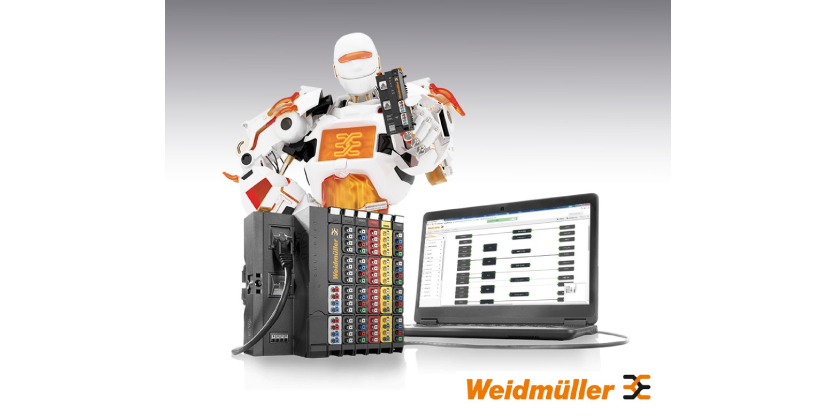
Utilize Space by Eliminating the Control Cabinet
March 31, 2026
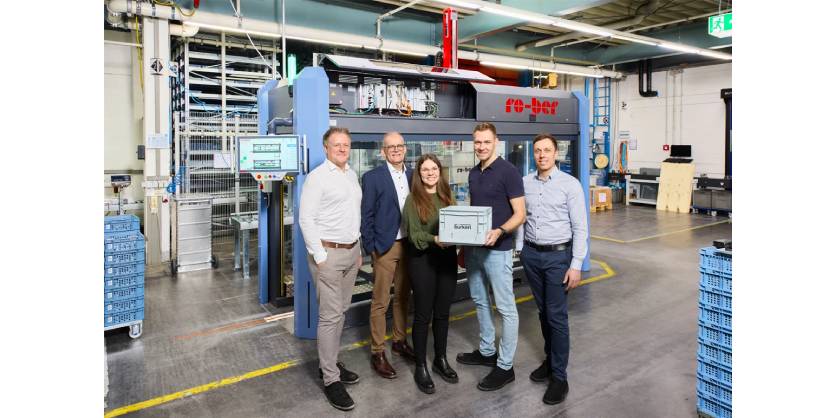
Depalletizing cell with MX-System solves age-old floor space problems in intralogistics
Bürkert Fluid Control Systems faced a classic production logistics challenge at its Criesbach Campus in Germany: manually feeding heavy containers into the automated small parts warehouse was slowing down processes and putting strain on personnel. However, there simply wasn’t enough floor space for conventional automation solutions. That’s when Bürkert commissioned gantry robot and material handling equipment manufacturer RO-BER to deliver an exceptionally compact depalletizing cell that receives pallets from AGVs (Automated Guided Vehicles). Despite this solution, the end user still needed more space savings to satisfy its high demands: the MX-System from Beckhoff, which allows the system to operate entirely without a control cabinet, provided the solution to the limited space constraints.
Floor space is one of the most valuable resources in intralogistics – usually, every single square centimeter counts, and this was certainly true for Bürkert. The supplier of measuring, control, and regulation systems for liquids and gases is on a steady growth trajectory, which means it has to achieve constant improvements in its internal material handling and logistics. Bürkert does not sell standard products but instead focuses on valve designs and materials precisely tailored to each customer. As a result, the company’s product range comprises 140,000 sellable items.
Frank Landgraf – who is responsible for all logistics processes at Bürkert – described the starting point: “Getting to grips with this kind of diversity in production and intralogistics is a real challenge. While automation used to focus on assembly, today the greatest potential lies in intralogistics.” He also believes that it is important to consider ergonomics; “Manually handling heavy crates of 20 kg or more isn’t the way we do things now – and given the labor shortage we’re experiencing, it isn’t a method we can support anymore.”
The process of feeding material into an automated small parts warehouse with around 27,000 bays was creating a bottleneck at the Criesbach site. The company was looking for an automated solution, but the on-site conditions left little room to maneuver. The system had to fit into an existing niche that would have been too small for conventional robot cells and bulky control cabinets.
Less work, less space
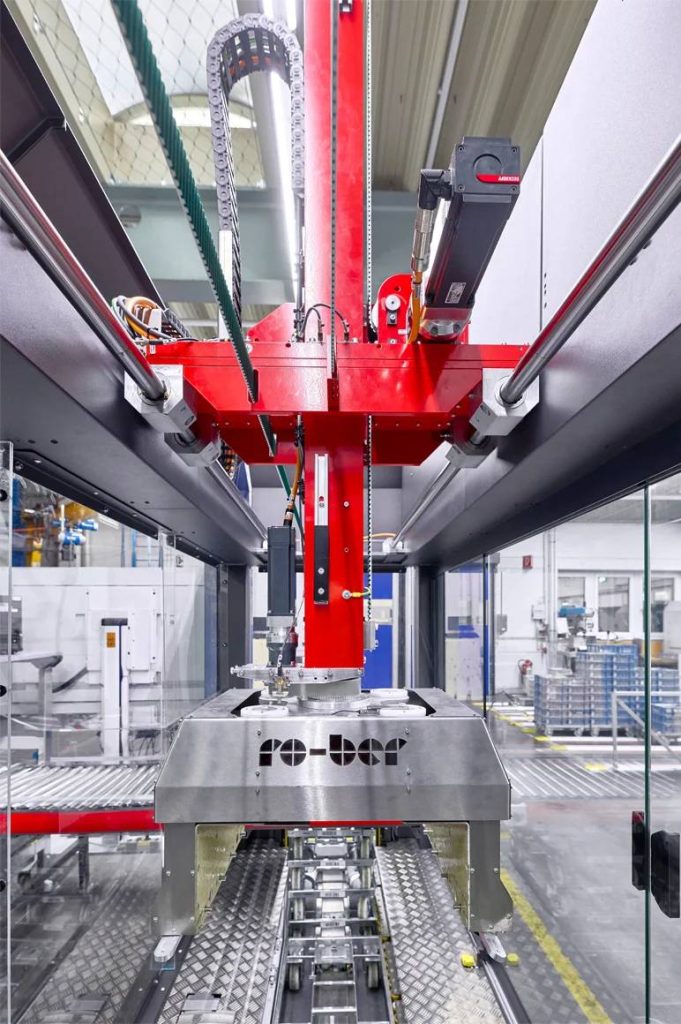
With this goal in mind, Bürkert approached RO-BER Industrieroboter, based in the German town of Kamen. As RO-BER specializes in sophisticated gantry robot systems, their team worked with the specific requirements for the Criesbach site to develop a tailor-made cell for depalletizing Euro containers from floor rollers. A linear robot with a multi-functional gripper removes the containers and places them, perfectly aligned, on the conveyor system in the automated small parts warehouse. While RO-BER was able to fall back on its proven range of solutions for the mechanics and robotics, it pursued new paths for the automation aspect. To ensure the requisite compactness, RO-BER opted for the MX-System from Beckhoff.
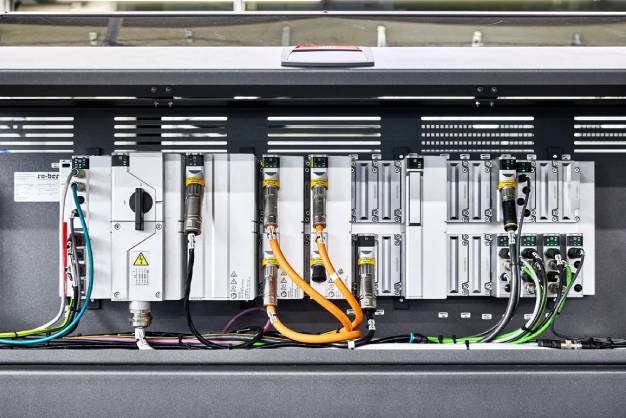
“As a pluggable, modular solution for control cabinet-free automation, it quickly caught our attention,” explains Elmar Stöve, Managing Director of RO-BER. The MX-System is a modular automation system that contains all control cabinet functions – from control and drive technology to I/Os, power supply, and fusing. The robust, IP67-protected function modules make it possible to completely eliminate conventional control cabinets in many applications. All the required modules are plugged onto a machine mounted baseplate.
For RO-BER, this meant that there was no need to plan any separate space for installing a control cabinet. Instead, the automation was integrated directly into the machine superstructure, which significantly reduced the amount of space and cabling work required while simplifying the design of the entire cell.
Faster assembly and commissioning
“The benefits of the MX-System span the entire life cycle of the equipment, from design and planning to maintenance,” explains Antonia Kuhn, who works in sales at Beckhoff. “During assembly, the baseplate’s standardized interface concept eliminates the need for manual wiring and complex cable routes. Function modules are simply plugged in and screwed in place, which automatically establishes the electrical connection. All field devices are connected to the MX-System modules with pluggable, connectorized cables, further eliminating any potential wiring errors.” This resulted in an enormous gain in efficiency for the machine builder.
“A complete MX-System could be installed on the machine in just a few minutes, with an industrial PC, servo drives, main switch, infeed, 48 V power supply, and I/O modules,” confirms Elmar Stöve. “That’s a huge difference compared to the time required for installing traditional control cabinets – which can be hours or even days.” One Cable Automation (OCA) reduces the amount of wiring work required for the motors, as power, data, and feedback are routed in a single cable. This also reduces the potential for errors. In addition, every component from the MX-System portfolio can be diagnosed – a major advantage from a maintenance perspective.
Seamless integration and networking
“For us, automatic depalletizing wasn’t just about the functions that a new machine would bring – it also had to allow seamless integration into higher-level structures and connection to our automated guided vehicles,” states Marius Mazugo, who works in process optimization at Bürkert. This is where open, PC-based control technology and EtherCAT from Beckhoff shows its strengths, as it accommodates all common IT and communication standards, allowing the user to achieve seamless traceability in logistics control, production control systems, and company databases.
When an AGV enters the plant, the system automatically recognizes the order, depalletizes the Euro containers, takes them to the automated small parts warehouse, and stacks the empty floor rollers, which the AGV then picks up. This fully automatic cycle eliminates the need for manual intervention and avoids downtime.
Project planning and scalability made easy
In addition to the MX-System, the depalletizing system also features a custom control panel from Beckhoff’s CP39xx series, situated on a mounting arm with a compact push-button extension. The HTML5-capable display with TwinCAT 3 HMI is designed for intuitive operation and provides a detailed diagram of the machine and its processes, as well as dynamic real-time graphical monitoring of the EtherCAT network for rapid diagnostics of the system. In addition to servomotors from the AM8000 series, the system uses a number of IP67 EtherCAT Box modules. The entire application was configured in TwinCAT 3 automation software.
“For RO-BER, an experienced user of Beckhoff technology, no programming changes were needed in order to use the MX-System,” states Elmar Stöve. The flexibility of the software and the high computing power of the industrial PCs can handle and manage extremely complex automation tasks. In principle, RO-BER systems are even able to process mixed pallets or different packages.
Excellent ergonomics and process stability
For Bürkert, investing in the new depalletizing system has paid off. “RO-BER really brought our ideas to life in terms of the functions that it provided and the way the system operates: smooth and error-free,” summarizes Stefan Keilbach, team coach in the Warehouse and Logistics department at the Bürkert Campus. “The system also has an advanced look and integrates very well visually.” The project underlines the trend toward modular, compact logistics units that can be flexibly integrated into established material flows.
The MX-System is a technological catalyst here: machine builders no longer need to design systems around control cabinets and can instead integrate automation into the mechanical system directly. This results in machines that are compact, sleek, and easier to maintain.
Real competitive advantages
The collaboration between Bürkert, RO-BER, and Beckhoff shows that thinking outside the box – or, in this case, outside the cabinet – leads to innovative solutions that can significantly increase efficiency and add value. “We see huge potential in the MX-System and have many ideas for more automation projects,” says Elmar Stöve, looking to the future. “For example, at this year’s LogiMAT, we’re exhibiting a new compact palletizer cell that reflects this approach to equipment.” It is yet another sign that control cabinet-free machine building is no longer a far-off vision; it’s a reality in today’s industrial production, where it is already delivering real competitive advantages.
Source
More Information
- Pluggable system solution for control cabinet-free automation: The MX-System
- Bürkert GmbH & Co. KG
- RO-BER Industrieroboter GmbH