Guide to Mechatronics – Part 6: Applications of Mechatronic Subsystems
January 7, 2025
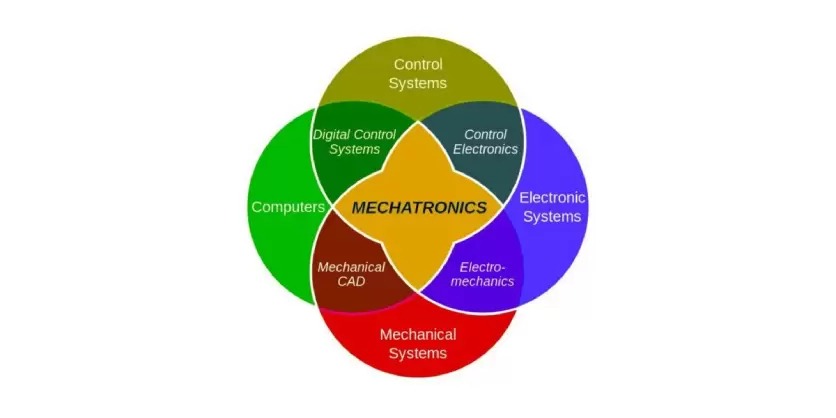
Mechatronic systems have found widespread applications across various industries, revolutionizing products and processes with their ability to integrate mechanical, electronic, and computer technologies. These industries include, but are not limited to:
Aerospace
In this sector, mechatronics plays a crucial role in enhancing the safety, efficiency, and performance of aircraft and spacecraft.
- Flight Control Systems: Employ advanced mechatronic systems for stability and maneuverability, utilizing sensors, actuators, and control algorithms.
- Satellite Positioning: Mechatronic systems accurately position satellite components, such as solar panels and communication antennae.
Automotive:
The automotive industry has been transformed by mechatronics, leading to safer, more efficient, and smarter vehicles.
- Engine Control Units (ECUs): Use mechatronic systems to optimize fuel efficiency and emissions.
- Advanced Driver-Assistance Systems (ADAS): Incorporate sensors, cameras, and control systems for features like automatic braking, lane-keeping assistance, and adaptive cruise control.
Manufacturing:
Mechatronics is at the heart of modern manufacturing, enabling automation, precision, and adaptability.
- Industrial and Collaborative Robots: Utilize mechatronic systems for precise and repetitive tasks, such as welding, painting, and assembly.
- Automated Material Handling: Implement mechatronic solutions for efficiently transporting and sorting materials.
Healthcare:
Mechatronic systems in healthcare have led to breakthroughs in diagnostics, treatment, and patient care.
- Medical Imaging Devices: Use mechatronic components for precise positioning and control in MRI and CT scanners.
- Robotic Surgery Systems: Employ advanced mechatronic systems for enhanced precision and control in many surgical procedures.
Advanced Robotics:
Robotics is perhaps one of the most evident fields of mechatronic application, where the integration of mechanical, electronic, and software components creates highly sophisticated machines.
- Humanoid Robots: Designed to mimic human motion and interaction, these robots incorporate complex mechatronic systems for movement, sensing, and decision-making.
- Collaborative Robots (Cobots): Designed to work alongside humans, cobots are equipped with sensors and control systems that ensure safety and efficiency in shared work environments.
These innovative applications represent just the tip of the iceberg in terms of mechatronics’ potential. The field continues to evolve, driven by technological advancements and an ever-increasing demand for smarter, more efficient, and more integrated systems.
This article is original content created and posted by Electromate. Please do not re-post this content without prior approval from Electromate.
Related Stories
A Guide to Mechatronics – Part 1: Introduction & Fundamentals
A Guide to Mechatronics – Part 2: Composition of a Mechatronic Subsystem
A Guide to Mechatronics – Part 3: Strategies for Integrating Mechatronic Subsystems
Guide to Mechatronics – Part 4: Software & Programming
Guide to Mechatronics – Part 5: Tools & Languages in Mechatronics Software Development