University of Toronto AV Researchers Take On Winter
February 11, 2022
The fields of artificial intelligence, machine learning and robotics are key to developing self-driving technology. Ontario, particularly the University of Toronto, has a history of excellence in all of them going back thirty years or more. Listening to Steve Waslander talk about autonomous vehicle (AV) research and development at the University of Toronto, it’s impossible not to get excited.
Waslander, an associate professor in the Faculty of Applied Science & Engineering, is a leading authority on autonomous aerial and ground vehicles. He’s taken the wheel of a five-year, $10+ million research initiative, called Autonomous Driving in Adverse Conditions – WinTOR for short — which aims to teach self-driving cars how to handle whatever winter throws their way.
“Winter conditions aggravate the remaining challenges in autonomous driving,” says Waslander. “Reduced visibility limits perception performance, and slippery road surfaces are a big challenge for vehicle control. But they haven’t received the attention they should from AV developers.”
WinTOR is set to change that by bringing together more than 30 of the best minds in academia and industry to focus on making sure autonomous vehicles can always receive advanced warning of changing winter weather conditions – and react quickly to them – despite limits to sensor range.
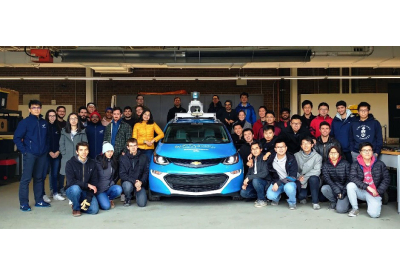
Using a Chevrolet Bolt EV retrofitted with a sensor suite to become a self-driving vehicle, they’ll record and annotate data that can be used to teach AVs. The test bed will be the streets of Toronto, which Waslander says are ideal for the task.
“Toronto is a big, busy city with a four-season climate, including at least 15 days a year of nasty winter weather, so it combines a complexity of driving experience with an often-challenging environment.”
Toronto, Ontario: driving an autonomous vehicle future
As Waslander is quick to point out, when it comes to self-driving R&D, Toronto starts in the fast lane.
“The fields of artificial intelligence, machine learning and robotics are key to developing self-driving technology. Ontario, particularly the University of Toronto, has a history of excellence in all of them going back thirty years or more.”
Because global talent goes to where the most interesting work is being done, Waslander has been able to attract the best and brightest scientists for WinTOR. Some of them are products of Ontario’s network of world-class universities, including the U of T. Others have come from abroad. If the past is any predictor of the future, many of them are likely to make Toronto their home, drawn by the work and the city itself which Waslander describes as “warm and liveable.” It creates a self-perpetuating circle of innovation that bodes well for the future.
The wheels are in motion to secure Ontario as an AV innovation hub
As companies worldwide race to create fully autonomous vehicles, Ontario is poised to lead the AV revolution.
In addition to providing an almost unrivalled pipeline of talent – Ontario boasts the second largest IT cluster in North America – the province also offers one of the richest concentrations of auto-related resources anywhere, and strong government support for innovators. WinTOR is backed by the Ontario Research Fund and the National Science and Engineering Council – as well as direct and in-kind donations from project partners General Motors, LG Electronics, Applanix and Algolux.
Exceptional talent, a richness of resources and government determination is proving to be a winning combination, one that’s well on its way to attracting major players in the self-driving field. One example says Waslander is General Motors. The global heavyweight, which conducted its AV testing in the U.S., recently opened a new dedicated test track in Oshawa, Ontario which is being used to develop advanced technologies for electric and self-driving vehicles.
As for WinTOR, “We’re just getting started,” says Waslander. “We’ve got ambitious plans and we’re always looking to add faculty, partners and funding.”
Ontario, Canada is poised to lead the autonomous car revolution, learn more about how your business can plug into our innovation ecosystem by clicking here