Festo’s Automation Enables Fast Manufacturing Of Safe Insulin
April 13, 2021
With the number of diabetics in the world rising by about 10 million a year, there is steady demand growth for the insulin pens that help people manage their lives. That prompted OEM systems builder Syntegon Technology to develop a new flexible production line concept for assembling these auto-injectors that leverages Festo automation and especially the YJKP servo press kit.
“By using Festo automation, we are greatly expanding the flexibility and agility of our systems,” said Michael Andersen, Sales Director for Syntegon Technology’s Danish subsidiary. “A key component of greater agility is that YJKP servo press kit.”
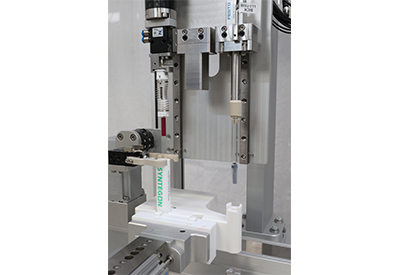
YJKP is a preconfigured modular system consisting of software, controllers, and standard electric drives that can be easily integrated in the plant and offers a high degree of flexibility thanks to its preinstalled software. The YJKP is easy to parameterize, and so ready for immediate use, providing electric pressing and joining up to 17 kN. It’s also more cost-effective than other systems on the market.
“We have installed more than 100 servo press kits in our automated assembly lines for insulin pens,” said Ulrik Keldke, Head of Syntegon’s engineering department. “The precisely adjustable pressing and joining forces ensure consistent quality and low reject rates. What we particularly like about the Festo servo press kit is that it is quick and easy to commission, and the machine operators don’t need to be trained to use it.”
Consistency in pressing is critical. The glass of the syringes should never be subjected to irregular pressure or they break. The automated systems ensure that the insulin pens are always in order and can deliver the precise amount of insulin.
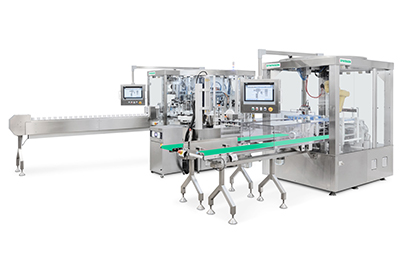
Depending on the machine type, Syntegon’s assembly lines produce up to 300 pens per minute. The degree of automation is scalable. The system can be expanded, at initial setup or at a later date as demand warrants, to increase output or automate more functions.
Adds Michael Anderson: “Automating the assembly line is a prerequisite for meeting the requirements for the end product: the insulin pens must be safe and user-friendly. The pens must not break when used by the patients, as that would put them at risk. The servo press kit keeps the tension and pressure constant.”
These production lines from Syntegon, formerly Bosch Packaging Technology, can be automated at all process steps, from filling, capping, assembly, testing, to labeling and packaging. The machine concepts are based either on a rotary table for low to medium outputs or on a linear transport system for high outputs.
The control system is based on electrical and pneumatic components and modules from Festo. This ensures a consistency of supply since Festo products are available worldwide and offer open interfaces to higher-level controllers. The CPX-E-CEC control module establishes the connection to the process control level, allowing it to be used with Ethernet/IP, Profinet, and EtherCAT. Standardization of components enables faster time-to-market possibilities.
For more information, visit www.festo.com.