FANUC CNC and Robotics Integration Simplifies Operations
March 31, 2021

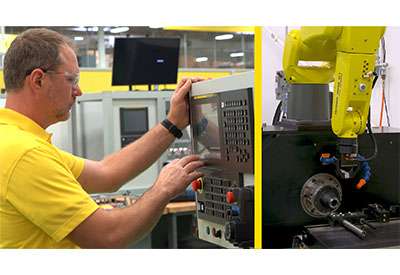
FANUC America recently introduced the next step in complete robotics and CNCs integration for more efficient operations. FANUC CNCs now have the ability to control connected FANUC robots providing machine tending or other assistance through FANUC’s Quick and Simple Startup of Robotization (QSSR).

More manufacturing operations are taking advantage of adding more robotics to execute repetitive tasks previously manually performed. Advanced automation offers a competitive edge and greater profit margins to shops of all sizes.

FANUC’s QSSR is a complete package that simplifies the connection of a FANUC robot to a FANUC controlled machine tool. The new QSSR G-code feature allows operators and machine tool builders to program robots easily through the FANUC CNC in ISO standard G-code format. Those unfamiliar with robotic programming language will no longer require additional training or specialists because the programming can be performed with G-codes. A reliance on a separate teach pendant for the robot is also greatly reduced with the capability of robotic programming and operation through the CNC user interface. 

FANUC’s QSSR not only makes connecting a FANUC robot through a high-speed Ethernet cable to a machine tool easy, but also simplifies the setup, programming and operation. The QSSR G-code feature is available on FANUC CNC Series Oi-FOi-F Plus30i-B and 30i-B Plus.

For more information, visit www.fanucamerica.com.
Related Articles


Editor’s Pick: Featured Article

Weidmüller’s u-control 2000: The Automation Controller

Weidmüller’s u-control 2000: The Automation Controller

Weidmüller’s scalable engineering software, u-control 2000, adapts individually to your requirements. And, the u-control is powerful, compact and fully compatible with Weidmüller’s I/O system u-remote. This article looks at what makes u-control the heart of your automation.

Programmable logic controllers (PLCs) are one of the main components of any automated system. A typical control system has inputs, outputs, controllers (i.e., PLCs), and some type of human interaction with the system, a human machine interface (HMI), for example.

Read More


Latest Articles

  • Applications of Physical AI in Canadian Sectors

    June 23, 2026 Physical AI — the convergence of artificial intelligence with robotics and autonomous motion systems — is reshaping how Canadian industries operate. Across sectors from healthcare to mining, AI-enabled machines are performing tasks that were once entirely dependent on human intervention. But deploying Physical AI effectively requires more than sophisticated algorithms: it demands… Read More…

  • Case Study: Optimizing Harmonic Mitigation in Wastewater Treatment

    June 22, 2026 Segment and Application In a municipality, wastewater treatment plants typically stand out as the main consumers of electricity. The operational processes exhibit significant load variations throughout a 24-hour cycle, necessitating the use of AC drives to regulate pumps, blowers, and other motorized equipment in response to fluctuating demand. In one wastewater treatment… Read More…