TeleCANesis Boosts Software Development Efficiency with Embedded Connectivity Toolkit Built on QNX
November 4, 2025
- Graphical configurator, VSCode extension, and runtime core
- Automated code generation
- Quickly creates software bindings and connects well known buses, protocols, and HMI frameworks
TeleCANesis is announcing an embedded software environment for teams creating smart industrial, medical and mobility products, which helps quickly interconnect system nodes using standardized communication interfaces and protocols. The new toolkit is built on the QNX ® Operating System (OS), a high-performance, real-time operating system designed for mission-critical embedded systems like those within robotics, medical devices, industrial controls and more. Targeting use cases in automation and control, asset tracking, remote condition monitoring, e-mobility, smart agriculture and healthcare, TeleCANesis reduces software development costs by 70% or more and accelerates time to market significantly.
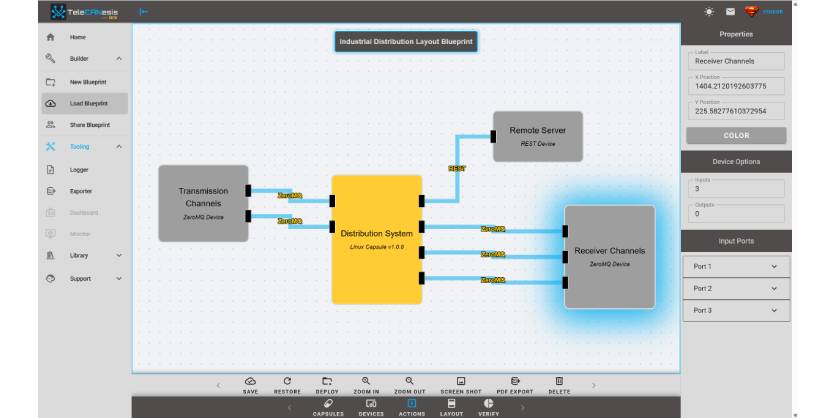
The environment provides a graphical web-based design application, a VSCode extension for editing and integration, and a runtime core for real-time control and connectivity. Engineers can define their required connections at a high level, and then let the tools work out the interactions between nodes and generate code automatically. The tools support a wide range of bus standards, communication protocols, and HMI frameworks, which handle everything needed for translating between the different communication models.
“We created TeleCANesis from our own experience as application developers, to overcome the time-consuming challenges when building today’s increasingly complex and interconnected systems,” said Jonathan Hacker, CEO of TeleCANesis. “The tools let software teams work efficiently and get to market faster than conventional approaches allow. They can focus on the differentiating features of their products and avoid repeating the same tasks in subsequent projects. Building this toolkit on QNX technology is a statement of our commitment to low-latency, real-time connectivity for our customers.”
Customers can access the tools online, bundled with an engineering support package that provides individual attention from TeleCANesis specialists to help understand the tools and integrate with their workflow.
Comprising three main elements, TeleCANesis is both easy to understand and use. System architects can take advantage of TeleCANesis Hub, the web-based drag-and-drop GUI, using built-in templates to quickly perform hardware configuration and bus layout. TeleCANesis Builder, the VSCode extension, provides a signal explorer and routing visualization for software engineers, automates generation of test cases and endpoint bindings, and integrates seamlessly into typical work environments. The runtime core, TeleCANesis Engine, provides real-time control and connectivity.
“Our collaboration with TeleCANesis expands our growing partner ecosystem and reinforces the value of QNX technology,” said Justin Moon, Vice President, Core Product Engineering at QNX. “We are thrilled to support the team bringing this product to market and are honored they recognize that QNX provides the right foundation to help customers develop quickly, safely and cost efficiently.”
Engineers can use TeleCANesis to facilitate designs using a wide range of hardware buses including CAN, SPI, I2C, RS485, Ethernet, Bluetooth Low Energy, and LoRa. There is support for popular industrial protocols including JSON, MQTT, Modbus, J1939, ZeroMQ, Protobuf, and ISOBUS, and HMI frameworks including Crank Storyboard, DiSTI GL Studio, Flutter, Slint, Qt, and Unity.
The TeleCANesis team made the announcement as part of its participation to embedded world North America, which is taking place in Anaheim this week. Visitors can find them at the company’s booth #2062.
More Information
For more information, visit https://www.telecanesis.com/